Tuesday, October 02, 2018

Dunford Pleased DOD Enters Fiscal 2019 With Budget


By Jim Garamone, DoD News, Defense Media Activity

MADRID --  For the first time in a long time, the Defense Department entered the fiscal year with a budget, and the chairman of the Joint Chiefs of Staff said troops should be extremely pleased with the development.

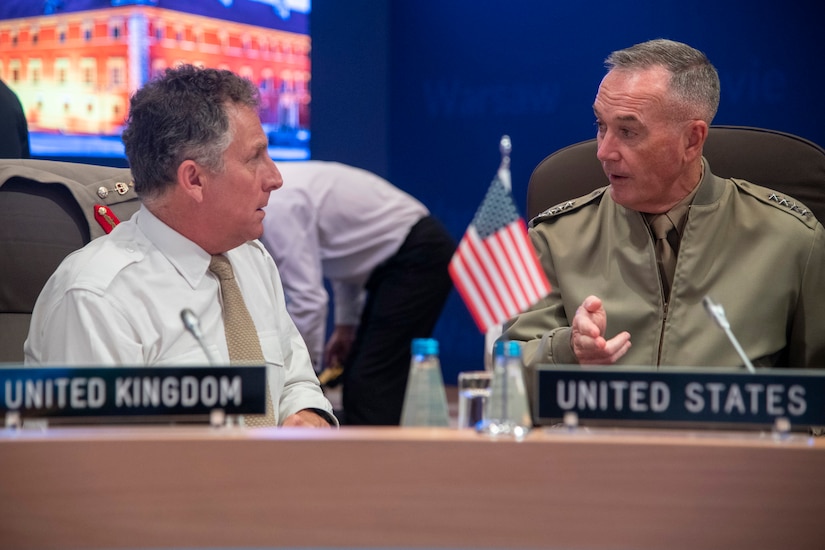
“What the troops have seen is a commitment from the executive and legislative branches of government to give them the wherewithal to do their jobs,” Marine Corps Gen. Joe Dunford said during an interview with reporters traveling with him.

President Donald J. Trump signed the appropriations bill on Friday meaning the Defense Department starts fiscal year 2019 with money in the bank. The president signed the John S. McCain National Defense Authorization Act in August. Both bills must be passed before DOD can operate.

Defense leaders had made the case for the budget through “identifying the challenges we face and also the demonstrated performance of our men and women in uniform every day,” Dunford said. Congress understood that the U.S. military needs these capabilities, “and we can be entrusted to make good use of them.”

His message to Congress and the American people this year is for an appropriate, sustained level of funding. “It took us years to get into this problem and you don’t spend money efficiently, you don’t spend money as good steward, if you lurch from year to year,” he said. “You can’t plan a program and develop capabilities over time.”

Predictability will allow the department to build effective partnerships with industry. This will allow companies to deliver capabilities on time and on cost.

“We need to have predictability to properly prioritize what we are going to invest in,” he said. “Every year, no matter how big the budget is, you have to make choices. We are much better at making choices if we are informed by a three-to five-year look ahead and predict what level of funding we will have.”

Dunford: Russia, China Pose Similar Challenges to U.S., Rules-Based Order


By Jim Garamone, DoD News, Defense Media Activity

MADRID -- The challenges the United States sees from Russia and China are similar because both have studied the America way of war, the chairman of the Joint Chiefs of Staff said yesterday.

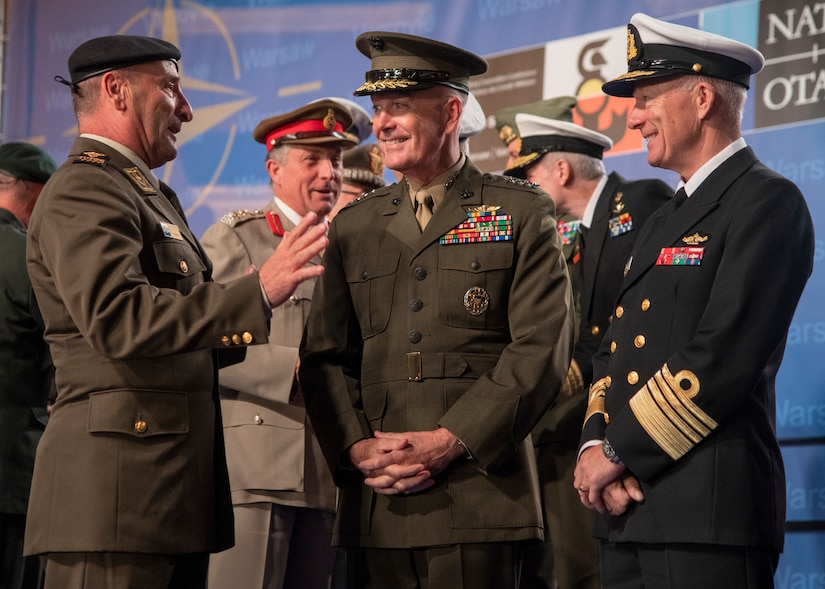
Marine Corps Gen. Joe Dunford is here visiting Spanish officials after attending the NATO Military Committee meeting in Warsaw, Poland, over the weekend.

The bottom line for the United States and the country’s greatest source of strength strategically “is the network of allies we’ve built up over 70 years,” Dunford told reporters traveling with him. At the operational level, he added, the U.S. military’s advantage is the ability to deploy forces anywhere they are needed in a timely manner and then sustain them.

“Russia has studied us since 1990,” Dunford said. “They looked at us in 2003. They know how we project power.”

Russian leaders are trying to undermine the credibility of the U.S. ability to meet its alliance commitments and are seeking to erode the cohesion of the NATO alliance, he said.

Russia has devoted serious money to modernizing its military, the chairman noted, and that covers the gamut from its nuclear force to command and control to cyber capabilities. “At the operational level, their goal is to field capabilities that challenge our ability to project power into Europe and operate freely across all domains,” Dunford said. “We have to operate freely in sea, air and land, as we did in the past, but now we also must operate [freely] in cyberspace and space.”

The nature of war has not changed, but the character of war has. The range of weapon systems has increased. There has been a proliferation of anti-ship cruise missiles and land-to-land attack missiles. Cyber capabilities, command and control capabilities and electronic warfare capabilities have grown.

Great Power Competition

These are the earmarks of the new great power competition. Russia is the poster child, but China is using the same playbook, the chairman said.

“What Russia is trying to do is … exactly what China is trying to do vis-a-vis our allies and our ability to project power,” Dunford said. “In China, what we are talking about is an erosion of the rules-based order. The United States and its allies share the commitment to a free and open Pacific. That is going to require coherent, collective action.”

Against Russia, the United States and its NATO allies have a framework in place around which they can build: a formal alliance structure allows the 29 nations to act as one, Dunford said.

However, he added, a similar security architecture is not in place in the Pacific.

The United States has treaties with Australia, New Zealand, Japan, South Korea, the Philippines and Thailand. Politically and economically, the United States works with the 10-nation Association of Southeast Asian Nations.

“I see the need for all nations with an interest in the rules-based architecture to take collective action,” Dunford said. “The military dimension is a small part of this issue, and it should be largely addressed diplomatically and economically.”

He said the military dimension is exemplified by freedom of navigation operations, in which 22 nations participated with more than 1,500 operations in the past year. “These are normal activities designed to show we will fly, sail and operate wherever international law allows, and not allow illicit claims to become de facto,” the chairman said.

Navy Undersecretary Modly Shores Up Alliances in Oceana


By Jim Garamone, DoD News, Defense Media Activity

ABOARD A MILITARY AIRCRAFT -- Freedom of navigation and issues of sovereignty were front and center as Navy Undersecretary Thomas B. Modly journeyed through Oceana.

The undersecretary spoke to reporters via phone from Guam. The trip involved stops in Kiribati and its capital on the island of Tarawa. Modly and his party also visited Papua New Guinea, Vanuatu, Fiji,  and the Federated States of Micronesia, and it ended in Guam.

Defense Secretary James N. Mattis asked Modly to make the trip. “It was a fascinating trip for me, having not spent too much time in this region in either my professional or personal life,” he said.

The vastness of the Pacific theater impressed on him and reinforced the “tyranny of distance” that the area entails, Modly said. He added that he also was impressed by “the broad range of friendships and partnerships we have across the region in these small island nations who have big challenges.”

Mattis encouraged Modly to take the trip to cultivate and reinforce U.S. partnership with the nations. He noted that the second line of effort in the National Defense Strategy is to build and strengthen partnerships and alliances. “This is part of that effort to get out here to insure our friends that the United States is committed to freedom of navigation and peace and prosperity for the region,” he said.

Freedom of navigation is the key concern for the nations. More than 80 percent of their economic zones are water. “When you look at that and you look at it on a map, they are heavily dependent on access to those waters, and also [on] control and maintenance of those waters for fishing,” Modly said.

Fishing is the primary source of revenue for the nations, and protecting fisheries and sovereignty is of primary importance.

Freedom of Navigation

Modly, who served in the Navy from 1983 to 1990, said that freedom of navigation was important to the United States then and it is just as important today. “From my perspective, … I don't think that's really changed: these are international waters, and they’re governed by international rules,” he said.

The people of the region are concerned about their ability to maintain freedom of navigation. Modly assured them that the United States and its allies in the region are committed to maintain that right.

The islanders are finding it is becoming more difficult to manage these waters because “more and more countries, or at least commercial operators from various countries, are encroaching on those areas,” he said.

The islands do not have large navies; they have small coast guards. “They are investing in some technologies to give them better situational awareness of what's happening in the seas, and I was introduced to some very interesting things that they are doing to try and maintain that and we're trying to help them there as well,” Modly said.

The undersecretary was supposed to visit Chuuk, but the water landing of an aircraft in the lagoon there stopped that. He offered his aircraft to evacuate four people injured, but the U.S. Coast Guard already had that covered.

The Navy did help however, as a Navy underwater construction team working in the lagoon rescued the passengers and crew of the Air New Guinea flight. The sailors also will retrieve the planes’ black boxes.

“It is just a great example of how our presence even with just a few people on these islands can be critical to helping in these types of situations,” Modly said.