Friday, August 31, 2018

Army Medics Test Skills at Competition in Germany


By Army Sgt. Benjamin Northcutt, 21st Theater Sustainment Command

BAUMHOLDER, Germany -- It is 6 a.m. and a light mist begins to fall on Minick Field here.

Fourteen medical professionals, representing the best of the best from their units, await the opening event, a physical fitness assessment at the 21st Theater Sustainment Command’s annual Best Medic Competition, held Aug. 27-30.

Soldiers from Regional Health Command Europe, 18th Military Police Brigade and 30th Medical Brigade, among others, tested their medical skills, physical fitness and basic soldier task skills during the four-day event.

The competition was split into two teams. One team comprised of competitors from the 30th Medical Brigade and the 21st Theater Sustainment Command, and the other team comprised of competitors from Regional Health Command Europe.

Army Capt. Stona Jackson and Army Sgt. 1st Class Steven Lockwood won the competition for Regional Health Command Europe, while Army 1st Lt. Keith Ammerman and Army Sgt. Jake Weingartz, won from 30th Medical Brigade. They were recognized during the Aug. 30 closing ceremony, and will advance to the Department of the Army-level competition -- the 2018 Command Sgt. Maj. Jack L. Clark Best Medic Competition at Camp Bullis, Texas, in September.

Testing Medics’ Readiness

"The concept of the competition was to test each soldier on their ability to perform tactical combat casualty care, as well as their physical and mental agility throughout the competition," said Army 1st Lt. Brianna Brown, 30th Medical Brigade, who served as the event coordinator. "More so, it is designed to test the readiness of our medics to perform under stressful conditions and throughout daily situations they might encounter."

The event also gives competitors the opportunity to put their skills on display in a contingency environment.

"These competitions are about making sure soldiers are prepared for anything and this competition allows these medics skills and abilities to shine," said Army Command Sgt. Maj. Matthew Baller, senior noncommissioned officer for the 30th Medical Brigade. You never know what to expect, and at any time we must always be ready to answer our nation’s call. This type of event showcases Army medicine, and what our medics bring to the fight when called.”
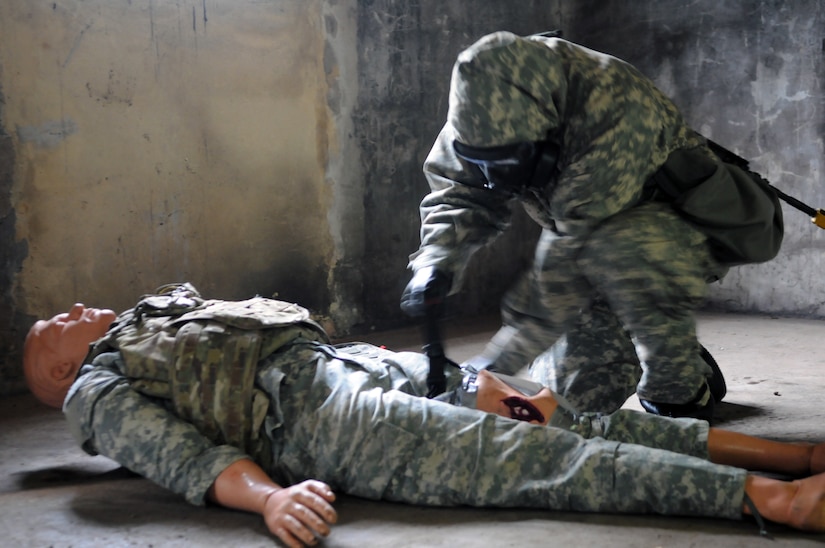
Army Sgt. Jake Weingartz, assigned to 30th Medical Brigade, dons his protective gear during a chemical, biological, radiological, nuclear event during the 21st Theater Sustainment

The competition was broken down into four days. Events included: a physical fitness assessment, M4 rifle qualification and stress shoot, tactical combat casualty care, tailgate medicine, chemical, biological, radiological, nuclear and explosive event, a mystery event, obstacle course, day and night land navigation, a written exam and a 12-mile foot march followed by the award ceremony to announce the winners.

The winners discussed their experiences and lessons learned during the competition. For Jackson, this was about redeeming himself for a disappointing performance in last year's competition.

“It is a lot of lessons learned. Slowing down, and making sure I check all the boxes and try not to rush what I am doing,” he said.

Sharpening Skills

Weingartz offered a perspective of learning to grow through the competition.

“I think it is about finding our weaknesses and strengths, and then sharpening our skills to adapt and overcome,” Weingartz said.

All the competitors have earned the Expert Field Medic Badge, the Combat Medical Badge, or both. The purpose of the competition was to test the readiness of these soldiers and find out who are the best medics.

“Train hard, hone your skills and come with the right attitude,” Weingartz said. “That’s what it takes to win.”

Mattis, State Department Officials Meet With Middle East Representatives at the Pentagon

WASHINGTON -- Defense Secretary James N. Mattis and U.S. Department of State officials hosted a regional security roundtable at the Pentagon Aug. 29 with representatives from the Gulf Cooperation Council states -- Saudi Arabia, the United Arab Emirates, Bahrain, Kuwait, Qatar, Oman -- along with Egypt, Jordan and Morocco.

In a statement summarizing the meeting, chief Pentagon spokesperson Dana W. White said Mattis discussed a broad range of security issues with the diplomatic and defense officials.

The secretary thanked the group for their regional leadership and years of close cooperation with the United States, White said.

The representatives discussed working together against common security challenges, and agreed to reconvene in the coming months to continue discussions on shared strategic objectives and regional challenges, she said.

Thursday, August 30, 2018

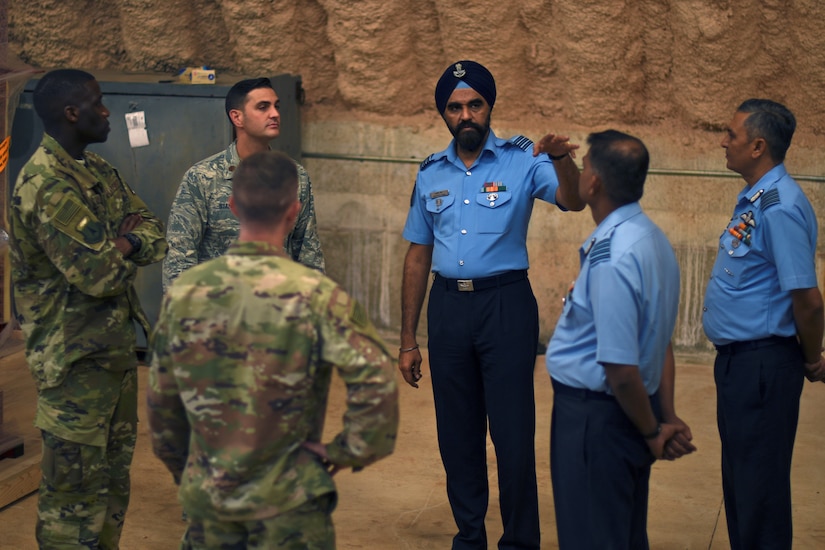
U.S.-India Meeting Seeks to Deepen Cooperation


By Jim Garamone, DoD News, Defense Media Activity

WASHINGTON -- Next week’s “two-plus-two” meeting of defense and diplomatic leaders in New Delhi will seek to deepen cooperation between India and the United States and bolster programs and policies to maintain the free and independent Indo-Pacific region that has been in place since World War II, the assistant secretary of defense for Asian and Pacific security affairs said today.

Randall G. Schriver spoke with Ashley J. Tellins at the Carnegie Endowment for International Peace about the ground-breaking meeting scheduled Sept. 6 and 7 between Secretary of State Mike Pompeo and Defense Secretary James N. Mattis and their Indian counterparts, External Affairs Minister Sushma Swaraj and Defense Minister Nirmala Sitharaman.

It is the first such meeting between the nations.

The outreach to India – the largest democracy in the world – is the outgrowth of more than 20 years of diplomacy reaching back to the Clinton administration, Schriver said. At its heart is ensuring conditions for a free and independent region.

“We believe countries should have complete sovereign control of their countries, to make decisions from capital free from coercion [and] free from undue pressure. We also mean free, open and reciprocal trade relationships,” he said. “By ‘open,’ we’re talking about open areas for commerce, for navigation, for broad participation in the life of the region commercially and economically.”

Schriver talked about “operationalizing” the areas of convergence between the two nations. Some of these areas will be in defense, some will be economic, and others will be political, he said, noting that the principals will discuss this at the meeting.

Chinese Aspirations

China is the elephant in the room. Though U.S. policy is not aimed at any specific nation, Schriver said, “China is demonstrating that they have a different aspiration for the Indo-Pacific region. This manifests in their economic strategy, the Belt and Road Initiative, their militarization of the South China Sea, a lot of the coercive approaches to the politics of others.” The Belt and Road Initiative is Chinese investment in infrastructure projects in countries that lie between China and Europe.

The United States would prefer China buy into the current rules-based international system, the assistant secretary said.

At the meeting, officials will examine how and where the United States and India can work together, Schriver said, adding that he sees both countries’ efforts complementing each other in some nations of the region and closer cooperation on the security side.

“We’ve seen exercises – not just bilateral India-U.S. exercises, but multilateral exercises,” he said. “Obviously, you exercise for a reason. You exercise to improve the readiness and training of your own forces, but you think about contingencies, you think about real-world possibilities.”

The substance of the meeting will be discussions about regional and global issues, but there will also be concrete outcomes, Shriver said.

“We’re working on a set of enabling agreements,” he said. “Collectively, what they will allow us to do is have secure communications, protect technology, protect information. Getting those agreements in place will allow security assistance cooperation to go forward, allow us to exercise and train in more meaningful ways. I think we are going to expand the scope of some of our exercises – increase the complexity and elements that will participate.”

Schriver said discussions also will look at the situations in Russia, Afghanistan, Iran and Pakistan.