Wednesday, August 15, 2018

U.S., Kenyan Military Dog Handlers Share Knowledge, Experience


By Navy Petty Officer 2nd Class Timothy M. Ahearn, Combined Joint Task Force Horn of Africa

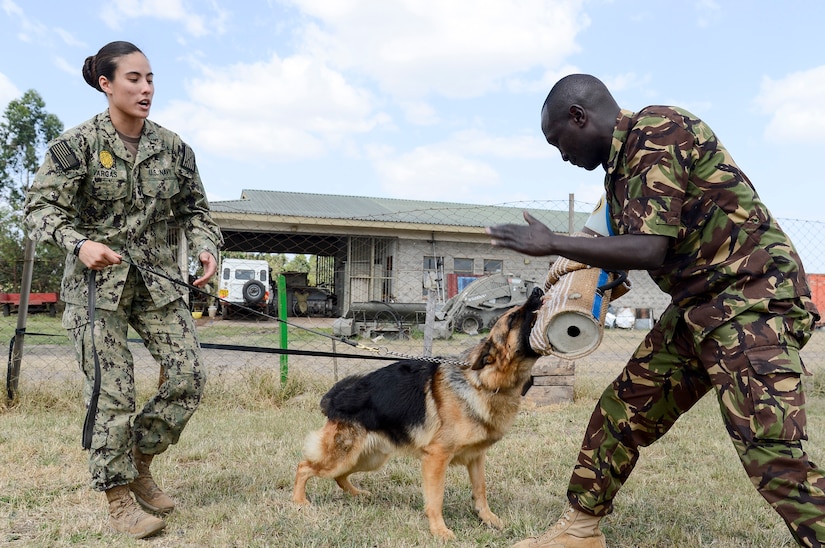
NAIROBI, Kenya -- Kenyan and American service members teamed up at the Kenyan army’s 1st Canine Regiment headquarters here to share the best ways to treat and train military working dogs in the field, Aug. 6-10.

A U.S. Army veterinary team assigned to Combined Joint Task Force Horn of Africa’s 404th Civil Affairs Battalion’s Functional Specialty Team and a U.S. Navy military working dog kennel master based at Camp Lemonnier, Djibouti, took part in the training.

Founded in 2012, the 1st Canine Regiment’s mission is to provide dogs as a force multiplier in war and peacetime in order to address the current threat of asymmetric warfare. To that end, they specialize in explosive detection, patrolling, road and building clearance, and search and rescue, said Kenyan army Maj. Marion Amulyoto, a veterinarian with the 1st Canine Regiment.

Dangerous Work

“We have been a valuable resource to our commanders, especially along the borders,” Amulyoto said. “Our explosive detection dogs deter violent extremists, because they are able to pick up on residual odors from explosives.”

This mission often brings dogs and their handlers to the Kenya-Somalia border to deter transnational threats, such as poachers, and violent extremist organizations, said U.S. Army Maj. Steven Pelham, the veterinarian officer in charge with the 404th Civil Affairs Battalion FXSP.

The FXSP veterinarians’ portion of the exchange included information on bandaging, wound care, heat stroke, canine CPR, fractures and suturing. The 1st Canine Regiment veterinarians shared their knowledge of the dangers the dogs face, specifically in East Africa.

“Heat injuries and threats from wildlife our dogs do not normally encounter, such as snakes, spiders and scorpions, are likely, given the environment that the U.S. and Kenyan MWDs operate in East Africa,” Pelham said, “We want to ensure that all MWD handlers recognize and treat their partners in case they suffer from these injuries.”

This exchange also marked the first time that members of the 1st Canine Regiment could share knowledge with a U.S. Navy dog handler.

Common Ground

“I am really excited to work with the 1st Canine Regiment’s MWD handlers; to share working knowledge with our Kenyan partners is an amazing opportunity,” said Navy Petty Officer 1st Class Kristina Vargas, a master-at-arms and Camp Lemonnier’s kennel master.

While learning the various techniques that the 1st Canine Regiment uses in their daily operations, Vargas shared knowledge of basic explosive detection, patrolling, building clearing, and improvised explosive device recognition.

Vargas said it is easy to find common ground among military working dog handlers, regardless of what nations the handlers are from.

“When you get MWD handlers together, regardless of their branch of service, or even if they are from another country, at the end of the day we are all dog handlers helping out dog handlers, we share the same passion for our respective MWD programs,” she said.

Kenya is the only country in East Africa with a canine unit organic to its military. Learning from one another helps both the 1st Canine Regiment and CJTF-HOA to maintain security and stability in their shared area of operations.

“We are very grateful to CJTF-HOA for this exchange program and we hope to have more in the future to better both of our capabilities,” Amulyoto said.
Vargas said the exchange strengthened the relationship with a key East African partner. The Kenyan dog handlers can incorporate the training into their existing working dog program to help counter threats from violent extremists and promote national and regional security.

Tuesday, August 14, 2018

Mattis Seeks to Deepen Relations with South American Partners


By Jim Garamone, DoD News, Defense Media Activity

WASHINGTON -- Defense Secretary James N. Mattis said the United States is seeking to deepen relations with hemispheric partners.

The secretary told students at the Brazilian War College in Rio de Janeiro that the United States “will earn your trust daily. We want to be your partner; especially if trouble looms.”

This is Mattis’s first visit to the region as secretary. He told the students that he has deployed many times in his career and he has never been on a battlefield in a solely U.S. formation. The United States seeks allies and looks to increase cooperation among partners.

“Our native languages may be different, but four decades of military service have persuaded me that the profession of arms has a language of its own and a way of turning strangers into family,” Mattis said.

Mattis described his job to the Brazilian officers, saying that he is an advisor to the elected commander in chief. He provides military options to the president, and he provides civilian oversight of the U.S. military.

Working Solutions

“Know what my real job is?” he asked the officers. “My real job is to try to keep the peace for one more year, one more month, one more week, one more day while the diplomats try to work out a solution to very difficult problems.”

He also described the lines of effort in the Defense Department. The first is to increase lethality of the U.S. military.

“I want any adversary to know that they are better off to deal with our secretary of state and our diplomats,” he said. “They do not want to deal with me and my soldiers, sailors, airmen and Marines.”

Another line of effort is to strengthen and broaden U.S. relationships with allies. “It’s simple: Nations with allies thrive; nations without allies do not survive,” Mattis said.

The reason for his trip to the region is to encourage partnership. The secretary will go to the Indo-Pacific next month and Europe after that, he said. “This is not something you turn on one day, walk in, make a speech, walk out and then forget about it,” he said. “It must be sustained.”

Trust is the currency for these relationships. “When speaking with senior U.S. officers, I tell them they must learn to build harmony,” Mattis said. “If they cannot build trust across national lines, across military lines, joint service lines, civilian-military lines, if they cannot build trust and harmony of operations, then their leadership … is obsolete and they must go home, for I have no use for them.”

Listening to Allies

Mattis said senior leaders must listen to allied leaders and be prepared to take their advice. “The nation with the most aircraft carriers is not always right,” he said.

Senior U.S. military leaders seek a collaborative and secure hemisphere, “one where we individually and collectively maintain situational awareness in all domains,” he said.

Partners must share information with neighbors because hemispheric priorities must be addressed together, the secretary said.

The United States and Brazil are long-time partners. Brazil fought alongside U.S. service members in World War II and continues to serve alongside them today. Mattis is personally committed to making the U.S.-Brazil military-to-military relationship stronger.

“Together we seek to strengthen our cooperative strategic partnership that is transparent, that is trustworthy and that is steady,” he said. “I see a bright future ahead for Brazil and our hemisphere.”

Mattis Thanks Brazilian Officials for Leadership in Defense Cooperation


WASHINGTON -- Defense Secretary James N. Mattis met with Brazil’s defense leaders today in Brasilia to reaffirm the defense relationship between the United States and Brazil, chief Pentagon spokesperson Dana W. White said.

In a statement summarizing the meeting, White said the secretary met with Defense Minister Joaquim Silva e Luna, Adm. Ademir Sobrinho, chief of Brazil’s joint staff, and the Brazilian service chiefs.

“The leaders discussed a broad range of defense issues, and the secretary thanked the group for their country’s global leadership in defense cooperation,” White said.

The leaders agreed to continue to reinforce the U.S.-Brazil strategic partnership, she added, focusing on interoperability, expanding shared capabilities and bolstering the ability to respond rapidly to a variety of security challenges.