Tuesday, July 31, 2018

Marine Marksmanship Instructor Enjoys Mentoring Recruits


By Marine Corps Sgt. Dana Beesley, Marine Corps Recruit Depot Parris Island

PARRIS ISLAND, S.C. -- Surrounded by a sea of recruits and the smell of hot brass, it’s easy to spot Marine Corps Staff Sgt. Estefania Patino’s campaign cover and trademark green marksmanship instructor jacket as she patrols Chosin rifle range’s firing line here, inspecting weapons and encouraging shooters as they sight in on their targets.

As a primary marksmanship instructor, Patino is charged to make riflemen out of the recruits. To them, she is a shooting guru. But they would never guess that Patino had never fired a weapon before she joined the Marines.

A Laredo, Texas, native, Patino first developed her interest in shooting during recruit training, where she fired a weapon for the first time in her life. It was not a natural experience for Patino, who struggled at first.

“In boot camp, I was actually really bad. I got sharpshooter,” she said. “All I remember about the first time shooting was that it was cold and it was December. It wasn’t natural to me and took a lot of practice and reiteration for me to learn how to shoot. Once I got comfortable with it, I loved it.”

Honing Marksmanship Skills

While stationed in Okinawa, Patino volunteered to go through the Combat Marksmanship Coach Course, where she honed her rifle marksmanship skills and learned to shoot a pistol for the first time. Patino excelled, and her love for teaching grew along with her love for shooting.

“I love that I would be able to help my Marines through the process because I was able to memorize the knowledge and sustain it,” Patino said.

Patino later volunteered for drill instructor duty. While training recruits, she noticed there were trends of female recruits not performing as well on the range as Patino felt they could. Using her experience as a marksmanship coach, she stressed the importance of marksmanship knowledge to her recruits, and in turn, her platoons were recognized for their improved performance.

Seeking Unique Challenge

Later, she decided to pursue the challenge of becoming a primary marksmanship instructor, something few drill instructors had done before.

“I became a PMI because I enjoyed teaching marksmanship as a drill instructor,” Patino said. “My PMIs were always very helpful in helping me better assist my recruits.”

Patino said she relates to recruits on a personal level.

“I don’t put on a ‘persona’ for them, and I tell them that I struggled and I got nervous,” Patino said. “I try to make them comfortable, and tell them that if they keep trying and they keep pushing that maybe one day they’ll get to wear this green jacket.”

Marine Corps Gunnery Sgt. Angelica Dixon, senior drill instructor for Platoon 4036, Oscar Company, said Patino’s passion for teaching influenced her decision to become a marksmanship instructor.

“Weapons were her passion from the beginning, but I also believe she was born to teach,” Dixon said. “She’s a hard worker. She never complains.”

Mentor, Coach

Patino’s drive for mentoring and coaching on the range opened the door for more female drill instructors to pursue becoming PMIs, Dixon said.

“Besides making Marines, she’s also making marksmen, and for a recruit to see that is inspiring,” Dixon said. “She kept pushing to get to where she is, and that’s what every Marine should do. If you want to do something, don’t let anything stop you. And she didn’t let anything stand in her way.”

Patino will return to regular drill instructor duty in a few months. She hopes to become a senior drill instructor and a chief drill instructor before returning to the fleet.
“I’d like to take the knowledge that I have from the range and share it with my [drill instructors] and teach them how they can better prepare their recruits for the range -- even if it’s something small,” Patino said. “My [senior drill instructor] taught me how important the range is. When brand-new Marines get out to the fleet, they’re all going to have the same one ribbon, but their shooting badge is always going to be what sets them apart.”

Saturday, July 28, 2018

Communications Key in Solving International Disputes, Mattis Says


By Terri Moon Cronk, DoD News, Defense Media Activity

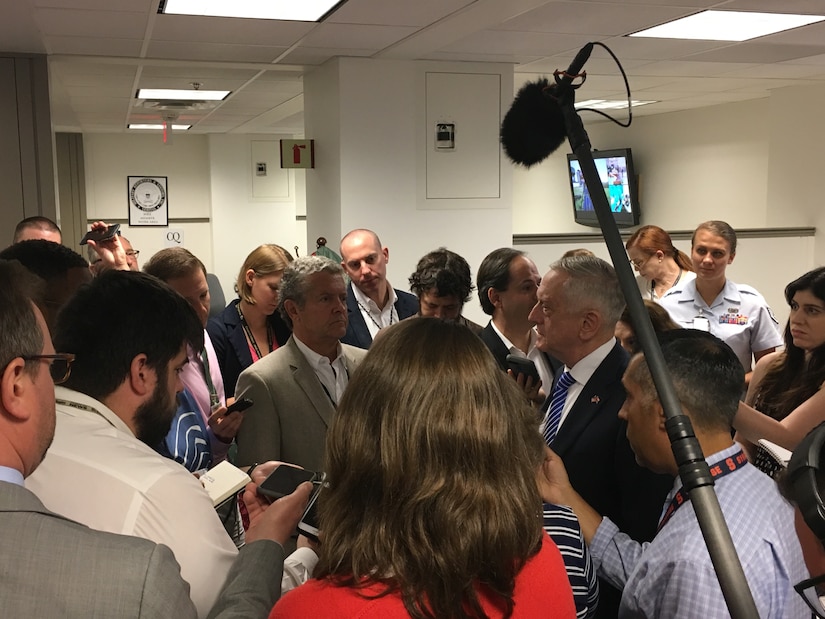
WASHINGTON -- Reopening communications at the top line between the United States and nations such as Russia is essential in solving disagreements, Defense Secretary James N. Mattis told Pentagon reporters today.

“Based on my long-standing stance on protecting America -- whether it be from a conventional attack, nuclear attack, cyberattack -- I have always been in favor, and in fact, promoted the idea that we talk with one another … even when [the United States and Russia] had nuclear missiles pointed at each other,” the secretary said.

“Even in the worse days of the Cold War, we had heads-of-state discussions and I believe we’ve been way overdue for that,” he added. “And this isn’t about this administration; this goes back years, many years.”

Mattis said such communications might not be easy or short term, “but I find nothing inconsistent in protecting this country by engaging diplomatically,” he said. “I’ve always said diplomacy leads our foreign policy. This is diplomacy in action.”

The secretary confirmed that he is considering meeting with his Russian counterpart, but added no decision has yet been made.

Iran

Mattis also talked about the Iranian government’s malign influence in the Middle East, and its threats to close the Strait of Hormuz.

“They’ve done that in years past; they saw the international community put dozens of nations’ naval forces in for exercises to clear the strait,” the secretary said. “Clearly, this [closure] would be an attack on international shipping and could have an international response to reopen the shipping lanes … because the world’s economy depends on those energy supplies flowing out of there.”

Iran, he noted, must start living by international rules.

“They are the exporter of instability across the region,” the secretary said.

Korean War Remains Repatriation

With 55 cases of reported U.S. service members’ remains being returned to the United States today from North Korea, Mattis emphasized the importance of giving the families of the fallen a sense of closure.

“When [the families] got the telegram, they have never had closure. They’ve never had the bodies returned,” he said. “So, what we’re seeing here is an opportunity to give those families closure, to make certain that we continue to look for those remaining.”

Mattis said each of the boxes of remains returned today bore a blue U.N. flag.

“Many of the U.N. nations also have missing [service members] -- we don’t know who’s in those boxes. As we discover it, they’ll be returned,” the secretary said, adding that nations such as Australia and France also have missing service members in Korea.

“This is an international effort to bring closure to those families,” Mattis said. “Obviously, we want to continue this sort of humanitarian effort.”

He added, “We also look at [the return of remains] as a first step of a restarted process, so we want to explore additional efforts to bring others home; perhaps have our own teams go in [to North Korea]. So we’re looking at all [opportunities].”

Mattis: U.S. Troop Remains Repatriation ‘Sets a Positive Environment’


By Jim Garamone, DoD News, Defense Media Activity

WASHINGTON -- Defense Secretary James N. Mattis said he’s pleased North Korea has turned over 55 cases of remains of fallen U.S. service members from the Korean War, and looks forward to further negotiations to repatriate the remains of more fallen service members.

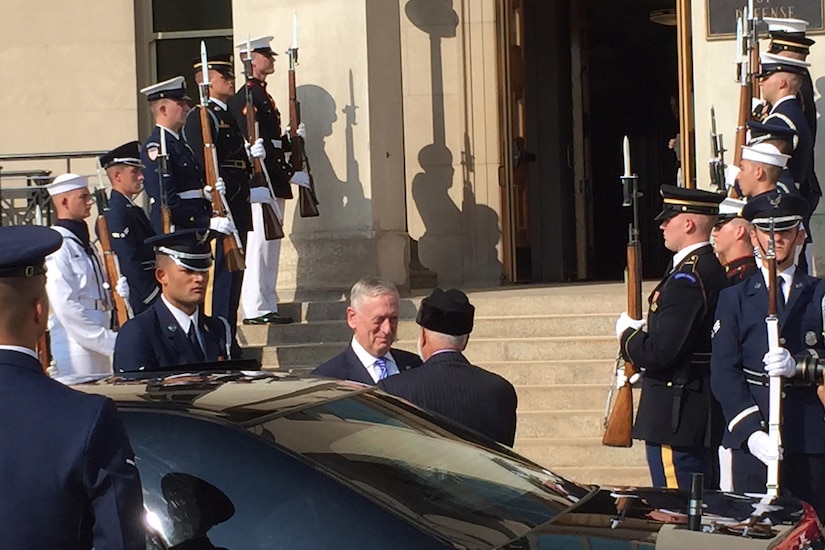
The secretary spoke to reporters this morning at the Pentagon before he welcomed Yusuf bin Alawi, Oman's minister responsible for foreign affairs, to the Pentagon.

Mattis said the North Korean gesture indicates the relationship between North Korea and the United States is thawing.

“The remains were turned over … as initiated during the summit that President [Donald J.] Trump had with Chairman Kim [Jong Un],” Mattis said. “It was a coordination effort over the past month to determine where they would deliver the remains to, and where our plane would fly in, where we would take them to for the initial review.”

‘A Step in the Right Direction’

The secretary added, “All of that went well. I think when you have that sort of communication going on it sets a positive environment and tone for other things in terms of international diplomacy. This humanitarian act is a step in the right direction.”

The secretary said negotiations are underway to have U.S. teams come to North Korea to search for more fallen U.S. service members’ remains.

Mattis said he is in constant contact with Secretary of State Mike Pompeo on this matter and more. DoD is in a support role to the State Department in negotiations with North Korea, but all levels are informed and DoD personnel are integral to the team, he said.