Wednesday, July 25, 2018

Face of Defense: Navy Father, Daughter Enjoy Serving Together


By Navy Seaman Michael Prusiecki, USS Nimitz

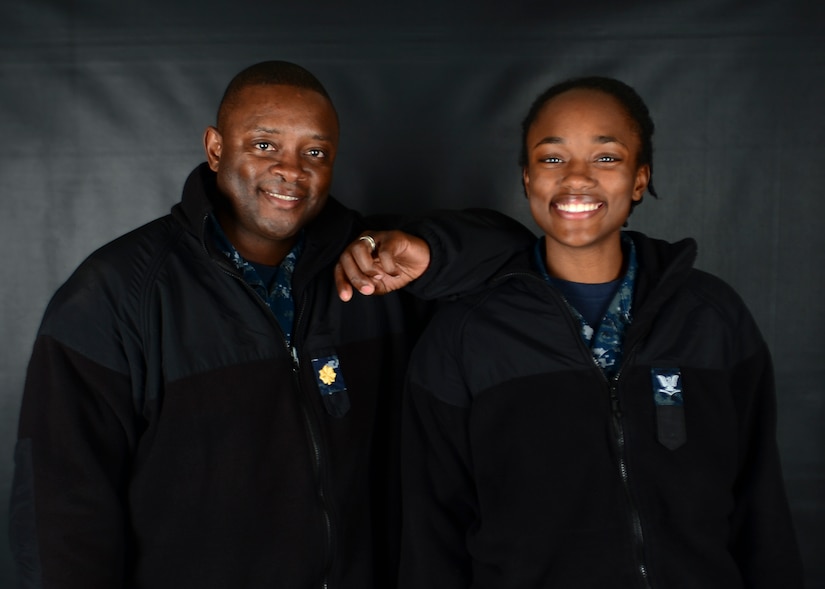
NAVAL BASE KITSAP-BREMERTON, Wash. -- A Navy father and daughter here say they enjoy their service together aboard the aircraft carrier USS Nimitz.

Navy Lt. Cmdr. Eric Alexander, a native of Stuttgart, Arkansas, enlisted in the Navy in 1996 as an aviation boatswain’s mate. He served at various commands and eventually reached the rank of chief petty officer before being commissioned through the limited duty officer program in 2007. Since February, he has been serving as the aircraft handling officer on the Nimitz.

Alexander’s daughter, Petty Officer 3rd Class Erica Alexander-Quow, enlisted in the Navy in June 2017 as an intelligence specialist. She has been serving on the Nimitz since January.

“We commute together and I get to mentor her a lot,” Alexander said of his daughter. “I train her on shipboard safety and being a better sailor. Her safety is my biggest concern.”

Serving alongside her father on the Nimitz is “pretty cool,” Alexander-Quow said.

“We have a great relationship, and it’s interesting to be able to work in the same place, even though we are in completely separate departments with different chains of command,” she said. “It’s nice to have a watchful eye in the sky -- someone who is always looking out for me -- even though I try not to involve him much because I don’t want to be seen as having an advantage. I try to keep it separate.”

Following Dad’s Footsteps

Alexander-Quow said she joined the military due to the lessons learned from her father’s long and successful career in the Navy.

“Seeing his experience and the benefits from it, and also moving around to so many places, was a big inspiration to follow in his footsteps and serve,” she said.

Alexander-Quow said she would like to earn a commission, but for now she’s taking it day by day. “So we will see how my career plays out,” she added.

Both said they try to remain professional at the workplace.

“At work, it’s all business,” Alexander said. “She sees me and she says, ‘Sir.’”
“We’re good at maintaining that father-daughter relationship at home away from work,” Alexander-Quow said. “Our everyday commute gives us time to unwind and diffuse any problems so we don’t have to bring any negativity home.”

Soldier Amputees Have More Options for Continued Service


By Whitney Delbridge Nichels, U.S. Army Warrior Care and Transition

ARLINGTON, Va. -- Thanks to advances in modern medicine and the availability of sturdier prosthetics, soldiers who are able to redeploy after amputation have a number of possible options for continued military service.

Army Staff Sgt. Brian Beem lost his leg in 2006 to an improvised explosive device in Iraq.

“I thought my career was over,” he said.

Beem credits his experiences at Walter Reed National Military Medical Center in Bethesda, Maryland, with helping him assess and eventually find options for returning to duty.

‘I Was Feeling Pretty Confident’

“It took me about a year to get up to speed with [physical training], and I was feeling pretty confident,” he said. Within a short time, Beem was ready to deploy to Afghanistan with his unit. Although he was no longer on patrol as he was in previous deployments, he still played a vital role in battle staff operations.

“It was really gratifying to be able to deploy,” he said. “It’s possible, but it’s not easy. The process is there for those who have the perseverance.”

Some of those processes include passing the Physical Evaluation Board, which determines if a soldier with a prosthesis is still fit to serve. The Continuation on Active Duty/Continuation on Active Reserve program also provides options for some wounded, ill and injured soldiers who can prove they are still physically able to serve.

“I was able to continue on and reach retirement,” Beem said.

Deployments “are really what the Army is all about,” he said. “Even the training you do at home. It all culminates with deploying. And for combat arms folks, if you don’t have deployments, you can’t be competitive [for promotion].”

Beem acknowledges that every case is different. For some, he said, the will to serve alone is not enough to overcome the severity of their injury. But for those who are able, Beem said, it is very rewarding to continue to serve with their comrades.
“I didn’t join the Army to sit around and have a comfortable lifestyle. I joined the Army because I knew it would be hard work, and it is,” Beem said. “But when you’re done, you can look back and say, ‘Wow, look at everything I did.’”

Tuesday, July 24, 2018

Shanahan, Senior Vietnamese Official Discuss Security Relationship


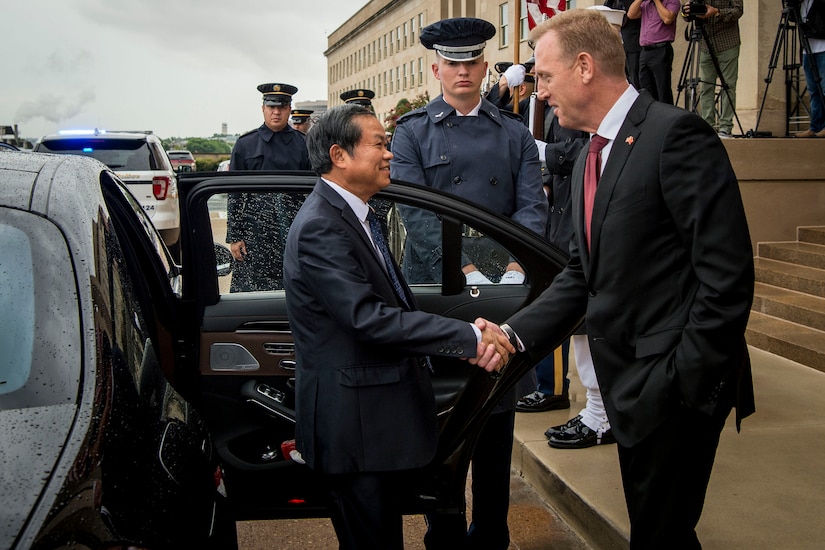
WASHINGTON -- Deputy Defense Secretary Patrick M. Shanahan and Gen. Do Ba Ty, vice president of the Vietnam National Assembly, reaffirmed the long-standing defense relationship between the United States and Vietnam during their meeting at the Pentagon today, Charles E. Summers Jr., principal deputy assistant to the secretary of defense for public affairs, said in a statement.

The leaders discussed the regional security environment and highlighted historic progress in the U.S.-Vietnam partnership, said Summers, noting the two leaders agreed to increase cooperation in the areas of maritime security, peacekeeping, military medicine and cybersecurity.

Regional Security Environment

Summers said the two leaders also agreed that a strong and comprehensive U.S.-Vietnam partnership, particularly in the area of defense cooperation, promotes regional and global security and economic development, including in the South China Sea.

The U.S.-Vietnam partnership is based on mutual respect and common interests, particularly freedom of navigation, respect for international law, and recognition of national sovereignty, Summers said.