Tuesday, July 17, 2018

Former Business Partner of U.S. Military Contractor Pleads Guilty to Bribery Scheme Related to Contracts in Support of Iraq War


A former business partner of a U.S. military contractor pleaded guilty today to one count of bribery for his role in a years-long scheme to bribe U.S. Army contracting officials stationed at a U.S. military base in Kuwait, announced Assistant Attorney General
Brian A. Benczkowski of the Justice Department’s Criminal Division.

According to the plea filed today in the U.S. District Court for the Northern District of Alabama, Finbar Charles, 62, a citizen of Saint Lucia most recently residing in Baguio City, Philippines, was a business partner of a former U.S. military contractor, Terry Hall.  As Hall’s business partner, Charles facilitated Hall and others in providing millions of dollars in bribes in approximately 2005 to 2007 to various U.S. Army officials in exchange for preferential treatment for Hall’s companies in connection with Department of Defense (DOD) contracts to deliver bottled water and construct security fencing to support U.S. troops stationed in Kuwait and Iraq.

As part of his role in this criminal conspiracy, Charles managed bank accounts in Kuwait and the Philippines that he used to receive DOD payments and transfer illegal bribes to various U.S. Army contracting officials, including Majors Eddie Pressley, John Cockerham, James Momon, and Chris Murray.  All of those individuals, as well as at least 10 other coconspirators, have pleaded guilty or been convicted of crimes relating to this scheme.  Charles admitted that he personally received over $228,000 in illicit gains as a result of his participation. 

The sentencing is set for Nov. 26.

This case was investigated by the Defense Criminal Investigative Service, the U.S. Army Criminal Investigation Command, the FBI, and the Special Inspector General for Iraq Reconstruction.  The case is being prosecuted by Trial Attorneys Peter N. Halpern and Robert J. Heberle of the Criminal Division’s Public Integrity Section.

Face of Defense: Former Enlisted Marine Serves as Army Warrant Officer


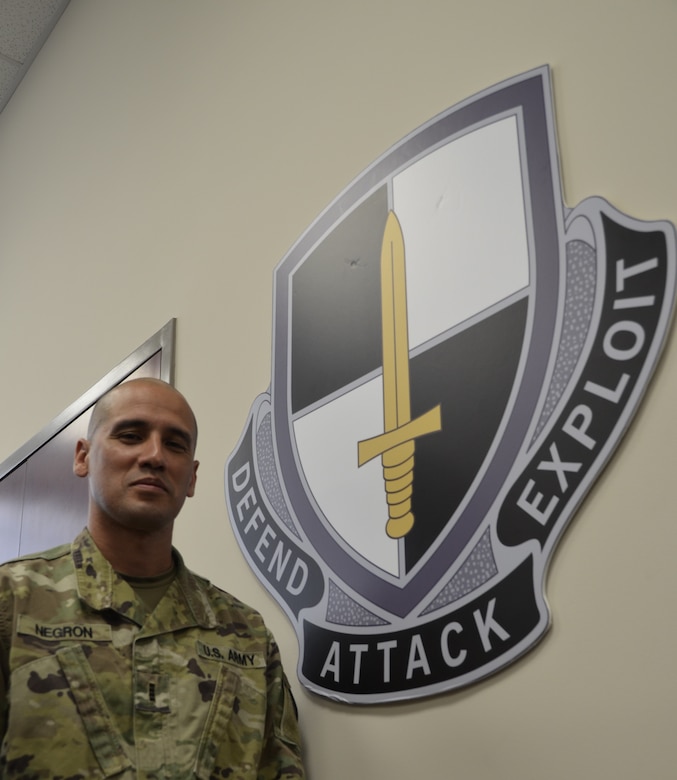
By William Roche, U.S. Army Cyber Command

FORT GORDON, Ga. -- You’d think that making the jump from serving as an enlisted Marine Corps signals intelligence specialist to an Army cyber warrant officer would be a pretty complicated process that involves more than a few flaming hoops, but Army Chief Warrant Officer 4 Raul Negron Jr. makes it sound almost routine.

In fact Negron not only made that leap, he ultimately jumped into the role of proponent, and helps to recruit Army cyber warrant officers and guide their careers.

Negron, a native of Tampa, Fla., says he became interested in being an Army warrant officer during his second assignment as a Marine. That tour was his first exposure to warrant officers, and he was intrigued by the fact that they served as the leading technical experts in their fields. But though he was an ambitious young Marine, he says he recognized that he wasn’t quite ready for that move at that time.

“I recognized that I was still too junior, and I had a lot more to learn before I was ready for that,” he said. “I didn't want to be a technical expert if I still needed to learn a lot more.”

Service Transfer

But Negron stayed focused on his goal, and when he felt he was ready he applied for a service transfer to join the Army’s ranks as a warrant officer. He was returning from deployment in 2005, he said, a Marine staff sergeant with seven and a half years in the Corps, when he learned that his request had been approved.

It sounds like a rare occurrence, but Negron said that while it’s not widely advertised, there are quite a few Army warrant officers who transferred from other services.

The next jump was from signals intelligence to cyber. Negron said it really wasn’t that much of a stretch, since cyber grew from signal and military intelligence. And it had been his first interest. He had earned a bachelor’s degree in computer science and was pursuing his master’s degree. So when he was offered the opportunity to help build the brand-new Army Cyber Command in 2010, it “lined up perfectly” with his goals and he jumped at the chance.

“It just happened to be that I had the right degree, the opportunity presented itself, and I was in my [permanent change of station] window. And I guess timing is everything,” he said.

At the time Negron was still a signals intelligence warrant officer. He said the occupational code for cyber warrant officers -- 170A, cyber operations technician -- didn’t even exist. But building Army Cyber Command required people with technical expertise.

“It was something new that no one really knew, [and when] I got to Army Cyber Command in 2010, it was mostly about organizing the command, [developing] authorities and things of that nature. I did start doing technical stuff eventually, because the organization was so new, and you had to figure out who was supposed to be doing what,” he said.

Recruiting Others

A few years later, he says, when the first call went out for interested Army warrant officers to transfer into the cyber field via the Voluntary Transfer Incentive Program, he again jumped at the chance. Eventually his experience and drive earned him his job as the Army’s career field proponent, a role that keeps him busy making recruiting trips, talking with noncommissioned officers in all services about being an Army cyber warrant officer, and developing and facilitating training, career paths and retention programs for cyber warrants.

Negron clearly likes what he does, and clearly believes in the opportunities and satisfaction the cyber warrant officer profession has in store for anyone who wants to pursue -- and remain in -- a technical career path.

“The selling point I give to the NCOs that I brief, whether it's Army, Navy, Marine Corps or Air Force, is that there's only one place that you can remain technical in cyber for an entire career. And that's with us, in the Army. As an Army cyber warrant officer. We are the only [specialty], the only service that can offer that,” he says. “Our warrant officers … are very technical. We are hands on keyboard. We want you to ... remain technical for an entire career. That is how we built the and have set up the [specialty].”

“In the Army, typically you make E-7 [the rank of sergeant first class], and what do we do? Probably make you a platoon sergeant,” he adds. “That's kind of the rule, if you will. And there's nothing wrong with that. That's a vital function. We need that. But there are some guys and gals that want to remain ‘hands on keyboard.’ And so those are the folks that we recruit, because they want to remain on a keyboard for an entire career.”

But Negron stresses that being on a keyboard and being a cyber technical expert is a challenge, not a vacation.

“Things are changing fast and are changing every day. We're very busy. This really isn't going to be a career where you join and you get to kick back and relax. You are going to be busy,” he says.

Watercraft Operators Gain Experience in Annual Exercise


By Army Spc. Trenton Fouche, 214th Mobile Public Affairs Detachment

TACOMA, Wash. -- The U.S. Army Reserve offers a wide variety of career fields ranging from logistical support to human resources. However, with so many jobs to choose from, some military occupational specialties can sometimes be overlooked by potential recruits. One such specialty is watercraft operator.

Watercraft operators play a huge role in ensuring the Army’s overall mission readiness by overseeing cargo operations and making sure soldiers on land and at sea have access to resources needed for combat.

With such a great responsibility of carrying the load and executing an essential mission, it is important that the Army find soldiers capable and combat ready to engage the enemy by navigating the sea aboard Army watercraft.

With so few watercraft operators in both the active and reserve component of the Army, it is essential that the Army makes certain that these soldiers are proficient in their field.

“The watercraft field is a very small community,” said Army Staff Sgt. Eric Barker, a watercraft operator representing the 824th Transportation Company in Tampa, Florida. “A lot of us know the same people.”

Not an Easy Road

The road to becoming a watercraft operator isn’t easy. In addition to 10 weeks of basic combat training, soldiers must also endure six weeks of advanced individual training, with on-the-job instruction taking place both in the classroom and the field.

In addition to knowing how to use communication and navigation systems, being an Army watercraft operator also entails being able to lead other soldiers during operations.

“Everyone has a mission, and if you have 10 people asking 10 different people the same questions, there would be chaos,” said Army Sgt. Brian Hays of the 651st Harbormaster Detachment. “It’s important to know where to go to find an answer. This is why leadership is very important.”

With so many moving parts on each vessel, it is essential that watercraft operators gain as much experience as possible to ensure they are capable of executing the mission when the time comes.

Annual Training Exercise

The U.S. Army Reserve’s annual training exercise Big Logistics Over-the-Shore West 2018 here provides Barker with the experience and time he needs to get his license. Big LOTS West 18 is a hands-on training opportunity for soldiers in watercraft units, terminal battalions and deployment support command units.

“Being from Florida allows me to get a little bit of a different experience,” Barker said. “Sailing over here is a lot different than sailing back home. The currents are different over here.”

Watercraft operators depend on training events such as Big LOTS to test their proficiency and ability to achieve the next level of responsibility in their specialty.

As soldiers in this career path continue to advance, they must complete a duty task performance packet to become licensed and ensure they are competent and efficient in each task. This allows them the opportunity to gain experience toward the goal of becoming vessel masters.

Emphasis on Competence

“Each level has a packet to complete once you come out of your respective school,” Barker explained. “It can take a week for active-duty soldiers, but for Reserve soldiers it can take a few months, because they only have battle assembly weekends to complete a task.”

In the face of evolving global threats, the Army continues to emphasize competence in basic soldier tasks and specialties. Proficiency and mastering the fundamentals are essential to being an effective watercraft operator.
“There’s a lot of hard work involved, and you have to have a good attitude because you’re in close quarters with other soldiers,” Barker said. “You have to be willing to work, because we deliver cargo over multiple platforms, whether it’s a beach or a fixed location. That’s what makes us vital to the Army’s mission.”