Tuesday, July 17, 2018

Special Operations Competition Kicks Off in Panama


By Army Staff Sgt. Brian Ragin, U.S. Special Operations Command South

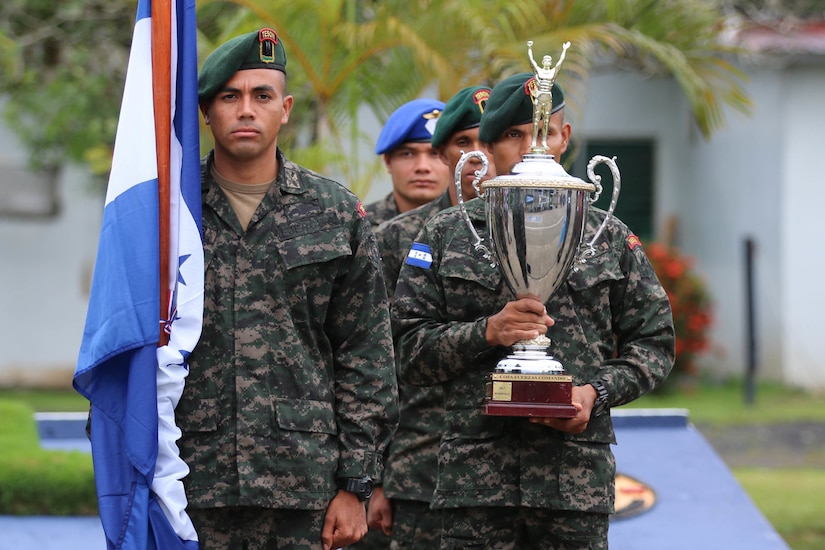
PANAMA CITY, Panama -- Despite cloudy skies, spirits were high for about 100 competitors as Fuerzas Comando, a multinational special operations competition sponsored by U.S. Southern Command and executed by U.S. Special Operations Command South, kicked off its 14th iteration here yesterday.

Seventeen countries, from the Caribbean, Central America, South America -- including the United States -- participated in the ceremony opening the competition, which is hosted by Panama’s Ministry of Public Security.

“It’s a great honor to be here,” said Army Col. Brian Greata, Special Operations Command South’s deputy commanding officer. “This competition gives us the opportunity to establish and strengthen relations with special operations professionals in our region facing criminal and terrorist challenges.”

Fuerzas Comando has been held annually since 2004, and this is the first time Panama has hosted it. Through friendly competition, officials said, this exercise promotes interoperability, military-to-military relationships, increases training knowledge, and improves regional security.

“Together we will improve our ability to defeat our challenges,” Greata said.

Technical and Tactical Skills

The nine-day event will test participants’ technical and tactical skills and will include a distinguished visitor program.

“In this regional event, you all are the best of the best of the nations you are representing,” said Alexis Bethancourt Yau, Panama’s public security minister. “So make your comrades proud by giving everything you have in every moment."

The special operations skills competition will include a physical fitness test, confidence course, close-quarters combat, marksmanship, a ruck march and an obstacle course.
Greata closed his remarks by urging those participating to share ideas and to build trust and knowledge.

Monday, July 16, 2018

Face of Defense: Sailor Enjoys Challenges, Lifestyle of Recruiting Duty


By Navy Petty Officer 3rd Class Zachary S. Esleman, Navy Recruiting Command

DELAND, Fla. -- When future sailors walk into a Navy recruiting station, it’s not by accident. They’re driven through those doors by something. Whether it’s patriotism, a desire for self-improvement, or the prospect of adventure and travel, they’re all seeking a way forward.

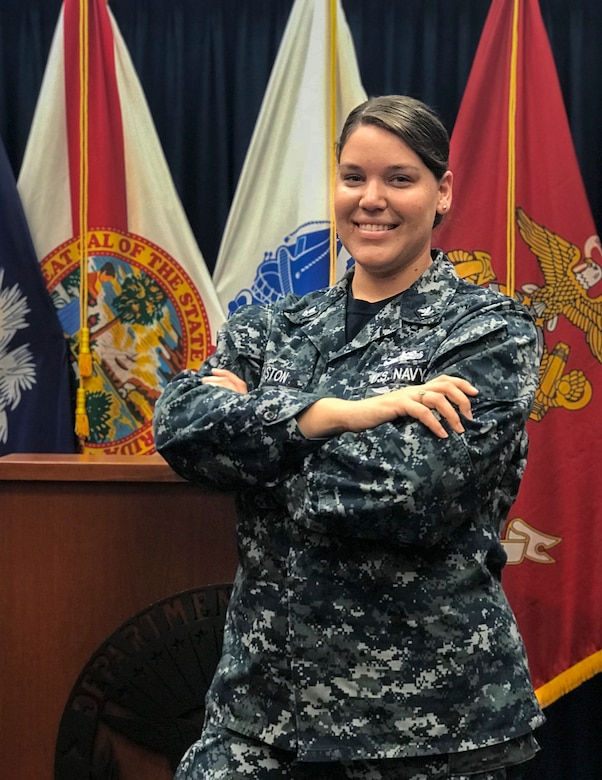
If they happen to take that step here, they’ll be greeted by Navy Petty Officer 2nd Class Abbe Beaston, a quartermaster and a member of the Navy Recruiting District Jacksonville recruiting team. She’s a sailor who can relate.

Beaston was born in Harrisburg, Pennsylvania, and raised in Columbia, South Carolina. Motivated by a love for her country and a sense of responsibility to serve, she said, she joined the Navy in October 2010 and was happy to be able to follow in the footsteps of her grandfather, who served in the Marine Corps, and two of her uncles, who served as enlisted Navy sailors.

Her first command was the aircraft carrier USS Dwight D. Eisenhower out of Naval Station Norfolk, Virginia. She hit the ground running and quickly became a standout sailor in the navigation department, earning petty officer of the quarter honors and other accolades. While serving aboard the Eisenhower, she said, she completed two deployments and cherished the important role she was able to play in the ship’s mission.

After serving at sea, Beaston transferred to an office job on Naval Station Norfolk and gave birth to her son, Alexander. While working there, she said, she began to miss the operational nature of being deployed at sea on an aircraft carrier and started to feel as if she wasn’t contributing to the Navy’s mission like she used to. She wanted a high-speed, challenging job where she could feel more rewarded for her hard work, she said, and that’s exactly what she got when she received her new mission: to go to Florida and become a recruiter.

Changing Lives for the Better

“Recruiting made me look forward to going to work again,” she said. “It gave me back my ‘pep in my step.’ The best parts of recruiting are being able to be a mentor to the future sailors and changing people’s lives for the better.”

Beaston added that she is pleased with the lifestyle recruiting has allowed her to develop by being able to fully embed herself into the community around her.

“I’ve been able to buy a house and settle in this community for a little while, which is great for raising my son,” she said. “It’s all stuff that I never thought I’d be able to accomplish this early in my career. I love to be able to go to the beach, swim and take Alexander to the park.”

Now that she’s been enlisted for almost eight years, Beaston said, she’s been able to see the benefits of her choice to join the military, and she’s decided to pursue the Navy as her career until retirement.

“I don’t know where I would be without the Navy; I love being a mom, sailor and daughter, and being part of the best team in the world,” she said. “I like the rich tradition, and the camaraderie and discipline I’ve experienced among the ranks.”

She’s also proud of the professional development she’s been able to accomplish, she said, gaining leadership skills, taking mentorship classes and taking college classes toward an associate’s degree in general studies.

Using these skills, and the motivation the Navy has given her, she said, she has applied herself to helping her community by volunteering with the local Boys and Girls Clubs of America as a track coach.
“The children are from 7 to 18 years old,” Beaston said, “so I help them stay out of trouble and give them something to look forward to while in school and during the summer.”

California Guard Engineers Build Temporary Bridge for Firefighting Effort


By Army Staff Sgt. Edward Siguenza, California National Guard

CACHE CREEK REGIONAL PARK, Calif. -- This was a mission about speed for the California Army National Guard’s 132nd Multirole Bridge Company.

First, there was the Pawnee Fire that erupted in late June in Lake County, California, that scorched more than 15,000 acres. Then the Spring 2 Fire ignited a few days later, but that was extinguished after a modest 80 acres burned. Yet the California Department of Forestry and Fire Protection was immediately busy again as the County Fire erupted in Napa and Yolo counties, and Cal Fire’s urgency to move its assets to fight the latest blaze was heightened.

“If we went left or right, it would have taken us several hours to get to the fight,” a Cal Fire official said. “But if we go up the middle, which we couldn’t at the time, we would be on site a lot faster. That’s why we called the [California Army National Guard]. They helped us out a few years ago with the same thing.”

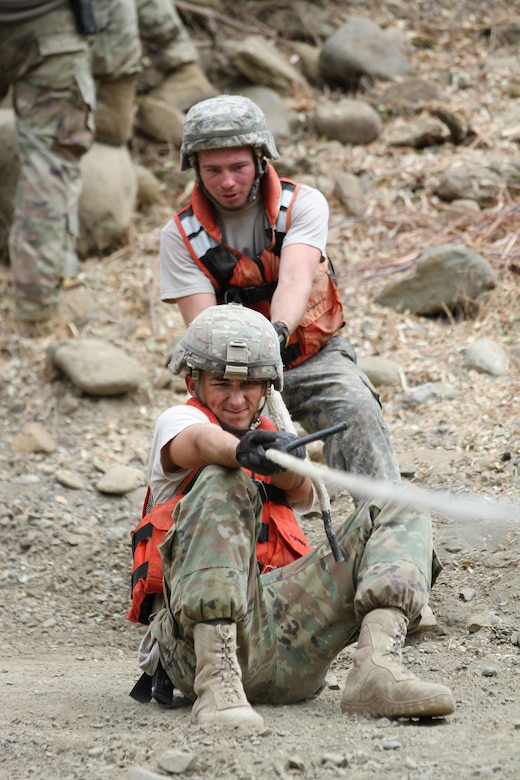
As in 2015, 132nd Multirole Bridge Company engineers quickly stepped forward. The Redding, California-based, unit constructed a 100-foot improved ribbon bridge in the same location as three years ago, for the same purpose. The “go up the middle” effect allowed Cal Fire and other California Office of Emergency assets to quickly move heavy equipment and personnel to the wildfire.

The County Fire consumed more than 90,000 acres as of mid-July. It was destined for worse until emergency services contained it. The 132nd’s efforts to build the bridge in a matter of hours contributed to the County Fire’s containment.

Critical Speed

“The main thing is quickness,” said Jeremy Salizzoni, Cal Fire captain and military liaison, in 2015. “We can’t cut the fire off until all the lines are in. This bridge gives us faster access to the fire. We can get our bulldozers, equipment and people up there to fight it.”

The temporary structure floated adjacent to a permanent concrete bridge that was deemed “zero tons,” according to Steve Sahs, a California Department of Transportation senior bridge engineer/inspector, in his 2015 inspection. It’s passable for normal vehicles, but big, heavy equipment such as fire trucks and bulldozers aren’t permitted, Sahs explained.

Sahs said California has about 24,000 bridges. This bridge is one of about 10 in Cache Creek Regional Park.

“This has been closed since 2009 due to scour issues,” he said, noting the bridge was built in 1930. “You can see it’s old, because it’s made with square rebars.”

The improved ribbon bridge was used for about a week, Army Sgt. 1st Class Harley Ramirez said. More than 650 vehicles and 1,200 personnel crossed it. Ramirez stationed his troops on a 24-hour safety watch. He credited the team for its productiveness, noting how quickly the temporary bridge went up -- and down -- compared to three years ago.

“The water is a lot higher this year, along with a faster-moving current,” said Army Sgt. Dillon Graben, who was part of the crew in 2015. “There were a lot of variables from the last time we did this.”

“We had issues working in the tight areas, but this gave us hands-on experience on what to do and not,” said Army Sgt. Ellie Ogsbury, a 2015 bridge returnee.

Making a Difference

Three years ago, the 132nd erected the bridge mainly for Cal Fire to battle the Jerusalem and Rocky fires in Lake County. The Rocky Fire, which burned about 70,000 acres, was one of the largest blazes that year, second only to the nearby Valley Fire, which burned about 76,000 acres.

“This definitely opened our eyes. It let us know the importance of what we do,” said Army Spc. Aaron W. Parker. “It’s good to know what we did made a lot of difference.”

The 132nd is part of the 49th Military Police Brigade, which has seen several units activated this year. The 270th Military Police Company assisted law enforcement personnel during the Siskiyou Fire near the California-Oregon border. More than 500 from the 144th Field Artillery Battalion were training for ground operations by mid-July, one of the earliest call-ups for hand crews.
One person was injured in the County Fire, and 20 buildings were destroyed. More than 450 emergency personnel responded to the fire, and the majority of them used the bridge to reach the affected area.