Monday, July 09, 2018

U.S., Philippines Strengthen Alliance with Maritime Training Activity Sama Sama


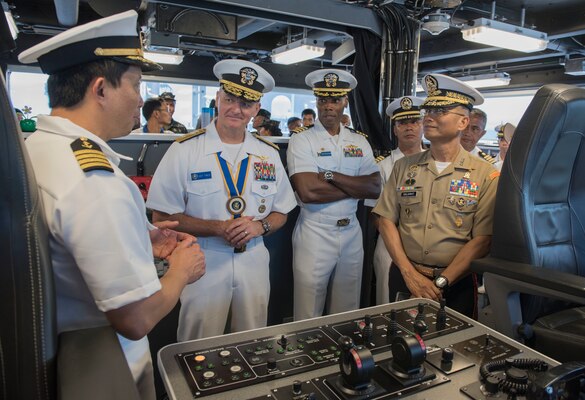
SAN FERNANDO CITY, Philippines -- The U.S. and Philippine navies kicked off maritime training activity Sama Sama at Naval Station Ernesto Ogbinar here today.

The week-long engagement focuses on the full spectrum of naval capabilities and is designed to strengthen the close partnership between both navies while cooperatively ensuring maritime security, stability and prosperity.

Expeditionary fast transport ship USNS Millinocket, diving and salvage ship USNS Salvor and a P-8 Poseidon maritime surveillance aircraft will operate alongside the Philippine navy frigate BRP Ramon Alcaraz and landing dock ship BRP Tarlac in at-sea evolutions in the South China Sea.

Evolutions include air defense exercises aimed to increase proficiency in air and missile defense, diving exercises to promote mutual efficiency underwater, and search and rescue exercises designed to enhance capabilities in aid-and-assistance to distressed mariners.

Shore phase evolutions include symposiums and seminars on a wide range of naval capabilities, including medical, public affairs, engineering, explosive ordnance disposal and anti-submarine and surface operations, all taking place here and in San Antonio, Manila and Subic.

The Japan Maritime Self-Defense Force will join the exercise as an observer and valued partner.

‘Together, Jointly’

“The name of this Maritime Training Activity, Sama Sama, -- meaning ‘together, jointly’ -- perfectly captures the spirit and energy of this tremendous event. The U.S. and Philippine alliance has always been a special relationship based on mutual trust and respect and strengthened by enduring maritime engagements,” said Navy Rear Adm. Joey Tynch, commander of Task Force 73. “Built on 70 years of strong friendship and deep historical ties, our shared interest in maritime security is what maritime training activity Sama Sama is all about -- our shared belief that regional challenges increasingly require cooperative solutions by capable naval forces.”

Sama Sama builds upon other engagements with the Philippines, including Pacific Partnership, the largest annual multilateral humanitarian assistance and disaster relief preparedness mission; Southeast Asia Cooperation and Training, which involves more than a dozen partner nations; and Balikatan 34. These engagements serve to enhance information sharing and coordination and support long-term regional cooperation.

“This training provides us with an exceptional opportunity for both Philippine and U.S. navies to engage in a broader range of maritime operations and unique scenarios in our maritime areas,” said Philippine Marine Corps Lt. Gen. Emmanuel Salamat, commander of Northern Luzon Command. “In this way, we could explore for more cooperation, enhance our interoperability, and provide us effective mechanisms for collaboration and partnership of our navies in the spirit of our mutual treaty engagement

“Notably,” he continued,” this maritime training activity demonstrates the extraordinary commitment of our navies in building and strengthening our partnership in keeping with our bilateral relations as longtime ally. As such, this year’s exercise focuses on developing mutual capabilities in addressing maritime security priorities and concern for mutual benefits and interests”.

In July 2017, the U.S. and Philippine navies conducted a coordinated patrol in the Sulu Sea demonstrating a mutual commitment to responding to piracy and illegal transnational activity. Sailors from both navies exchanged best practices in visit, board, search and seizure techniques, as well as information sharing.
“It is incredible to see all that will be accomplished during this exercise, as sailors and Marines from the U.S. and Philippines work side by side across multiple domains to safely execute and engage on and under the sea, in the air, on land and in the local communities,” said Navy Capt. Lex Walker, commander of Destroyer Squadron 7. “As the MTA continues to evolve in scope and scale, the U.S. and Philippine navies will continue sailing together towards the common goals of increased maritime security and stability.”

Coast Guard, Canadian EOD Specialists Train to Mitigate Maritime Threats


SAN DIEGO -- U.S. Coast Guard deployable specialized forces and Royal Canadian Navy explosive ordnance disposal technicians trained for maritime interdiction operations during the opening events of the force integration training phase of Rim of the Pacific Southern California.

This year marks the first time that the Coast Guard’s Maritime Security Response Team West has participated in Rimpac. The Maritime Security Response Team is the Coast Guard’s counterterror unit.

The Coast Guardsmen and Canadian sailors, from Fleet Diving Unit Pacific, partnered in the training event under the umbrella of Commander Task Force 177, Rimpac’s mine warfare commander. Maritime Security Response Team West is headquartered here, and Fleet Diving Unit Pacific is headquartered in Victoria, British Columbia.

The focus of the daylong event was for the teams to observe and train alongside one another during maritime interdiction operations while boarding a training vessel identified as both high-value and high-threat that was assessed to be carrying improvised explosive devices. The added capability provided by the EOD technicians laid the groundwork for successful future operations where additional expertise is required.

Aligning Tactics

“We work closely with a variety of federal law enforcement and other government agencies on a regular basis,” said Coast Guard Senior Chief Petty Officer Richard Young, a maritime enforcement specialist and Maritime Security Response Team West’s operations chief. “Routinely, we get aboard the vessel, gain positive control and ensure the vessel is safe prior to turning over custody to another agency or technical unit like EOD techs. Our training today helped us observe and integrate with our Canadian EOD partners to make sure our tactics, techniques, and procedures are aligned before we move into the next phase of the Rimpac [Southern California] exercise.”

Maritime Security Response Team West began operations in 2017, and the command’s mission is to provide the nation with highly specialized and maritime-dedicated tactical teams able to support both homeland security and national defense operations.

Commander Task Force 177 is the Rimpac 2018 mine warfare commander, operating in the Rimpac Southern California operating area. Its mission is to integrate and train in the operations area and to conduct mine warfare and maritime security operations to deter aggression and promote freedom of navigation and stability. CTF 177 is composed of 26 units with about 1,100 personnel representing seven countries: the United States, Australia, Canada, the United Kingdom, Japan, the Netherlands and New Zealand.
Twenty-five nations, 46 ships, five submarines, about 200 aircraft and 25,000 personnel are participating in Rimpac until Aug. 2 in and around the Hawaiian Islands and Southern California. The world’s largest international maritime exercise, Rimpac provides a unique training opportunity while fostering and sustaining cooperative relationships among participants critical to ensuring the safety of sea lanes and security of the world’s oceans. Rimpac 2018 is the 26th iteration in a series that began in 1971.

Saturday, July 07, 2018

Mattis Plans Visits to Croatia, Norway After Attending NATO Summit


WASHINGTON -- Defense Secretary James N. Mattis plans to visit Croatia and Norway next week after he attends NATO’s summit, Defense Department officials announced today.

The secretary leaves July 10 for the July 11-12 meeting of NATO’s heads of state and government.

In Brussels, Mattis will join President Donald J. Trump and leaders of allied and partner nations at the NATO summit to reinforce U.S. priorities, including more equitable burden sharing, strengthening the alliance’s deterrence and defense capabilities and enhancing NATO’s role in fighting terrorism, officials said.

The secretary then will travel to Zagreb, Croatia, where officials said he will meet with defense ministers of the U.S.-Adriatic Charter to reinforce U.S. support to southeast Europe.
The secretary’s final stop on his overseas trip is Oslo, Norway, where he will meet with Norwegian Defense Minister Frank Bakke-Jensen and Foreign Minister Ine Eriksen Soreide.