Wednesday, June 27, 2018

DoD Honors Employers for Support of Guard, Reserve Employees


WASHINGTON -- Defense Department officials today announced the 15 recipients of the 2018 Secretary of Defense Employer Support Freedom Award, the highest U.S. government honor to employers for support of National Guard and Reserve employees.

“It is my pleasure to recognize these 15 outstanding civilian employers,” Defense Secretary James N. Mattis said. “Our National Guard and Reserve members are a vital part of our national defense and deserve as much support as our country can provide. These 15 employers lead the way, and we are grateful for their role in helping to keep our nation safe and secure.”

The Freedom Award recipients will be honored Aug. 24 at a Pentagon ceremony. They are:

-- Texas Department of Insurance, Austin, Texas.

-- Duke Energy, Charlotte, North Carolina.

-- Dunlap Police Department, Dunlap, Tennessee.

-- Crystal Group Inc., Hiawatha, Iowa.

-- AME Swiss Machining LLC, Ligonier, Indiana.

-- Greencastle Associates Consulting LLC, Malvern, Pennsylvania.

-- Argen Tech Solutions Inc., Newmarket, New Hampshire.

-- Werner Enterprises Inc., Omaha, Nebraska.

-- FMI Corp., Raleigh, North Carolina.

-- Wicomico County Sheriff’s Office, Salisbury, Maryland.

-- Amazon, Seattle.

-- Slippery Rock University of Pennsylvania, Slippery Rock, Pennsylvania.

-- South Charleston Police Department, South Charleston, West Virginia.

-- Big Sky Advisors, St. Louis.

-- Minnesota Department of Transportation, St. Paul, Minnesota.
The 2018 recipients were selected from more than 2,350 nominations received from guardsmen and reservists highlighting how their civilian employers went far beyond what the federal law requires to support them. The Freedom Award began in 1996 under the auspices of Employer Support of the Guard and Reserve to recognize exceptional employer support, with 250 honorees to date.

Official Highlights DoD Role in Supporting Global Stabilization Efforts


By Lisa Ferdinando, DoD News, Defense Media Activity

WASHINGTON -- The Defense Department has redefined its goals in global stabilization and security efforts and is focusing on transitional, small-scale stabilization working by, with and through its partners, a defense official said today.

Mark Swayne, deputy assistant to the secretary of defense for stabilization and humanitarian affairs in the Office of the Assistant Secretary of Defense for Special Operations and Low-Intensity Conflict, participated in the keynote plenary on the Stabilization Assistance Review at a stabilization symposium held at George Washington University.

The Stabilization Assistance Review is an interagency effort with the State Department, the U.S. Agency for International Development and DoD to identify ways the United States can leverage diplomatic engagement, defense and foreign assistance to stabilize conflict-affected areas.

The review took place last year; the secretaries of State and Defense and the administrator of USAID signed it in February.

‘Redoubling Efforts’ With Partner Elements

Swayne pointed out DoD is not the lead agency in stabilization efforts, but rather it supports efforts of the State Department and USAID. The effort supports the objective in the National Defense Strategy to enable U.S. interagency counterparts to advance U.S. influence and interests, he said.

“We are redoubling our efforts to make sure that we are a good partner working with the other elements,” Swayne said, “because whenever we have an area where we deploy, soldiers, sailors, airmen [and] Marines, we want to make sure that any victories or any gains that they make on the ground are sustained.”

He added, “Working with our interagency colleagues will do that.” For example, he noted, USAID and State Department personnel are being supported in northeastern Syria by DoD elements.

Seeking Small-Scale Stabilization Ability

DoD lacks a global authority to conduct stabilization activities on its own, Swayne said, adding that DoD has asked Congress to give the department small-scale stabilization ability.

After the defeat in 2016 of the Islamic State of Iraq and Syria in Manbij, Syria, DoD personnel were the only U.S. government officials on the ground there. DoD could have started a stabilization effort and then handed it over to State or USAID, if DoD had the authority, he explained.

DoD’s new stabilization policy, which is a revision of DoD Directive 3000.05, clarifies DoD’s core responsibilities during stabilization as security, basic public order and the immediate needs of the population, he said. If proposed fiscal year 2019 legislation is enacted, DoD will establish a Defense Support to Stabilization program and a program office at the Defense Security Cooperation Agency, he said.

The $25 million fiscal year 2019 DSS program would take advantage of existing interagency mechanisms and information technology infrastructure to ensure efficient and effective program execution, according to the Office of the Under Secretary of Defense for Policy. Stabilization activities are separate from humanitarian assistance, the office points out.

Those activities may include efforts to establish civil security, provide access to dispute resolution mechanisms, deliver targeted basic services and establish a foundation for the voluntary return of displaced people, DoD officials said.

Defense Intelligence Agency Bringing Forewarning into 21st Century


By Jim Garamone, DoD News, Defense Media Activity

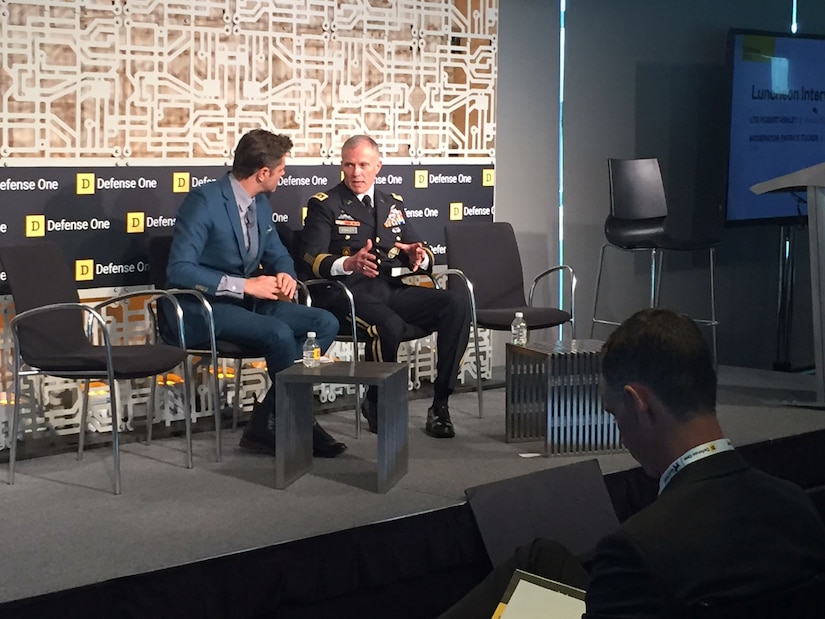
WASHINGTON -- The adage “forewarned is forearmed” has entered the digital era at the Defense Intelligence Agency, as leaders, collectors and analysts there seek to adapt to the changing security and technological world, the agency’s director said at the Defense One Tech Summit here today.

DIA has the mission of compiling information and intelligence on foreign militaries and the operational environment the American military will confront, Army Lt. Gen. Robert P. Ashley Jr. told Defense One editor Patrick Tucker.

The agency is in the business of giving leaders strategic warning. “What are the emerging technologies that are coming out that we need to be thinking about?” Ashley said. “The other part of that is to inform the decision-makers and what they have to build to counter them.”

Hypersonics, anti-satellite capabilities, and sophisticated ground, sea, air capabilities must be countered, and the agency looks to gather information and intelligence on them Ashley said. The general talks often about analytic modernization. This concept deals with data. “How do we deal with big data? How do we deal with the wealth of information that is out there and available?” he said.

So much information is available that it is difficult for humans to digest it all, he pointed out. “One of the things we are working on now are analytic data teams,” he said. “How do we take a traditional analyst and link him up with a data scientist?” Ashley said he sees the job of an analyst morphing into that of a political scientist and data scientist in the future.

Growth of Space Domain

The agency is broadening its collection to deal with the new military domain of space. Ashley said he sees the domain growing over the next decade. “If you look to the National Defense Strategy, the central problem that it seeks to solve is [that] the technological gap that we have had the lead on is slowly collapsing,” the general said. “The goal is to maintain primacy and a leading role.”

Since 2001, the only domain the American military has been challenged on is the land domain, through improvised explosive devices and combat in cities. American dominance in the sea, air, cyber and space domains was not seriously contested by terror groups. “The re-emergence of great power competition – Russia and China – you start seeing a closing gap in all domains, and they are being contested,” he said.

Military capabilities to interdict satellites both in space and on the ground is possible, the general said. “In the warfighting doctrine, you have to account for the resilience you build into the domains, you have to build in redundancy, and in some cases, if it is degraded or denied, how do you fight in that realm?” Ashley said.

Reflexive Control

The general also discussed a concept current in the agency with regard to Russia – reflexive control – and it deals with hybrid warfare. The Russians use this to intimidate, coerce and scare nations into doing what is in Russia’s best interests. Ashley said the concept is an outgrowth of Soviet doctrine that the Russians continued to work on after the brea-up of the Soviet Union.

“Reflexive control is information operations [conducted] in such a way to drive you toward a decision or outcome that you think is yours,” he said. “[The Russians)]seed the information in such a way to drive you toward that decision.”

Identifying this is tough, the general said, using Russian involvement in Western elections as an example. “What’s happening now is you have a great deal of sensitivity across the European nations – they are actually looking for [reflexive control]. They are looking for those themes to ensure they will be able to put the truth out and counter to that.”