Wednesday, June 27, 2018

Official Highlights DoD Role in Supporting Global Stabilization Efforts


By Lisa Ferdinando, DoD News, Defense Media Activity

WASHINGTON -- The Defense Department has redefined its goals in global stabilization and security efforts and is focusing on transitional, small-scale stabilization working by, with and through its partners, a defense official said today.

Mark Swayne, deputy assistant to the secretary of defense for stabilization and humanitarian affairs in the Office of the Assistant Secretary of Defense for Special Operations and Low-Intensity Conflict, participated in the keynote plenary on the Stabilization Assistance Review at a stabilization symposium held at George Washington University.

The Stabilization Assistance Review is an interagency effort with the State Department, the U.S. Agency for International Development and DoD to identify ways the United States can leverage diplomatic engagement, defense and foreign assistance to stabilize conflict-affected areas.

The review took place last year; the secretaries of State and Defense and the administrator of USAID signed it in February.

‘Redoubling Efforts’ With Partner Elements

Swayne pointed out DoD is not the lead agency in stabilization efforts, but rather it supports efforts of the State Department and USAID. The effort supports the objective in the National Defense Strategy to enable U.S. interagency counterparts to advance U.S. influence and interests, he said.

“We are redoubling our efforts to make sure that we are a good partner working with the other elements,” Swayne said, “because whenever we have an area where we deploy, soldiers, sailors, airmen [and] Marines, we want to make sure that any victories or any gains that they make on the ground are sustained.”

He added, “Working with our interagency colleagues will do that.” For example, he noted, USAID and State Department personnel are being supported in northeastern Syria by DoD elements.

Seeking Small-Scale Stabilization Ability

DoD lacks a global authority to conduct stabilization activities on its own, Swayne said, adding that DoD has asked Congress to give the department small-scale stabilization ability.

After the defeat in 2016 of the Islamic State of Iraq and Syria in Manbij, Syria, DoD personnel were the only U.S. government officials on the ground there. DoD could have started a stabilization effort and then handed it over to State or USAID, if DoD had the authority, he explained.

DoD’s new stabilization policy, which is a revision of DoD Directive 3000.05, clarifies DoD’s core responsibilities during stabilization as security, basic public order and the immediate needs of the population, he said. If proposed fiscal year 2019 legislation is enacted, DoD will establish a Defense Support to Stabilization program and a program office at the Defense Security Cooperation Agency, he said.

The $25 million fiscal year 2019 DSS program would take advantage of existing interagency mechanisms and information technology infrastructure to ensure efficient and effective program execution, according to the Office of the Under Secretary of Defense for Policy. Stabilization activities are separate from humanitarian assistance, the office points out.

Those activities may include efforts to establish civil security, provide access to dispute resolution mechanisms, deliver targeted basic services and establish a foundation for the voluntary return of displaced people, DoD officials said.

Defense Intelligence Agency Bringing Forewarning into 21st Century


By Jim Garamone, DoD News, Defense Media Activity

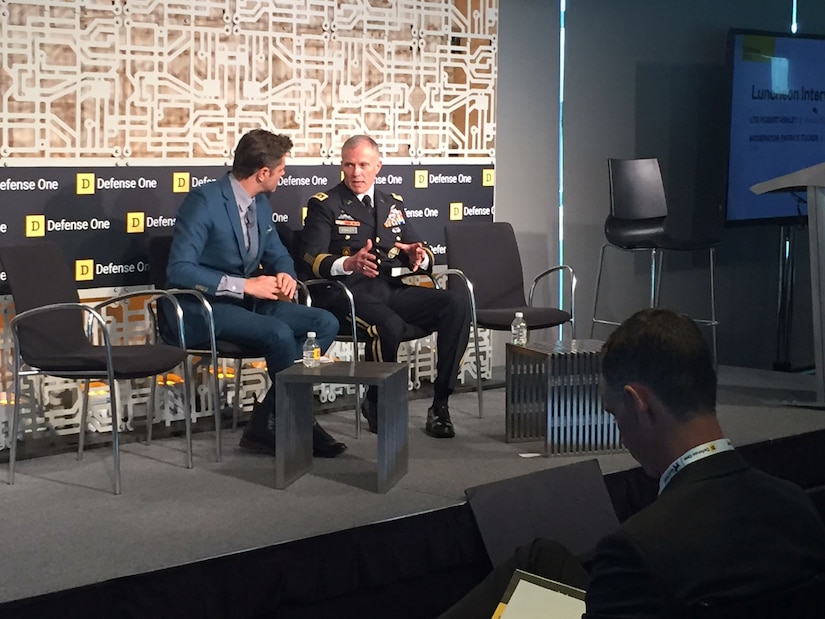
WASHINGTON -- The adage “forewarned is forearmed” has entered the digital era at the Defense Intelligence Agency, as leaders, collectors and analysts there seek to adapt to the changing security and technological world, the agency’s director said at the Defense One Tech Summit here today.

DIA has the mission of compiling information and intelligence on foreign militaries and the operational environment the American military will confront, Army Lt. Gen. Robert P. Ashley Jr. told Defense One editor Patrick Tucker.

The agency is in the business of giving leaders strategic warning. “What are the emerging technologies that are coming out that we need to be thinking about?” Ashley said. “The other part of that is to inform the decision-makers and what they have to build to counter them.”

Hypersonics, anti-satellite capabilities, and sophisticated ground, sea, air capabilities must be countered, and the agency looks to gather information and intelligence on them Ashley said. The general talks often about analytic modernization. This concept deals with data. “How do we deal with big data? How do we deal with the wealth of information that is out there and available?” he said.

So much information is available that it is difficult for humans to digest it all, he pointed out. “One of the things we are working on now are analytic data teams,” he said. “How do we take a traditional analyst and link him up with a data scientist?” Ashley said he sees the job of an analyst morphing into that of a political scientist and data scientist in the future.

Growth of Space Domain

The agency is broadening its collection to deal with the new military domain of space. Ashley said he sees the domain growing over the next decade. “If you look to the National Defense Strategy, the central problem that it seeks to solve is [that] the technological gap that we have had the lead on is slowly collapsing,” the general said. “The goal is to maintain primacy and a leading role.”

Since 2001, the only domain the American military has been challenged on is the land domain, through improvised explosive devices and combat in cities. American dominance in the sea, air, cyber and space domains was not seriously contested by terror groups. “The re-emergence of great power competition – Russia and China – you start seeing a closing gap in all domains, and they are being contested,” he said.

Military capabilities to interdict satellites both in space and on the ground is possible, the general said. “In the warfighting doctrine, you have to account for the resilience you build into the domains, you have to build in redundancy, and in some cases, if it is degraded or denied, how do you fight in that realm?” Ashley said.

Reflexive Control

The general also discussed a concept current in the agency with regard to Russia – reflexive control – and it deals with hybrid warfare. The Russians use this to intimidate, coerce and scare nations into doing what is in Russia’s best interests. Ashley said the concept is an outgrowth of Soviet doctrine that the Russians continued to work on after the brea-up of the Soviet Union.

“Reflexive control is information operations [conducted] in such a way to drive you toward a decision or outcome that you think is yours,” he said. “[The Russians)]seed the information in such a way to drive you toward that decision.”

Identifying this is tough, the general said, using Russian involvement in Western elections as an example. “What’s happening now is you have a great deal of sensitivity across the European nations – they are actually looking for [reflexive control]. They are looking for those themes to ensure they will be able to put the truth out and counter to that.”

Tuesday, June 26, 2018

Face of Defense: Airman Combines Creativity, Service, Entrepreneurship


By Army Sgt. 1st Class Jose Ibarra, DoD News, Defense Media Activity

LOS ANGELES -- When people think of service members, they typically think of combat arms jobs such as infantrymen or fighter pilots -- jobs you see in Hollywood movies.
Airman prepares cameras for production shoot.

The truth is that the military has a dynamic range of jobs requiring a dynamic range of skills. Thinkers, problem solvers, creators and artists -- yes, even artists -- all play their part in today’s military. Most military jobs provide the necessary experience to succeed in the civilian sector, whether it’s in logistics, law, the environment or the creative arts, including graphic design and film.

One airman got more than he initially expected when he raised his right hand and swore to support and defend the Constitution of the United States. “I never dreamed of being able to create for the military,” said Air Force Reserve Staff Sgt. Corban Lundborg as he described the first time he was introduced to the creative side of the military. “While on active duty, I rarely left the warehouse and didn’t know photojournalism existed.”

His first job in the Air Force was as a logistician, and one day a supervisor asked if anyone wanted to be the base photographer. At the time, Lundborg said, he was desperate to get out of the warehouse where he worked, so he took the job and never looked back.

Seeking Adventure

As a high school senior, Lundborg said, he knew he wanted more than four more years of sitting in a classroom. He wanted adventure. During his senior year, he was into boxing and spent his after-school time at a local boxing gym. A lot of veterans hung out there, he said, and they told him about the Air Force. At that moment in his life, Lundborg said, he knew he had to make a change for the better.

“I had absolutely no idea what to expect, other than I needed to get out my environment,” he said. So, at age 18, Lundborg enlisted in the Air Force on an “open general” contract -- meaning without a specific job -- and left, as he said, “ASAP.”

Lundborg was off to Korea for a year, followed by three years in Italy. He planned to do four years of active service and then reassess his life. Though he was not satisfied with his initial supply job, he said, overall he enjoyed the Air Force.

“I joined to travel and learn a little about the world. I got what I signed up for and wouldn’t change a thing,” Lundborg said. He had gone from hardly leaving the Midwest to being an international explorer.

The experience was “nothing short of life-changing,” he said.

“I don’t think I could even put into words how my travels impacted my perspective on culture, opportunity and the people around me,” Lundborg added.

Being Creative in the Military

“It’s really a dream come true to work an Air Force job that so closely aligns with my life’s passion,” Lundborg said. After his four-year active-duty contract was over, he decided to go to the Air Force Reserve, where he has established himself as a capable storyteller.

“I’ve been tasked for projects [from] co-directing creative production sets to flying into the eye of a hurricane on a day’s notice,” said Lundborg, who now serves in the Air Force Reserve as a photojournalist with the 4th Combat Camera Squadron at Joint Base Charleston, South Carolina.

Looking back, he said, the Air Force helped to make him who he is today. “The Air Force taught me to set goals and showed me my ability to push perceived limits,” Lundborg explained. “I’ve learned success is nothing more than constructive daily habits manifested over time.”

As an Air Force reservist, Lundborg can enjoy the best of both worlds: his military career and his desire to be a successful artist and entrepreneur. His military photography inspires his paintings and vice-versa, he said, and his artistic eye helps his ability to tell the Air Force story.

Out of the Uniform into Entrepreneurship

While stationed in South Korea, Lundborg started studying the art of tattooing and that reignited his love for the arts. From there, he continued to create, starting his first business at age 20 while stationed in Italy. He was selling paintings out of his dorm room, where he started his “Cold Studio” brand, growing it day by day. He is now 26, and that same business is now booming in Los Angeles. “It is so fun to look back on the journey,” he said.

Lundborg’s global journey continues. He travels to work on art projects around the world, and he has even gone “rogue,” spending a year living and working out of a mobile studio on a cross-country art tour. His entrepreneurial journey has taught him to take risks, to trust and also to celebrate the small victories, he said. “The entrepreneur life is a windy road -- one day you’re heading this way, then the next you are taking the business in a new direction,” Lundborg said.

There is a saying that “If you love what you do, you will never work one day in your life.” Lundborg is the living proof. “It has been so rewarding that just this week my wife and I launched a second business that focuses on media production,” he said.

The Future

“The Air Force has no doubt shaped me as a man, an artist and as entrepreneur,” he said, adding that he plans to continue to grow his fine-art company. Lundborg said he hopes his media production company will similarly take root into something inspiring. “I’ve always focused on providing exceptional service and quality to the customer, and because of that, there has never been a shortage in income or work,” he said.

You can follow Corban Lundborg on social media and occasionally watch him go live on Facebook from his studio in North Hollywood as he works on paintings that range from modern portraits to works that spread social awareness of world issues such as pollution and veterans issues.