Tuesday, June 26, 2018

Transcom Nominee: U.S., Partners Face Increasingly Complex Security Environment


By Terri Moon Cronk, DoD News, Defense Media Activity

WASHINGTON -- The United States and its global partners face an increasingly complex security environment that requires a joint force that’s relevant to the times, the nominee to be the next commander of U.S. Transportation Command told the Senate Armed Services Committee today.

Army Lt. Gen. Stephen R. Lyons told senators that such a joint force must be one that can compete, deter, and if necessary, respond and win decisively.

“Transcom’s mission is to project and sustain military power globally, at our time and place of choosing, providing an immediate force tonight and a decisive force when needed,” he said.

“If confirmed, I recognize that I indeed have big shoes to fill,” Lyons said. “The Transcom team is absolutely exceptional, and I have been the beneficiary of that unparalleled professionalism throughout my entire career.”

Projecting Power Globally

The general told the senators that if he’s confirmed, he looks forward to working with the committee to ensure that the Defense Department’s ability to project power globally remains a comparative advantage, capable of providing multiple options to national leaders and multiple dilemmas to potential adversaries.

Lyons serves as the Joint Staff’s director for logistics, responsible for integrating logistics planning and execution to support joint operations to drive joint force readiness, maximize the joint force commander's freedom of action and advise the chairman of the Joint Chiefs of Staff on logistics matters.

He previously served as Transcom’s deputy commander at Scott Air Force Base in Illinois. If confirmed, he would be the first Transcom commander from outside the Air Force.

Ohio Army Guardsmen Hone Combat Casualty Evacuation Skills


By Army Sgt. Andrew Kuhn, 196th Mobile Public Affairs Detachment

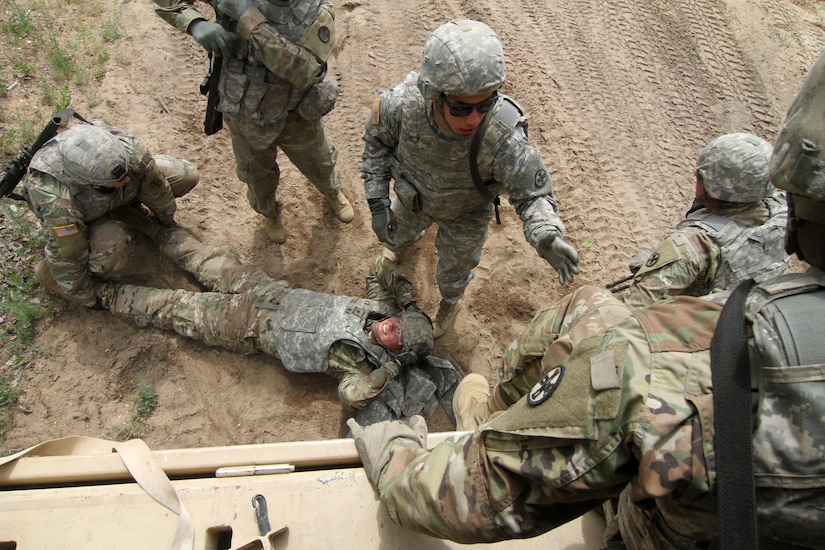
CAMP GRAYLING JOINT MANEUVER TRAINING CENTER, Mich. -- Members of the Ohio Army National Guard practiced their ability to evacuate combat casualties during an exercise here, June 19.

Army Spc. Matthew Sell, an interior electrician with the 1194th Engineer Company, role-played a casualty with a gunshot wound through the chest and a dwindling pulse. Army Spc. Diantre Pressley, a plumber with the 1194th, provided first aid to Sell, while other soldiers provided security and suppressive fire, and radioed a medical evacuation report.

"At first I was nervous," Pressley said. "Then it just kicked in, and I started to go through the steps of what I learned and what I needed to do."

With time working against them, Pressley and the team peeled off Sell's vest to get a better look at the simulated wound. The team continued to communicate their situation to Army Spc. Adam Reeder for the evacuation report, while Pressley began to execute necessary lifesaving measures.

‘There was an Exit Wound’

"I slapped a chest seal on him, and there was an exit wound. So, I put one on his back too," Pressley said. "It's my job to make sure he's good until he gets [additional] medical care."

The soldiers then hoisted Sell above their shoulders into the bed of their tactical vehicle.

"We just changed our technique," Pressley said. "There are certain carries you can do without the vest, so we had to switch to that to get there fast enough and efficiently."

As the truck tires stirred up dust down the rugged trail to the landing zone, Pressley continued to reevaluate Sell's condition and administer care.

As the truck halted, the tailgate dropped, and the team poured out with Sell in tow to await the arrival of a CH-47 Chinook helicopter.

"I just made sure everybody was in the right places," Reeder said. "First establishing our security lines, and then there were some situations where things had changed so we had to quickly reevaluate, reassess and get everybody on the right page."

Casualty Evacuation

After several anxious minutes, the helicopter's beating blades could be heard. Army Spc. Ryan Reneker painted the sky from the middle of the field with his fluorescent yellow safety belt, hoping to be seen by the helicopter’s pilots as they emerged over the tree line.

With a roaring pass, the helicopter looped around and began its descent. The force of the rotor wash, like a tornado, blasted the air with debris, and blowing sand stung exposed skin.

"I really wasn't sure what to expect," Reeder said. "I think some of the new guys didn't expect the sand to come in as quickly and as hard as it did."

Once the dust settled, Pressley and Army Spc. Anthony Romeo collected Sell and rushed toward the waiting helicopter with support from the rest of the team. The silhouette of the helicopter's crew chief greeted them as they crossed the field with Sell to the waiting helicopter.

"My squad relies on me to take care of them if anything would happen," Pressley said. "My training allowed me to properly evaluate him, take care of him and take him to safety."

En Route to Field Hospital

For nearly 15 minutes they soared several hundred feet over the training facilities here. As the Chinook landed, the adrenaline-fueled soldiers flooded from the rear, and -- for one last time -- they held a secure position until it departed.

"When I landed my blood was rushing," Pressley said. "It was good to go fast and really apply our training to something fast-paced like that."

Pleased with their run, the team eagerly mounted their vehicle and returned to celebrate their success and share the news with the other two teams back at the start of the training lane.

"After running through it, I was highly pleased," Reeder said. "The guys did an outstanding job, and I think everybody really enjoyed the whole real-life scenario aspect of it."

"I really appreciated the willingness and motivation of the younger soldiers," said Army Capt. Bryan Andrews, commander of the 1194th.
West Virginia Soldiers Dive Into FEMA Certification Training


By Army Sgt. Zoe Morris, West Virginia National Guard

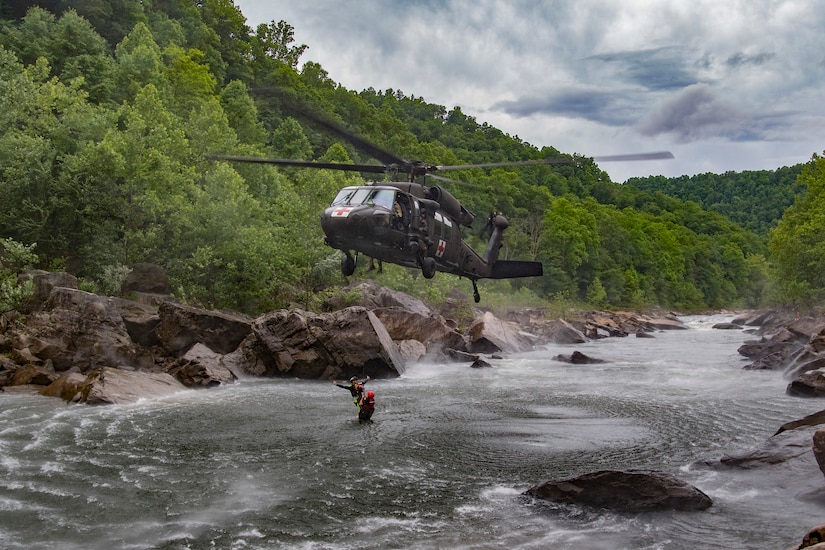
KINGWOOD, W.Va. -- Soldiers from the West Virginia Army National Guard and the West Virginia Swift Water Rescue Team attained the necessary training and certification June 10-13 to identify as a Federal Emergency Management Agency Type 1 swift water/flood search and rescue team within the National Incident Management System, the comprehensive, national approach to disaster response.

On the Cheat River in Preston County, West Virginia, three soldiers from the Swift Water Rescue Team and 18 soldiers from Company C, 2nd Battalion, 104th General Support Aviation Battalion trained on the helicopter underwater egress trainer and a helicopter search and rescue course that encompassed helicopter hoist, tracking victims dow river with a helicopter and deploying a rescuer from the helicopter. The team included pilots, crew chiefs and rescue swimmers.

In addition to the training on the Cheat River, three Swift Water Rescue Team soldiers assisted Spec Rescue, a national search and rescue training organization, in training FEMA urban search and rescue teams from around the country on the New River outside of Fayetteville, West Virginia, June 20 and 21. The training consisted of a boat operations specialist course that taught students how to navigate a boat flip, how to conduct rescues from a boat and how to tether rescue swimmers from a boat.

Important Training

“This [training] is important to the West Virginia Swift Water Rescue Team, as it shows our certification to operate in these flood disaster environments anywhere within the United States,” said Army Sgt. 1st Class Mark A. Shrewsbury, Joint Interagency Training and Education Center WVSWRT noncommissioned officer in charge. “Being recognized as a FEMA Type 1 swift water rescue team gives us the ability to deploy and be recognized at a national level as capable of performing many technical rescue disciplines that could occur in a flood situation, such as helicopter search and rescue, large animal rescue, technical rope rescue, flat water and swift water rescue, to name a few.”

Jimmy Gianato, director of the West Virginia Division of Homeland Security and Emergency Management, said tying aviation rescue to swift water rescue allows this team to operate in a new environment and capacity for the state.

“Our hope is that we can put teams like this all over the state, so that when something happens we’ve got the capabilities and the response time is diminished,” Gianato said. “It’s tremendous training, and we’ve got some outstanding swift water rescue teams in the state. By taking the National Guard capabilities and adding that with those teams, like we’ve done here, I think it will give us the capability that many other states won’t have.”
In the wake of a very active 2017 hurricane season, said Army Lt. Col. Walter Hatfield, the JITEC commander, there was frustration in not being able to deploy to Texas and Florida, due the few lingering certifications needed. But heading into this hurricane and storm season, he added, he is confident that this team is ready to deploy anywhere in the United States and territories to come to the aid of people in need.