Friday, June 08, 2018

DoD Warrior Games Athletes Excited for New Sports


By Shannon Collins, DoD News, Defense Media Activity

COLORADO SPRINGS, Colo. -- Throughout the week here, about 300 wounded, ill and injured service members representing teams from the Army, Marine Corps, Navy, Coast Guard, Air Force and U.S. Special Operations Command, along with allied armed forces from the United Kingdom, Australia, and for the first time at Warrior Games, Canada, have competed in shooting, archery, cycling, track and field, swimming sitting volleyball and wheelchair basketball for gold, silver and bronze medals.

This year, the Department of Defense Warrior Games feature three sports new to the competition: powerlifting, cycling and rowing.

“It was the vision of Air Force leadership and the popular demand of the athletes to include these sports,” said Scott Danberg, DoD Warrior Games sports director since 2015 and five-time Paralympian. “The response has been amazing. Powerlifting was the first of three, and we had a full house.”

He said the rules and regulations were changed with more options to choose from so the athletes could select four individual sports and two team sports in which to compete.

Athlete Response

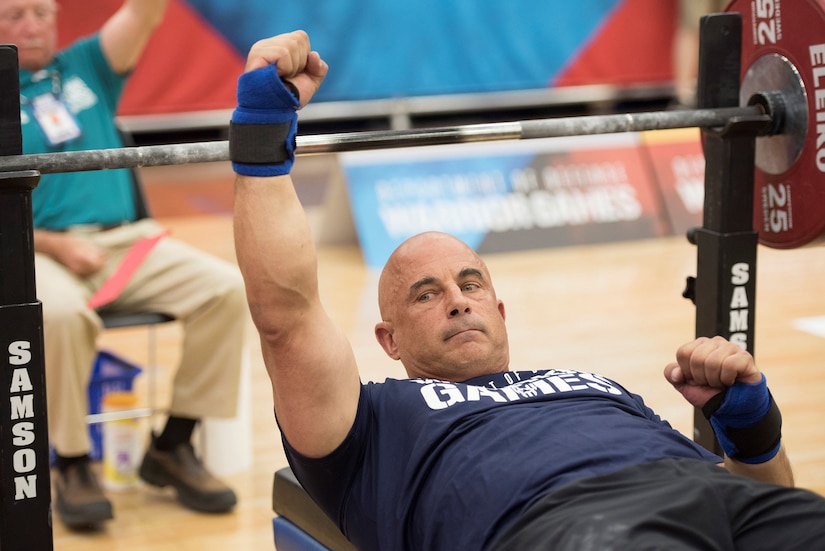
Navy Reserve Senior Chief Petty Officer Joe Paterniti, attached to the Voluntary Training Unit in Everett, Washington, for 32 years, said he’s excited to have the new sports. He competed in powerlifting and the cycling time trial, and will compete in rowing June 9.

“I’ve lifted since I was 15, but I’ve never competed in powerlifting,” he said. “It’s not like the other sports, where you have to learn this really special dance that requires a lot of balance and athleticism, like discus. This is something a knuckle dragger like me could do with no problem.”

Paterniti said the sports also can go hand in hand. “Rowing and powerlifting can both work to increase your lactate threshold and increase your endurance,” he said. “It’s training your mind to being really comfortable with being uncomfortable.”

He said he’s made friends with Marines and Australians, who also compete in powerlifting. “We’re always either pounding fists or giving each other great big hugs. We’ve all got that warrior spirit. We all leave it on the mat,” he said.

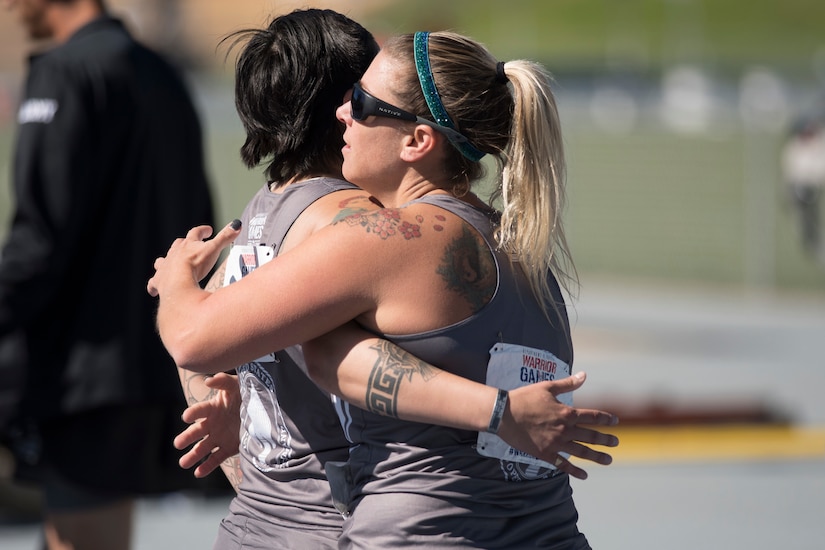
Medically retired Air Force Staff Sgt. Janelle Lykon, an air transportation specialist for 13 years, had a personal best in shot put and earned a gold medal in the women’s 4X100 relay June 2. She earned a bronze medal in powerlifting in the 55-kilogram class June 5 and will compete in swimming tomorrow and indoor rowing June 9.

“We’ve had indoor rowing at the [Air Force Wounded Warrior Program in San Antonio], but it just wasn’t a competition. There’s a bunch of us that are excited that it’s a competition this year,” she said.

Lykon said she had gone to the gym to work out and lift before but had never powerlifted before the San Antonio events.

Variety of Sports

Lykon said she loves that the DoD Warrior Games added new sports, giving the athletes more to choose from. “It’s definitely important to keep these sports. I’d love to see sled hockey someday, even as an exhibition match,” she said. “I play ice hockey now. I’ve been playing for 31 years, so sled hockey would be a joy.”

Jason Melo, a bombardier in the Canadian army has served in the artillery for 11 years. He said he picked powerlifting and indoor rowing because he watched them on television last year when the Invictus Games took place in Toronto. He will also compete in swimming and sitting volleyball.

“I picked my sports based on what I found most intriguing watching on TV, so it’s great,” he said. “There are so many athletes and so many options. It’s great.”

He said he hopes competing in the new sports will help to give him a chance to return to the DoD Warrior Games next year in Tampa, Florida, and a chance to compete in the Invictus Games, scheduled for October in Sydney and in the Netherlands in 2020.

Whether it’s new sports or the sports that have been around since the inception of the games in 2010, Danberg said, the athletes and their families have had fun so far this week.

“The athletes and the families are having the best time that I can recall since the inception of the Department of Defense Warrior Games,” Danberg said.

Special Forces Speedster Takes Gold, Pioneers Female Engagement Teams


By Shannon Collins, DoD News, Defense Media Activity

COLORADO SPRINGS, Colo -- For former Marine Corps Reserve Gunnery Sgt. Tiffany Hudgins, speed is the name of the game.

Representing U.S. Special Operations Command, Hudgins earned 100-meter and 200-meter gold in the women’s competition in her disability category, competed in archery yesterday and competes in swimming today at the 2018 Department of Defense Warrior Games at the U.S. Air Force Academy here.

“I love all the fast things,” she said. The last time she competed in the games was in 2015, where she earned bronze in the women’s 1,500-meter race in her disability category.

Hudgins said she couldn’t leave Spokane, Washington, fast enough as she was graduating from high school so she joined the Marine Corps. She said even though none of her family had served, they were happy to see her join.

“My parents told me they high-fived each other and said, ‘Cool, we don’t have to worry any more. She will have good benefits, good direction, a good outlet for all of her energy,’” she said, laughing.

Female Engagement Teams

For most of her 15 years in the military, Hudgins served as a telecommunications chief, but while she was deployed from 2007 to 2008 with Socom, she worked with a civil affairs team. A grassroots movement that was a precursor of what later would be called female engagement teams, it was called Iraqi Women Engagement.

“We were distinct from the Lioness team,” she said. “They served a very particular surgical purpose. We had the long-term commitment and connection with the community – that was the biggest difference.”

In 2009, the U.S. Marine Corps Forces Special Operations Command officials approached her through her husband, a fellow Marine, and asked her to be the chief of a new team that became known as the cultural support team. Her team went to the Shindand province in Afghanistan in 2010 to support Socom’s Operational Detachment Alpha, or ODA.

“They said, ‘The ODA needs your help. You’re going to go down there and do female engagement for them,’” she said. “We went down to very, very small towns in the Shindand province, where there were a lot of tribal struggles going on. We were helping to kind of break that up. There were a lot of misconceptions about why the ODA was there. Women were scared to even come see them.

“We need that persistent and consistent engagement; it’s critical, Hudgins continued. “You can’t just come in and do a patrol one day and hand out some stuff and move on. We’re their neighbors. It takes a long time. They are a culture that has been built on overcoming occupiers. We’re not here to do the same thing. It was good.”

Injured by IED

During a foot patrol on her Afghanistan deployment in 2010, an improvised explosive device hit directly below Hudgins. “I absorbed all of the blast, and I’m very fortunate to even be here, because it was on a foot trail around a field. The way the blast occurred, it was an up and out, and I ended up falling into a giant hole. I learned all of this second-hand, because I wasn’t conscious for it. It’s crazy what energy will do to your body,” she said.

Hudgins ended up with a traumatic brain injury because of the blast and has balance issues.

Because she and her husband have served multiple combat tours, Hudgins said, she never got to a place where she couldn’t communicate with him if she was having a hard time with doctors or with her recovery. She also continued to train others to continue the cultural support team mission.

Support Agencies

Hudgins said her health care providers, friends at her command and her husband, Bob, encouraged her to go to the National Intrepid Center of Excellence in Bethesda, Maryland.

“It’s the Disneyland of health care,” she said. “I had a neurologist, psychologist, an internist, pharmacologist -- you name it -- there for you and your issues. We did music therapy, art therapy, yoga meditation. And it’s in a very small group of about five to 10 individuals.”

If she ever has any issues as she works at Socom headquarters, she said, visits the care coalition program there. “They’re always very accessible and always there to help. They’re genuinely happy to be there,” she said.

A Special Operator for Life

Hudgins said Socom has made her feel as if she is part of the special operations forces family. “SOF for life -- I wasn’t an operator, but in my capacity in how I served and how I was injured, there was no question Socom was going to be my advocate once I was injured. Socom said, ‘You’re one of us. You got injured under our flag. You’re our person.’ They make you feel like you’re part of the community no matter what capacity you fell under their umbrella. I really appreciate that. It’s a great family feeling.”

As she continues to compete this week with her special operations family, she said, she’s stoked to share that love with the other branches and other countries here.

“I was talking to someone I competed with from the [United Kingdom], and they were so inspired we invited them to come over here -- ‘Heck yeah, you guys served side by side in all these different places. You guys saw the same things we did, and we all have similar issues. It doesn’t matter,’ I told them,” she said. “They are our allied partners. I love the fact that the rest of the commonwealth community is here. We’re all interested in culture [and] asking questions. It’s great.”

Defense Relationship Highlights Mattis Meeting With German Counterpart


WASHINGTON --  Defense Secretary James N. Mattis met with German Defense Minister Ursula von der Leyen at the NATO defense ministers conference in Brussels today to reaffirm the long-standing defense relationship between the United States and Germany, chief Pentagon spokesperson Dana W. White said.

In a statement summarizing the meeting, White said the two leaders discussed a broad range of defense issues, and that Mattis thanked his German counterpart for her country’s recent increase to its contributions to Afghanistan. They agreed on the critical importance of NATO solidarity in the face of increasing threats, she added.

Mattis thanked von der Leyen for her strong leadership, White said, and acknowledged German efforts to increase defense spending while encouraging further defense investment.