Wednesday, May 30, 2018

Maple Resolve Exercise Strengthens Bond between U.S., Canadian Forces


By Joshua Ford, U.S. Army North

WAINWRIGHT, Canada -- More than 3,500 Canadian, U.S., British, Australian and French forces participated in this year's Exercise Maple Resolve, providing an opportunity to enhance multinational interoperability in a brigade-level field training exercise.

U.S. Army North and the Canadian armed forces plan year-round for the Canadian army's Exercise Maple Resolve, the largest allied exercise conducted in North America.

More than 1,300 soldiers from the U.S. Army's active, Reserve and National Guard components participated in the exercise, which was held here May 13-24.

"If we're going to prepare brigade combat teams to go to combat, we want them to be able to train with our allies and train as we fight," said Dave Morrison, Canada branch chief, theater security cooperation division, U.S. Army North. "So if we're going to deploy with our partners, we want to train with them."

U.S. Army North coordinates theater security cooperation activities between the militaries of Canada and the United States to help maintain interoperability and improve both nations' ability to work together during global coalition operations.

‘We Know We Need to be Interoperable’

"There are certain areas where we know we need to be interoperable," said Canadian Lt. Col. Joseph Pospolita, deputy commander, Canadian Manoeuvre Training Centre. "We know communications is something we need interoperability with because that effects how we call in requests for fire and how you coordinate air assets."

Communication isn't the only focus area during the exercise. Other capabilities practiced included command and control of allied forces, logistics operations and personnel processing.

This year was the first time the U.S. Army sent an entire maneuver battalion to the exercise. Other American military assets included military intelligence, aviation, medical, chemical and logistics units.

The 650th Regional Support Group provided command and control of all U.S. forces during the exercise.

"It's good for us to get involved in exercises like Maple Resolve because it's real world versus simulation. We're actually working off demand to provide logistics, the fuel, the ammunition and the food to all forces in the field," said Army Col. Rodney J. Fischer, 650th Regional Support Group commander.

"Every year we look across the force to help identify which units would benefit most in participating in these exercises. We build the requirements at [U.S. Army North], including those from other services like the Marine Corps," Morrison said. "And then we work out how to get them there and what capabilities we need to support them while they're there."

Since the exercise is held in Canada, deploying units there is less resource intensive than sending them overseas to train with allies, but it still provides the experience of deploying to another nation.

Expeditionary Army

"Traveling to another nation for these exercises is good, because the Army is looking to
become more expeditionary, so we have to be able to deploy and project power," Fischer said.

The ultimate goal for the exercise is to certify Canada's high readiness brigade.

After the exercise, 5th Canadian Mechanized Brigade Group will be on standby to answer the call if Canada is put in a situation where it needs to deploy units overseas or within its borders for natural or man-made disasters.

"The High Readiness Brigade is prepped for any operation, whether it be domestic or international," Pospolita said. "If we get a mission overseas and we need a task force or battlegroup to respond, the country would look to the high readiness brigade immediately."

An exercise like Maple Resolve doesn't come without its challenges. Since each nation operates on different systems, getting those technologies to communicate can prove to be difficult.

"The perfect incident would be you could have multiple multination battlegroups or brigades operating where they are, each with different gear, and they seamlessly meld in with our systems," Pospolita said. "Plug and play is exactly where we're going for here."

Old Allies

U.S. and Canadian forces have been working closely together from World War II to Operations Enduring and Iraqi Freedom.

"When it comes to straight operability soldier to soldier, we know how to operate together," Pospolita said. "That's the easy part. Our soldiers know what they have to do in order to accomplish the mission."

"It's important for us to operate at the multinational level because the United States will most likely never go to war alone," Fischer said. "We rely on our coalition partners and working out any issues now makes us that more formidable in the future."

He added, "If we show that capability and our adversaries know that if they do something wrong then the United States and Canadians will be there to protect good.”

Maple Resolve continues to grow each year, bringing together troops from different allied nations and partners.

"It just keeps getting bigger and bigger," Morrison said.

Tuesday, May 29, 2018

Army Military Police, Engineers Prepare for Exercise Saber Strike 2018


By Army 2nd Lt. Sierra N. Ejzak, 18th Military Police Brigade

GRAFENWOEHR, Germany -- Soldiers with the 18th Military Police Brigade and the 15th Engineer Battalion are here preparing to participate in Saber Strike 2018, a multinational exercise.

The exercise will be held June 3-15 at training areas in Estonia, Latvia, Lithuania and Poland, facilitates cooperation and enhances the NATO alliance. This year’s exercise anticipates 18,000 participants from 19 countries.

The 18th Military Police Brigade will be supporting maneuver forces such as the 2nd Cavalry Regiment with movement support and area security. Operations range from joint convoy security with support from allied and partner forces to facilitating river crossings.

The brigade will consist of a military police battalion and an engineer battalion as well as soldiers from U.S. Army Correctional Activity Europe, who have been setting the stage for the exercise. National Guard units from Puerto Rico, Michigan and Indiana will join the brigade, along with partners and allies from seven countries, including the United Kingdom, Poland, Germany and Macedonia.

Tough, Realistic Training

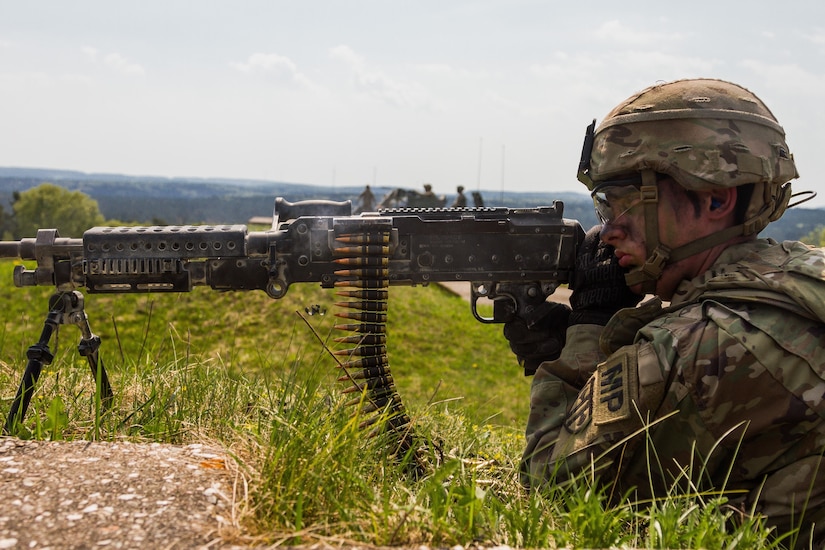
The brigade is preparing for the exercise through tough, realistic training, and by performing a thorough route reconnaissance that identified and marked key infrastructure along routes from Germany through Poland. The 709th Military Police Battalion completed preparations for Saber Strike 2018 with a live-fire exercise that tested the weapons, maneuvering and communications capabilities at each level of the organization.

“The training leading up to this summer has prepared our soldiers to work together almost seamlessly,” said Army 1st Lt. Chad Wanek, platoon leader from the 529th Military Police Company. “We’ve seen a lot of improvement … all the way to the company level. We were able to get after tasks that greatly improve our unit’s readiness, and that’s where we make our money.”

Multiple MP Missions

The military police will conduct law enforcement, border crossing assistance and route reconnaissance missions throughout the exercise.

The 15th Engineer Battalion recently completed the Resolute Castle exercise, and the battalion’s commander, Army Lt. Col. John McNamara, said he was pleased with his unit’s soldiers.

“Resolute Castle has prepared the battalion for Saber Strike by allowing soldiers and leaders to plan and execute mobility and survivability tasks in an unconstrained training area,” McNamara said. “Soldiers built and dug various types of fighting positions and constructed combat roads and trails maximizing the amount of time each soldier operated their assigned piece of equipment.”

USS Manchester Commissioned as Navy's Newest Surface Ship


By Navy Petty Officer 2nd Class Jacob I. Allison, Littoral Combat Ship Squadron 1

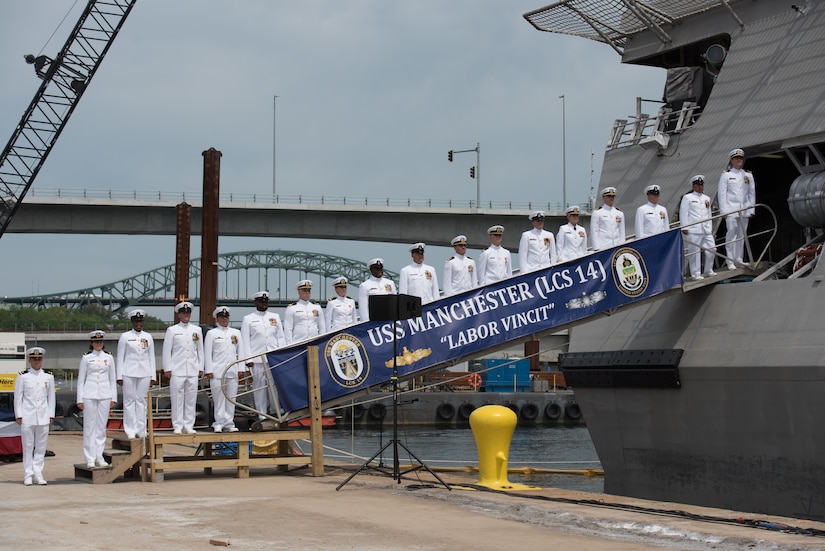
PORTSMOUTH, N.H. -- The littoral combat ship USS Manchester was commissioned as the Navy’s newest surface combatant vessel during a ceremony here, May 26.

The vessel is the Navy’s second ship to be named for the city of Manchester, New Hampshire.

Littoral combat ships are high speed, agile, shallow draft, surface combatant vessels designed for operations in the near-shore environment, yet fully capable of open-ocean operations.

“The faces of the sailors that ran to man this ship are the faces that I’ve seen day after day for the last 22 months as we worked to bring this ship to life,” Navy Cmdr. Emily Basset, Manchester’s commanding officer and a Seattle native, said during the vessel’s commissioning ceremony.

‘Each Sailor is Highly Trained’

Basset added, “They took the city of Manchester's Latin motto, ‘Labor Vincit’ -- work conquers -- and they have personified the spirit of our namesake city. Each sailor is highly trained and must do the duties that three or four would do on another ship. These sailors are reasons to make us all proud.”

The ship’s sponsor, Sen. Jeanne Shaheen representing New Hampshire, gave the traditional order to, “Man this ship and bring her to life,” signaling the sailors to embark and officially begin the vessel’s service as a Navy ship.

For the ship’s crew, the day was the culmination of months’ worth of work to get the Manchester prepared for commissioning. Having the commissioning in the ship’s namesake state was a special opportunity for some of Manchester’s sailors.

“It’s really amazing to be on a ship named for [a city in] my home state,” said Navy Petty Officer 1st Class Laryssa Noyes, an information systems technician from Derry, New Hampshire. “It’s really quite an honor that I’m here for this. It’s awesome because my family got to be here and see what I do on a daily basis.”

After the ceremony, the ship will transit to join Littoral Combat Ship Squadron 1 and eight other littoral combat ships currently homeported at Naval Base San Diego.

Manchester is the 12th littoral combat ship and the seventh of the Independence variant.

Litterol combat ships have the ability to counter and outpace evolving threats independently or within a network of surface combatants. Paired with advanced sonar and mine hunting capabilities, the vessels provide a major contribution, as well as a more diverse set of options to commanders, across the spectrum of operations.