By Sean Kimmons, Army News Service
WEST POINT, N.Y. -- As a young girl, U.S. Military Academy
Cadet Taylor England daydreamed about being in the infantry long before the
Army opened all of its combat arms positions to women.
She wanted to lead troops in combat, shoot weapons and
execute missions -- aspirations similar to those of her male counterparts.
“I wanted to be the person out there doing those things,”
said England, 22, of South Lebanon, Ohio. “I didn’t want to sit back and
relax.”
Her drive and competitive spirit led her to be valedictorian
at her high school and later to the U.S. Military Academy here, where she is a
regimental command sergeant major.
She also is the top-ranked cadet out of 230 others who have
branched infantry. Rankings are based on a cadet’s cumulative performance of
military skills, physical training and academic standing.
In her most recent physical training test, she maxed out at
360 points on a 300-point scale. Her 2-mile run was clocked in at 13:09, just
nine seconds shy of the men’s fastest standard.
“I want to do a job and I want to do it well. It doesn’t
matter that I’m a female,” she said. “I can do the same things a guy can do.”
Sandhurst
To broaden her leadership abilities, England volunteered to
take charge of her company’s team in the Sandhurst Military Skills Competition
last year.
The annual competition pits hundreds of cadets against each
other in strenuous events over two days. While most cadets come from West
Point, there are also teams from other service academies and ROTC detachments
at universities across the country as well as several nations. Her squad ended
up placing in the middle of the 60-squad field.
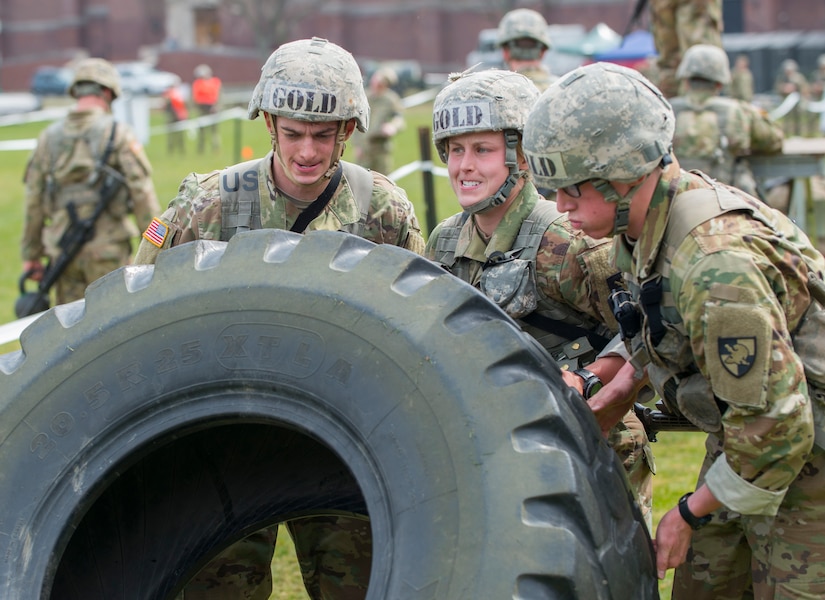
At this year’s competition, which ended April 14, she
decided to go all in. She tried out and earned a spot on the Gold Team, which
handpicks skilled competitors from across the academy. On a team of leaders,
she had the opportunity to learn from others who were as ambitious as she is.
Throughout the competition, she said, there were times where
she leaned on her teammates and vice versa for them to conduct all 11 events in
a timely matter.
“It definitely prepares you to be an infantry officer
because we’re doing infantry tactics,” she said of Sandhurst. “With the leading
part, we all had to step up at different times and take the reins. We left it
all out there.”
In his fourth Sandhurst competition, Cadet Eric Savini said
England helped keep the team motivated when grueling tasks sapped the energy
out of them.
England is typically the first-line supervisor to Savini,
who is a battalion command sergeant major in the Corps of Cadets. But because
of his past knowledge of Sandhurst, he was chosen as the team’s squad leader.
He described England as a cadet who is physically fit and willing to put in the
extra effort to get the job done. “We have been friends for over a year now,”
said Savini, 22, of West Chester, Pennsylvania. “It’s good working with her.”
While their squad failed to win this year’s competition, it
still had an impressive showing with a fifth-place finish out of 64 teams. It
also gave England and her squad a useful lesson on teamwork.
“Working together in a team-oriented [competition] is the
best thing you can experience,” England said afterward. “At the end of the day,
that’s why I do it -- because of the people who I’m with.”
Italy Bound
England’s time at West Point almost did not happen.
Initially, she thought about attending the U.S. Naval Academy until her strong
interest in land warfare eventually sunk that idea.
“I decided to come here, because I would rather be about
leading people than a boat,” she said, smiling.
In her sophomore year, her interest in joining the infantry
grew even more when Capt. Kristen Griest, who later became the Army’s first
female infantry officer, visited the academy. It was 2015, and Griest, along
with Army 1st Lt. Shaye Haver, had just become the first women to earn the
coveted Ranger tab.
A dozen women have now since graduated from the notoriously
difficult Army Ranger School. In fiscal year 2016, for example, more than 4,000
personnel attended the school and only 36 percent of them graduated, according
to Army statistics.
“It definitely lifted your spirits,” England recalled when
both women passed the course.
One day, she said, she hopes to add a Ranger tab to her
uniform, which already has Army parachutist and air assault badges sewn onto
it. If the opportunity to attend the course does come up, she added, it should
not matter that she is a woman.
“I don’t like focusing on that,” she said. “Overall, you go
out there and do what you need to do, and if you’re prepared, you’ll get
through it.”
Until then, England said, she expects to face other
challenges. First, she needs to graduate from the Infantry Basic Officer
Leadership Course. Then, she will be a young lieutenant in the prestigious
173rd Airborne Brigade based at Vicenza, Italy, which is the Army’s contingency
response force in Europe.
As the best Infantry cadet at the academy, she had the first
pick for her duty station. While she sought to receive a posting at the 173rd
brigade, the unit was not yet available to female Infantry officers. Then, in
January, Army Chief of Staff Gen. Mark A. Milley visited the academy.
As Milley greeted cadets at a dinner, he asked England where
she hoped to be posted. She replied, “Italy, sir.” Shortly after, she said,
Italy was opened up to female infantry officers.
“It was pretty awesome,” she said. “The best lieutenants end
up in Italy. It’s definitely going to be a challenge, even if I wasn’t a
female, because of the competition.”
With her dream of being an infantry leader drawing closer,
England said, she remains aware of the difficult road ahead in a male-dominated
career field.
Her competitive nature, though, looks forward to it.
“You just overcome it by being competent and being physical
and showing them that you can do what they can do,” England said. “You’re not
going to shy away from their resistance. You’re going to show them, ‘Hey, I’m
here, and I’m ready to lead soldiers.’
She added, “Once they see enough females who can set the
standard and keep the standard, it will just become like anything else.”






 Posts
Posts

