Friday, April 13, 2018

Officials Detail Combat Aviation Priorities at House Hearing


By Marine Corps Sgt. David Staten DoD News, Defense Media Activity

WASHINGTON, April 13, 2018 — Senior Navy, Marine Corps and Air Force leaders outlined priorities for combat aviation during a House Armed Services Committee hearing here yesterday.

Speaking for Navy and Marine Corps aviation, Navy Vice Admiral Paul A. Grosklags, commander of Naval Air Systems Command, told committee members he believes the DoD budget agreement covering fiscal years 2018 and 2019 is aligned with and supports the National Defense Strategy in rebuilding military readiness while providing a more lethal force.

“The lethality which naval aviation brings to bear in support of our nation's interest will be greatly enhanced by the increase procurement numbers for aircraft and weapons, increased investment in the development of new and advanced capabilities and increased funding of our critical readiness and sustainment accounts,” Grosklags said.

Marine Corps, Navy Aviation Priorities

Grosklags provided aviation priorities for the Marine Corps and Navy.

For the Marine Corps:

-- F-35 Lightning II aircraft procurement and sustainment;

-- CH-53K King Stallion helicopter development and continuation of low rate initial production;

-- Marine air-ground task force unmanned expeditionary capability, also known as MUX;

-- Completion of the H-1 upgrades procurement program featuring UH-1Y “Venom” and AH-1Z “Viper” helicopters, the next generation of Marine Corps utility and attack aircraft;

-- Maintaining lethality of legacy F/A-18 Hornet aircraft.

For the Navy:

-- F/A-18 super Hornet service life modernization;

-- Procurement of F-18 Block III upgrades, F-35’s, E-2 early warning aircraft, P-8 Poseidon aircraft, CMV-22 Osprey aircraft and MQ-4C Triton unmanned aerial vehicles; and

-- Development of the MQ-25 unmanned air system and the next generation jammer.

A critical priority for the Navy and Marine Corps is full funding for aviation readiness accounts, including spares, officials said.

Naval and Marine Corps leaders also told committee members their services are committed to flight safety and are dedicated to reducing the likelihood of accidents.

Marine Corps Lt. General Steven R. Rudder, deputy commandant of the Marine Corps for aviation, told the committee his service is maximizing efforts to prevent aerial mishaps, and taking corrective actions if they occur. More money, Rudder said, is being spent on aircraft maintenance to keep older airframes in good shape.

“We’re giving maximum amounts to our [maintenance and parts] depots; maximum amounts to buy spares, giving max amounts to program managers so they can fix the airplanes,” Rudder said.

The general also said the Marines are stepping up efforts to buy new aircraft to replace older, more maintenance-prone aircraft.

Demand for Air Force Capabilities Grows

The demand for Air Force capabilities continues to grow, as the United States experiences a more competitive and dangerous international security environment, Air Force Lt. General Arnold W. Bunch Jr., military deputy for the Office of the Assistant Secretary of the Air Force for Acquisition, told the committee.

The Air Force is supporting combatant commander requirements in response to growing challenges from Russia, China, North Korea and Iran, in addition to the counterterrorism mission in the Middle East and around the world, Bunch said.

Air Force spending priorities include F-35 aircraft procurement, sustainment and modernization, KC-46 aerial refueler aircraft for their power-projection role, and the B-21 Raider bomber development program, Bunch said. According to the general, these efforts are key to the Air Force so it can answer the nation's call when needed.

“The Air Force must build a more lethal and ready force, strengthen alliances and partnerships and deliver greater, more affordable performance,” Bunch said. “Future wars will be won by those who observe, orient, decide and act faster than adversaries in an integrated way across all domains.”

Bunch said his plan for the Air Force is to drive innovation, reinforce budget discipline and deliver capabilities with greater affordability at the speed of relevance.

“Today's modernization is tomorrow's readiness -- readiness is not static,” the general told the committee. The Air Force, he said, will continue its efforts to bolster readiness, increase lethality and modernize in a cost-effective manner.

Thursday, April 12, 2018

Face of Defense: Airman Recalls Journey to Lose Weight, Join Air Force


By Air Force Airman 1st Class Keith Holcomb 14th Flying Training Wing

COLUMBUS AIR FORCE BASE, Miss., April 11, 2018 — Air Force Airman 1st Class Jacob Davis was overweight and the target of bullies throughout his early high school years.

He decided to make some changes.

“I was tired of being bullied for my weight. I was hanging around the wrong groups, and I needed to change my lifestyle,” said Davis, an aviation resource manager with the 14th Student Squadron here.

‘Working Hard, Eating Right’

After his sophomore year in high school, Davis recalled, he “started working hard and eating right when I could.”

“Now looking back on it, lots of people started encouraging me at school and at home,” he said. “They were proud of me.”

During his high school senior year, Davis realized he didn’t want to become stagnant or lose the progress he was making.

“After changing my life around and looking into the Air Force, I saw they would push me to be better, and it seemed like a good fit,” he said. “A few of my friends were preparing to be Marines and soldiers, and they encouraged me to join, too. I didn’t just want to sit around at a comfortable job and gain all the weight back, so I became very interested in the military.”

Family Support

Davis’ family, which has a history of military service, was very supportive of his decision to join the Air Force, he said.

“My parents were helping me and tried to help push me in the right direction,” Davis said. “My brother was in the Marines, so he was a good influence, as well. Regardless of the help and the shift in my daily life, it was definitely an uphill battle.”

He ran almost every day, took up football, lifted weights with friends and consumed smaller portions of food. And over the next two years he lost weight.

“There was a lot for me to prove. I lost over 100 pounds to prepare for basic training, and I when I got there I was proud to be scoring really high on the physical fitness test,” Davis said.

He said his initial goal was just to complete basic training, but by the end of it he never scored below a 90 percent out of 100 on the physical fitness test.

Parents’ Pride

“My first time home after completing basic, my dad reminded me of how he remembers I couldn’t do a single pushup in the living room,” Davis said. “When both my parents saw my progress, I think that transformed my mindset from pride in my progress to pure determination to keep pushing myself up the hill.”

The effort Davis put into his physical fitness carried over into other aspects of his life, he said. After completing technical training, he was assigned here, where he maintains flight records and validates aircrew safety requirements.

“He works really hard. His work ethic did transfer into his career,” Air Force Airman 1st Class Amiron Cottman, the squadron’s aviation resource manager, said of Davis. “Motivation isn’t a question. When I was gone for two weeks, he took over a lot of the work. It shows in everything he does.”

Davis is always driven to achieve more, Cottman said.
“A lot of what Davis does is to better himself and those around him,” he added. “People like him for his sense of humor and the energy he brings every day. He is proof that working hard can get you where you want to be.”

Oklahoma Guardsmen Participate in Water Rescue Training


By Army Maj. Geoff Legler, Oklahoma Army National Guard

OKLAHOMA CITY, April 11, 2018 — Members of the Oklahoma Army National Guard participated in water rescue training last week over the waters of the Oklahoma River here as part of a newly formed rescue task force.

Oklahoma Task Force One is composed of members of the Tulsa, Verdigris, Norman and Oklahoma City fire departments, along with members of the Oklahoma Army National Guard.

The task force’s firefighters are certified rescue divers and paramedics who filled the roles of flood victims and rescue swimmers during the exercise.

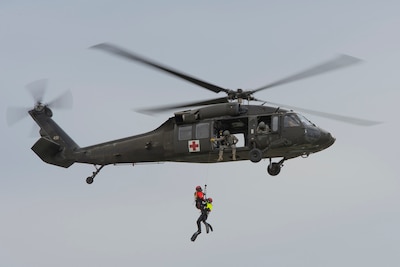
Oklahoma Army National Guard helicopters and guardsmen from Army Aviation Support Facility 1 in Tulsa and AASF 2 in Lexington spent most of the day hovering over the Oklahoma Riversport complex in Oklahoma City, hoisting rescue divers from the Oklahoma River.

Rescue Task Force

Task Force One, which officially began operations in October, specializes in rescuing civilians from deadly situations such as open and rapid water, lost hikers, collapsed trenches, and rooftop and post-natural-disaster rescues, among others.

“[We] are deployable during state/local emergencies and regional to national emergencies similar to what [is] seen during our flood season in the spring, [periods of] heavy storm impact, even up to the hurricanes that we’ve seen as recent as last year in Texas,” said Lt. Josh Pearcy, lead rescue swimmer for the Oklahoma City Fire Department.

Together, the firefighters and National Guard aviators make up what is known as an HSRT, or helicopter search and rescue team, which is overseen, funded and dispatched by Oklahoma’s Office of Emergency Management.

Practicing Rescue Techniques

For this exercise, the Oklahoma Army National Guard employed two UH-60 Black Hawk and two UH-72 Lakota helicopters. The aircrews, along with rescue divers, practiced open-water rescue techniques using both strop harnesses and rescue baskets.

Each rescue diver had the opportunity to play both the rescuer and the rescued and to rotate between each of the helicopters using both the harnesses and baskets.
“Next month we’ll be doing rapid-water training, and [for our] final culmination, we’d like to be doing rapid-water training at night, using night-vision goggles,” said Army Capt. Brandon Files, the Oklahoma Army National Guard’s liaison to Task Force One.