By Navy Petty Officer 1st Class Byron C. Linder Logistics
Group Western Pacific
YAP, Micronesia, April 3, 2018 — Pacific Partnership 2018
marks the 13th iteration of the Navy's humanitarian and civic assistance
mission. It brings together a vast array of military personnel from countries
including the U.S., United Kingdom, Australia and Japan. In each demographic,
you’ll find personnel who are on their first, second, or even third trip to
Micronesia.
But only one participant this year can claim to have the
most firsthand experience with the Micronesian islands. He is Navy Lt. Matt
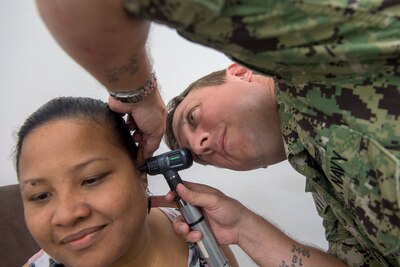
Thomas, an audiologist stationed at Navy Environmental Preventative Medicine
Unit 6 in Pearl Harbor, Hawaii, with 18 years of service on active duty and in
the Navy Reserve.
Seeking a Change
Before joining the Navy, Thomas found himself working for a
baseball team and being less than impressed with the “grunt work” the job
entailed.
“During my breaks, I would read, mostly history. I was a
history major, and I wanted to work overseas when I got out of college, but I
was not doing that. So I put it all together and figured the Navy would be the
way to make that happen,” Thomas explained.
Thomas pursued a career as a surface warfare officer, but it
was during a deployment to Djibouti in 2010 that he began not just a transition
from the reserve to active duty, but also to a whole new field.
“The medical field was my avenue to go from the reserves to
active duty, and audiology offered me the chance to take the prerequisite
courses while I was deployed. I took eight classes that one summer in Djibouti,
applied to every school that I could, and got accepted,” Thomas recalled,
adding he continued to serve in the Navy Reserve while balancing a full-time
class schedule.
Navy Environmental Preventative Medicine Unit 6, Thomas’
command, has a significant operational presence in the Oceana area. But, he
said, it was force of will that got him to Micronesia.
“I had to piggyback myself to missions that were coming out
here. I’d done my research and seen [Micronesia] had, at one time, taken U.S.
dollars to start a newborn hearing screening program for audiology, so that was
the foot in the door when we had a couple of projects in Chuuk,” he explained.
“Two months later, I was in Yap with an entomologist. While he did his work, I
did audiology and reviewed their programs. Since then, there’s certain funding
that comes up for public health works, and myself and a couple of other team
members are the caretakers for that. We go to different states in Micronesia and
determine what their needs are, and I’m also doing audiology, so I’m
dual-hatted in that sense -- working as a provider but also as an advance
planner for public health works there.”
Helping Where Needed
While medical professionals in Micronesia can perform
hearing screenings, Thomas explained that in the event of a patient failing the
screenings, solutions local to the islands are nonexistent.
“There is no audiologist in [Micronesia], period … if the
kids don’t pass, they don’t have the capabilities to do a follow-up diagnostic
test to determine if there’s any damage, or determine the extent. It’s nice to
come in and reassure parents that the kids are fine medically, or if there’s
permanent hearing loss, educate them on what next steps to take. It helps to
educate the teachers as well -- students who may have not appeared to be paying
attention actually can’t hear,” he said.
The effort to bring screenings to more people appears to be
paying off, Thomas said, allowing him to focus on the patients who need him
most. “My first day in Chuuk, I saw 40 people, and averaged 35 per day while I
was there,” he said. “Now I’ll average 12-20 people, and the last time I was in
Pohnpei, I saw six a day -- cases that were earmarked for me to see -- cases
with failed hearing screenings or speech difficulty.”
In addition to the lack of a resident expert, Thomas
identified two environmental factors for hearing loss in Micronesia.
“I see a lot of the hearing loss is due to ear infections,”
he said. “Kids in general are susceptible to ear infections, but when you add
in a warm tropical climate and, in Chuuk especially, the kids are always in the
water -- it’s a picnic for bacteria. Some treatment, if it’s done, it’s not
followed through, or they just don’t stay out of the water. So you see what
could be a temporary hearing loss develop into permanent hearing loss, and
unfortunately I’ve seen that happen a number of times here.”
Thomas noted that while children can usually be treated, the
sands of time are to blame for adult hearing loss.
“The kids I have seen here, I can get them to pass the
hearing screening, but a lot of the adults have permanent hearing loss through
age. They’re not exposed to a lot of the loud noises we have in the U.S., so
that’s typically not an issue we see here,” he said. “The ear infections that
lead to permanent hearing loss are definitely prevalent here.”
Specialists
Audiology is far from the only specialty available among the
personnel taking part in the Pacific Partnership mission, and for Thomas, it is
an incredible reward to see the effect that has on the people they help.
“A big thing for Pacific Partnership is the specialties they
don’t have and can’t sustain. It has a long-lasting impact. I was a surface
warfare officer for 14 years, and none of those deployments were as enjoyable
as this one -- you didn’t have the feel of the impact on the local population,”
he said. “You don’t have the feeling of, ‘I’m affecting lives on a local
basis.’ I became an audiologist in 2015, and I have been begging, kicking and
screaming to go on Pacific Partnership ever since. I finally got on this one,
and I’ve already thrown my hat in to go on next year’s as well.”
For new visitors to Micronesia, Thomas advised that Yap is
far from representative of the islands as a whole.
“See every island you can,” he said. “They’re all different,
and they all have their own features. Yap has great diving, Chuuk has different
diving and Pohnpei has waterfalls that I’ve never seen before. They’re all
friendly, but they’ve got their own unique vibe.”
Pacific Partnership is the largest annual multinational
humanitarian assistance and disaster relief preparedness mission conducted in
the Indo-Pacific. The mission’s objective is to enhance regional coordination
in areas such as medical readiness and preparedness for man-made and natural
disasters.
More than 800 military and civilian personnel from Australia,
Canada, France, Japan, Peru, Singapore, South Korea and the United Kingdom will
join allied and partner nations for the mission. Personnel are embarked aboard
the hospital ship USNS Mercy and expeditionary fast transport ship USNS
Brunswick, working side-by-side with host nation counterparts to be better
prepared for potential humanitarian aid and disaster response situations.




 Posts
Posts

