Monday, April 02, 2018

Face of Defense: Soldier Faces Life’s Challenges Head-On


By Annette P. Gomes U.S. Army Warrior Care and Transition

ARLINGTON, Va., April 2, 2018 — Like the legendary phoenix, Army Spc. Angel Euson is rising from the ashes and getting ready to face her next challenge.

“I can’t even count how many times I’ve wanted to give up. It’s so difficult to not get caught up in any setbacks or “failures” and there have been way too many to count,” said Euson, a combat medic. “However, as cliché as it sounds, ‘I don’t give up.’ is the biggest motto I live by.”

Euson is looking to live that motto at the 2018 Department of Defense Warrior Games, June 1-9 in Colorado Springs, Colorado. She recently competed at the 2018 Army trials at Fort Bliss, Texas, where she won four gold medals in swimming, two in field and one in track and became one of 40 athletes selected to represent the Army at the games.

Excited to Compete

“I’m super excited to go to Colorado! This is such a great opportunity and I feel so blessed to have made the team,” she said.

Her journey to the Warrior Games began when she entered the Warrior Transition Battalion at Joint Base Lewis-McChord, Wash., to heal after being injured. The recovery time brought about many changes for Euson, including introducing her to adaptive sports.

The Florida native said she likes learning new things and adaptive sports fit the bill.

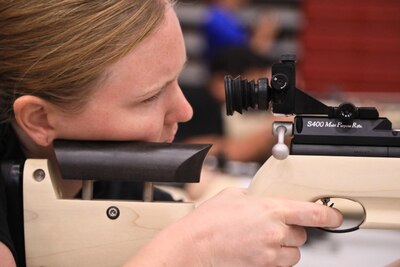
“I was overwhelmed with how many different activities there were. I never thought I would have so many opportunities to try new things,” Euson said. “I played sports my entire childhood, all the way through high school, and now I’m actively involved in swimming, shooting and shot put. Adaptive sports taught me to get outside of my comfort zone and try something new!”

However, she says the biggest lesson she learned was “off the field.”

Adaptive sports, Euson said, provide “a reminder of how far I’ve come in my recovery and how much stronger and happier I am now. The bonds [I’ve] formed and the support I’ve received from my teammates have been incredible.”

Special Operators Conduct Winter Training in Sweden


By Army Staff Sgt. Matthew Britton, U.S. Special Operations Command Europe

KIRUNA, Sweden, April 2, 2018 — Editor’s note: The names of special operations forces members have been withheld due to security concerns.

There’s cold, and then there’s the cold that comes from being above the Arctic Circle -- so cold, in fact, that frostbite can occur within minutes on exposed skin.

However, it isn’t cold enough to prevent special operations forces from operating in the arctic environment.

Airmen assigned to the 352nd Special Operations Wing and Special Forces soldiers assigned to 10th Special Forces Group conducted a winter training course here from February to March 2018.

The training consisted of six weeks of realistic scenarios and classroom instruction.

“The course included classes and practical exercises on survival in a cold weather environment,” a participating airman said. “We also trained [on] movement on skis and snowshoes, advanced snowmobile movements and live-fire ranges. We need to have the ability to employ and project global access, precision strike and personnel recovery across the globe, regardless of environment.”

Combined Training

Combined training and the exchange of information is critical for successful joint military operations.

“Our success relies on interoperability between U.S. and European forces,” said another airman. “We use common practices, but it is invaluable to integrate and train alongside our partners. This allows U.S. forces to gain credibility and build relationships that will continue during future engagements.”

The benefits of surviving and operating in the harsh conditions weren’t the only lessons learned from the course.

“Joint and combined training has been the most beneficial aspect of our trip to the Arctic,” according to another airman. “We have learned several tactics, techniques and procedures and standard operating procedures that we have adopted and trained to. These lessons learned not only add to our survivability, but also increase the lethality of our forces.”

Training in Arctic Conditions

Training in arctic conditions provides the U.S. and its partners the opportunity for future operations and strategic planning.

“The Arctic Circle holds strategic military, economic and geopolitical value,” an airman said. “The intent of our training is to support our European partners across all environments in [U.S. European Command]. The High North provides an opportunity for us to collaborate with partner nations in winter warfare exercises and learn from past and present experiences.”

The training in the unforgiving environment expanded the capabilities of the tactical teams and left them with a new-found respect for the cold.
“Training in the Arctic is a very humbling experience,” an airman said. “In the words of our partner forces, ‘In training, the enemy is simulated. The cold is real.’”

Army Provides Animal Care, Surgeries in Yap During Pacific Partnership 2018


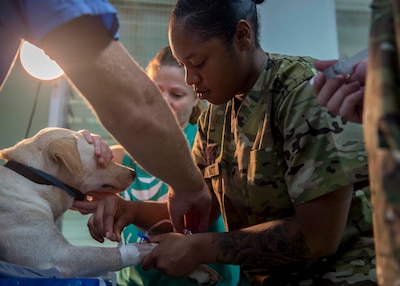
YAP, Micronesia, April 2, 2018 — Two U.S. Army veterinarians and an Army animal care specialist conducted surgeries on dogs and cats and shared knowledge and practices with local volunteers during Pacific Partnership 2018 here, March 26-29.

Veterinarians Dr. (Capt.) Adam Boe from Fort Shafter, Hawaii; Dr. (Capt.) Trevor Tenney from Naval Base Yokosuka, Japan; and animal care technician Spc. Diamond DeWindt from Kadena Air Base in Okinawa, Japan, provided vaccinations and conducted spay and neuter surgeries on nearly fifty animals.

‘We Are Honored to be Here’

“There are no practicing veterinarians in Yap,” Boe said. “The U.S. Army is the only branch of service with clinical veterinarians and we are honored to be here in Yap working side-by-side with local professionals.”

Before conducting the surgeries on March 23, the three veterinarians met with volunteers from the Yap Animal Protection Society to discuss the basics of first aid, euthanizations, preventative medicine, zoonotic diseases, animal husbandry and other common animal medical issues.

“YAPS consists of nearly twenty volunteers dedicated to bringing veterinarians from nearby countries through donations and fundraising campaigns,” Tenney said. “YAPS is a great resource, and we realized that by sharing techniques and practices, YAPS volunteers will be able to better assist veterinarians during surgeries.”

As part of the Pacific Partnership 2018 mission to provide sustainable practices in Yap, the veterinarians shared knowledge to improve and increase efficiency of food production from chickens and pigs through discussions on nutrition, housing and medical care.

“As the animal care specialist, Spc. DeWindt’s expertise in these areas was truly appreciated by YAPS,” Boe said. “Spc. DeWindt encounters every aspect of animal care and she is a vital member of our Pacific Partnership team.”

The veterinarian team also participated in the community health engagement at the Yap Memorial Hospital as part of a team of more than 35 sailors, soldiers and airmen from the United States, the United Kingdom, Australia and Japan.

“The most important aspect that we as visiting veterinarians can do is to provide the necessary education to the local community about animal care so the knowledge and experiences we share together during this year’s Pacific Partnership will last well into the future,” Tenney said.

Since 2006, 22 partner nations around the globe in 18 host nations have participated in Pacific Partnership, providing medical care to more than 300,000 patients, veterinary services to nearly 40,000 animals and completed nearly 200 engineering projects while building meaningful and close partnerships throughout the Indo-Pacific region.