Sunday, March 11, 2018

Face of Defense: Army Logistics Officer Improves Troops’ Quality of Life


By Army Staff Sgt. Scott J. Evans 22nd Mobile Public Affairs Detachment

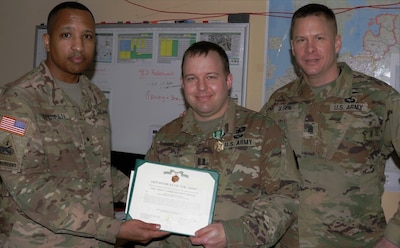
POZNAN, Poland, March 9, 2018 — A Mission Command Element liaison officer assigned to the 21st Theater Sustainment Command was recognized for his contributions to the Atlantic Resolve mission at the MCE headquarters here, Feb. 19.

Army Capt. Jason M. Spalding was awarded the Army Commendation Medal by Army Brig. Gen. William L. Thigpen, deputy commanding general, 4th Infantry Division, for his work to improve conditions for the service members currently serving here.

“Whether its gym equipment or furniture and supplies for our Morale, Welfare and Recreation, Captain Spalding has contributed an incredible amount for the quality of life of this organization,” Thigpen said.

Spalding, who hails from Stuarts Draft, Virginia, is a logistics officer assigned to the 21st Theater Sustainment Command based in Kaiserslautern, Germany. He has been assigned in Europe at different points in his career, and has experience handling what can be tedious paperwork and other administrative requirements that ensure border crossings for cargo and transportation are up to standard.

Spalding has served with 21st Theater Sustainment Command since September 2017 and was assigned as a liaison officer with the MCE in Poznan, Poland, November 2017 in order to facilitate a closer working relationship between the two units.

Supply Coordination

He handles supply coordination between 21st TSC and 4th ID MCE and subordinate brigades ensuring that items such as water, fuel, and ammunition reach training areas throughout the Atlantic Resolve area of operations. He ensures mission accomplishment and improves the quality of life of service members.

During his time at the MCE, Spalding drove approximately 2,500 miles and delivered $1.1 million worth of equipment to subordinate unit locations in an effort to build more capacity, said Army Maj. Christian Gatbonton, the 4th Infantry Division’s MCE transportation officer.

Because of Spalding’s efforts, service members stationed at locations such as the Mission Command Element have been able to maintain physical readiness, said Army Staff Sgt. Brian Pierce, originally from Fort Wayne, Indiana, serving here with the 44th Expeditionary Signal Battalion, 2nd Signal Brigade.

“Being able to have these types of facilities with various types of fitness equipment is definitely helpful with keeping us in shape,” Pierce said.

Due to working in various countries, regulations for U.S. Army Europe can be very different from what supply offices encounter back in the United States. As a liaison officer, Spalding provides the subject matter expertise in areas that fall outside the scope of the typical division supply experience.

Spalding said he appreciates the camaraderie he finds each time he gets the opportunity to serve in Europe.

“I find that soldiers tend to be closer [when serving] abroad than back home,” he said. “It seems that it’s because we have to rely on each other more to get by.”
(Editor’s Note: The 4th Infantry Division transferred authority of the Atlantic Resolve Mission Command Element to the 1st Infantry Division in a ceremony at Poznan, Poland, Feb. 28, 2018. Three years ago, in response to increased regional tensions, the 4th Inf. Div. formed the first Atlantic Resolve MCE, serving as the intermediate headquarters between U.S. Army Europe and U.S. Regionally Aligned Forces deployed throughout the eight eastern European Atlantic Resolve countries of Bulgaria, Estonia, Hungary, Latvia, Lithuania, Poland, Romania and Slovakia.)

Ballistic Missile Defense Remains Focal Point of Juniper Cobra 2018


By Air Force Tech. Sgt. Matthew Plew 48th Fighter Wing

TEL AVIV, Israel, March 9, 2018 — Juniper Cobra is a U.S. European Command bilateral exercise.

The exercise is part of a routine training cycle, designed to improve coordination between the U.S. forces and the Israel Defense Force, through a variety of computer-assisted simulations that range from rocket threats to crisis resupply, foreign disaster response and foreign humanitarian assistance.

However, the focal point of Juniper Cobra remains clear -- to provide integrated ballistic missile defense to counter regional threats to Israel and maintaining U.S. support of Israel's qualitative military edge.

Defense Partnership

"We are proud to welcome our friends and partners," said Brig. Gen. Zvika Haimovich, Israeli aerial defense commander. "Together we will prepare ourselves to meet the challenges of the future."

The U.S. Army has deployed the MIM-104 Patriot air defense missiles – a surface-to-air missile system and the Army’s primary high-to-medium air defense system -- to work in tandem with the IDF's Iron Dome air defense missiles in support of this premier training event.

The Patriot system is designed to provide multitier theater defense against adversary missile threats using peer-to-peer engagement coordination, early warning track data, and battle management situational awareness.

Air Defense System

Similarly, the Iron Dome is the IDF’s mobile all-weather air defense system designed to intercept and destroy regional short-range rockets directed at populated areas.

Each Iron Dome battery boasts a 90 percent intercept success rate. When paired with the Patroit system, they provide Israel with a near impenetrable layer of defense against attack.

“We're training to answer the call," said U.S. Air Force Lt. Gen. Richard Clark, Joint Task Force Israel commander. "The call to defend Israel."

Operating cohesively, U.S. and IDF forces will train over the next two weeks during Juniper Cobra to increase regional security, stability and military readiness.

Saturday, March 10, 2018

DoD Works to Incorporate More Gender Perspective in Operations


By Air Force Tech. Sgt. Chuck Broadway DoD News, Defense Media Activity

WASHINGTON, March 8, 2018 — The Defense Department is advancing its efforts to include more women in peacebuilding and conflict resolution processes following the signing of the 2017 Women, Peace and Security Act.

Mark Swayne, acting deputy assistant secretary of defense for stability and humanitarian affairs in the Office of the Assistant Secretary of Defense for Special Operations and Low-Intensity Conflict, said DoD is looking to leverage the unique aspects women bring to the table, not only in peacebuilding and conflict resolution, but also in all facets of military operations.

“When working with partner militaries or civilians, we are trying to include women so they don’t get overlooked,” he said. “Ensuring that our partners include [female perspectives] makes us more effective in our military operations.”

Research on the effectiveness of including women in military peacebuilding and conflict resolution negotiations found that peace agreements between civil society groups are 64 percent more likely to succeed -- and 35 percent more likely to last at least 15 years -- than agreements that overlooked the female perspective.

Setting the Example

According to the Women, Peace and Security Act, Congress found that, around the world, women remain underrepresented in conflict prevention, resolution, and post-conflict peacebuilding efforts. Meaningful participation of women in these operations helps to promote a more inclusive and democratic society, and is critical to the long-term stability of countries and regions, Congress determined.

To promote these findings, DoD is taking the necessary steps to be a global leader by setting a key example for international partners.

“We have a well-integrated military,” Swayne said. “Many of our allies and NATO partners are the same. But we have many military partners around the world where females do not have the same level of representation.”

Swayne added that when DoD representatives send female officers and senior noncommissioned officers to attend meetings with international partners, it conveys a strong message that females take a high priority within the government and the DoD.

Full-Scale Implementation

DoD leaders are working with the National Security Council on an interagency strategy for incorporating and operationalizing the Women, Peace and Security Act. Once that strategy is finalized, a DoD instruction will be created outlining how to implement women, peace, and security measures into all DoD operations. Swayne said he hopes to have the new instruction in place by the end of 2018.

DoD and the Joint Staff recently instituted a Women, Peace and Security Synchronization Group. This group, consisting of representatives from the combatant commands, military services, regional centers and professional military education institutions, as well as DoD and Joint Staff leaders, meets monthly to enable cross-sharing, optimize lessons learned and best practices, and advance future programs throughout the department.

Combatant commands are already successfully implementing Women, Peace and Security Act objectives through their individual theater campaign plans. These efforts aim to educate personnel on how integrating women, peace, and security concepts increases overall mission effectiveness.

“We are weaving Women, Peace and Security into all training activities, and into the fabric of how we institutionalize DoD objectives,” Swayne said. “It’s an opportunity for us to include women, peace, and security scenarios in every activity we are doing [to become] more effective in our military activities.”