Tuesday, February 13, 2018

Face of Defense: Married Army Paratroopers Serve Together


By Army Spc. Charlton Pope, 173rd Airborne Brigade Combat Team

VICENZA, Italy, Feb. 13, 2018 — Army Staff Sgts. Zachary and Michelle Evans have spent almost their entire military careers together.

They met while in-processing with the 82nd Airborne Division at Fort Bragg, North Carolina, in December 2010, after both had completed Airborne School. They were placed in the same company and platoon. Michelle jokes about Zach having to ask her out on a date three different times before she finally said yes. They have been practically inseparable since.

They deployed together to Afghanistan in 2012 with the 82nd Airborne in support of Operation Enduring Freedom, both earning a Combat Action Badge. The couple were married soon after returning from the deployment.

Both soldiers came into the Army as privates and have risen through the enlisted ranks together. While Zach beat Michelle to private first class, Michelle has beat him to every rank since; however, he has never been far behind her. This competitive spirit has kept them both striving to get to the next level and to be better than they were before.

Deployments to Afghanistan

In 2014, the couple were rotated back overseas for their second deployment together with the 82nd to Afghanistan. During this deployment, Michelle won the Sgt. Audie Murphy Board.

After returning from the deployment, the couple were posted to Italy with the 173rd Airborne Brigade Combat Team, heading to the Brigade Support Battalion. While serving in Italy, they both attended Jumpmaster School, failing together the first time. They were able to attend again soon after; this time, Michelle passed, but Zach would have to attend one more time.

As they gained experience as jumpmasters, the couple neared the requirements for their Senior Parachutist Wings. Michelle had been setting up manifests for jumps and assigning jumpmaster duties. She worked out a way for them to get the last jump needed for their senior wings together. This was one of only two jumps they shared together. Their first jump together was at Fort Bragg as privates. Their last was on Jan. 19, 2018, where they pinned on their Senior Parachutist Wings.

Instructor Duty

The Evans’ will next serve together at Fort Leonard Wood, Missouri, to be advanced individual training instructors. They are both looking forward to working in a new location and to teaching new soldiers. Zach says that he has always had a passion for instructing soldiers and passing down his knowledge. They are also excited about starting a family together. In September, they welcomed their first child, Elliot. They’re very joyful about starting this new chapter in their life.

Monday, February 12, 2018

Marine Reservists Battle Elements at Winter Break ‘18 Exercise


By Marine Corps Cpl. Dallas Johnson Marine Forces Reserve

CAMP GRAYLING, Mich., Feb. 12, 2018 — Marine Corps Reservists with Fox Company, 4th Tank Battalion, 4th Marine Division, are testing their ability to conduct operations in the deep snow and extreme cold of the harsh northern Michigan winter here during Exercise Winter Break ‘18, Feb. 6-14.

This was the first time the tank company, which is based at Camp Lejeune, North Carolina, conducted training specifically designed to improve their ability to operate in cold weather environments.

“Especially for Fox Company, this training gives us something else to work on outside of Camp Lejeune,” said Marine Corps Gunnery Sgt. Kyle Lloyd, the company’s master gunner. “It tasks us to an environment the Marines don’t normally operate in.”

The Marines began with land navigation, formations, night driving and a class on concealment and camouflage, which is more challenging in a snowy environment, particularly for an armored vehicle as large as the Abrams M1A1 tank. Throughout the week, Marines advanced to platoon offensive and defensive operations, then company level operations.

For many of the Marines taking part in the exercise, battling the cold was only part of the experience.

‘Different Environment’

“Being out here is definitely cold, but it gets us out and into a different environment,” said Marine Corps Sgt. Michael Colbert, a tank crewman. “We’re able to challenge ourselves on how we operate as a unit. Whether it’s hot, cold or raining, it doesn’t matter what the environment really is. Here in the Marine Corps, you learn how to lead, how to organize and be productive.”

Friction was built into the training exercise, but there were also unexpected challenges.

“Cold weather affects everything we do,” said Marine Corps Capt. Andrew Bender, the company commander. “In short, it has to be more deliberate. A lot of what we do is limited by weather that routinely gets down to single digits or below zero. In addition, the thought process -- simply thinking and responding to unknown uncertainties, friction points and chaos tends to be slower in Marines who aren’t acclimatized to an environment of such an extreme nature.”

Winter Break ‘18 was also an opportunity for Marines to validate their cold weather equipment. The M1A1 tank uses rubber pads on the track to provide adhesive friction. But the rubber pads lose traction under icy conditions in steep terrain, just like automobile tires lose traction on icy roads in winter. The Marines installed "ice cleats" on every fifth shoe of the track of their M1A1 tanks to give more "bite" and to provide traction on icy and hilly terrain.

Fox Company, a Marine Corps Forces Reserve unit, regularly trains with and augments 2nd Tank Battalion, 2nd Marine Division, which is also located at Camp Lejeune.

“For the bigger picture, for the Marine Corps, this is allowing us to go through and validate the training and readiness standards for the tank community for both Reserve and active-duty Marines,” Lloyd said. “We’re ensuring that not only are we training Reserve Marines to what ongoing threats are, but we’re showing the active component what’s going on as well.”

Air Force Maintainers Keep Flight Line Running


By Air Force Senior Airman Abby L. Finkel 48th Fighter Wing

ROYAL AIR FORCE LAKENHEATH, England, Feb. 12, 2018 — Getting a multimillion-dollar F-15 Eagle aircraft safely airborne and back down again takes coordination across many different career fields.

On the ground here and operating behind the scenes, the 48th Equipment Maintenance Squadron aerospace ground equipment airmen are one of the integral pieces of this puzzle.

"We have a saying, '[There’s] no airpower without ground power,'” said Air Force Senior Airman Eric Alaniz, a 48th EMS aerospace ground equipment journeyman.

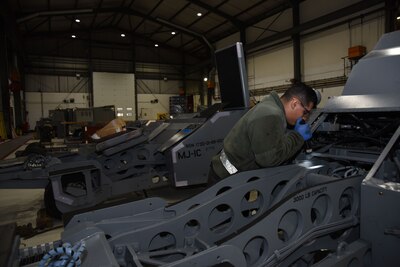
AGE airmen maintain equipment such as generators, heaters, floodlights and bomb lifts, which are essential for crew chiefs and other flight line airmen to do their jobs.

‘We Take Care of the Equipment Used on the Flight Line’

"We take care of the equipment used on the flight line,” said Air Force Airman 1st Class Hannah Christensen, 48th EMS AGE technician. “We maintain it, we inspect it and, when it breaks, we fix it.”

One of the important aspects of maintaining well-functioning equipment involves completing biannual inspections. The inspections allow AGE airmen to proactively find and fix potential issues before they become problems, thereby keeping all of the equipment in top working order.

"There's periodic inspections, Phase One and Phase Two,” Christensen said. “In a Phase One, it's usually just checking all the filters and looking over each part of the unit and making sure it's good. Phase Two will take multiple days, because you have to be very thorough."

Keeping the equipment in good condition allows AGE technicians to ensure that flight line airmen, such as crew chiefs, always get the equipment they need to take care of the 48th Fighter Wing’s aircraft.

“We can’t do our job without AGE,” said Air Force Senior Airman Joseph Rogel, the 494th Aircraft Maintenance Unit crew chief. “We have to do [operations] checks for every flight that we do. Without the proper equipment, that job can’t get done.”