By Army Col. Richard Goldenberg New York National Guard
SARATOGA SPRINGS, N.Y., Feb. 1, 2018 — During World War I,
when African-American National Guard soldiers of New York’s 15th Infantry
Regiment arrived in France in December 1917, they expected to conduct combat
training and enter the trenches of the western front right away to fight the
enemy.
However, at first, the African-American troops were ordered
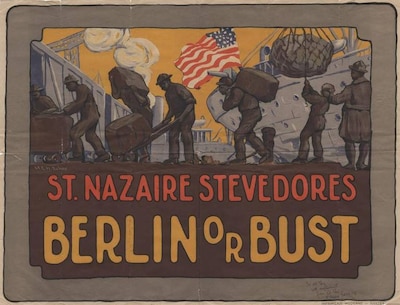
to unload supply ships at the docks for their first months in France, joining
the mass of supply troops known as stevedores, working long hours in the port
at St. Nazaire.
More than 380,000 African-Americans served in the Army
during World War I, according to the National Archives. About 200,000 were sent
to Europe. But more than half of those who deployed were assigned to labor and
stevedore battalions. These troops performed essential duties for the American
Expeditionary Force, building roads, bridges and trenches in support of the front-line
battles.
Preparing Docks, Railway Lines
In St. Nazaire, the New York National Guard soldiers learned
they would work to prepare the docks and railway lines to be a major port of
entry for the hundreds of thousands of forces yet to arrive in France. The
African-American regiment was a quick and easy source of labor, according to
author Stephen Harris in his 2003 book "Harlem’s Hell Fighters."
“First, [Army Gen. John J.] Pershing would have a source of
cheap labor,” Harris wrote. “Second, he wouldn’t have to worry about what to do
with black soldiers, particularly when he might have to mix them in with white
troops.”
But the 15th Regiment’s soldiers had not signed up for
labor. They were committed to fighting the Germans and winning the war.
“They had no place to put the regiment,” said infantry Capt.
Hamilton Fish, according to the Harris book. “They weren’t going to put us in a
white division, not in 1917, anyway; so our troops were sent in to the supply
and services as laborers to lay railroad tracks. This naturally upset our men
tremendously.”
Regimental Commander Fights for Troops
The regiment’s best advocate to get into the fight was their
commander, Col. William Hayward.
“It was time for us to try to do something towards
extricating ourselves from the dirty mess of pick-swinging and wheel barrel
trundling that we were in,” Hayward had said to Capt. Arthur Little, commander
of the regimental band, according to Jeffrey Sammons in his 2014 book
"Harlem’s Rattlers and the Great War."
“We had come to France as combat troops, and, apparently, we
were in danger of becoming labor troops,” Hayward said.
Hayward argued his case in a letter to Pershing, outlining
the regiment’s mobilization and training, and followed up immediately with a
personal visit to Pershing’s headquarters.
Band Helps Sway Opinion
He would bring with him the regiment’s most formidable
weapon in swaying opinion: the regimental band, lauded as one of the finest in
the entire Expeditionary Force.
While the regiment literally laid the tracks for the arrival
of the 2 million troops deploying to France, the regimental band toured the
region, performing for French and American audiences at rest centers and
hospitals. The 369th Band was unlike any other performance audiences had seen
or heard before, Harris noted. The regimental band is credited with introducing
jazz music to France during the war.
The military band would frequently perform a French march,
followed by traditional band scores such as John Philip Sousa’s “Stars and
Stripes Forever.”
“And then came the fireworks,” said Sgt. Noble Sissle, band
vocalist and organizer, in the Harris account, as the 369th Band would play as
if they were in a jazz club back in Harlem.
After some three months of labor constructing nearby
railways to move supplies forward, the regiment’s soldiers learned that they
had orders to join the French 16th Division for three weeks of combat training.
Heading for the Front
They also learned they had a new regimental number as the
now-renamed 369th Infantry Regiment. Not that it mattered much to the soldiers;
they still carried their nickname from New York, the Black Rattlers, and
carried their regimental flag of the 15th New York Infantry everywhere they
went in France.
While the 369th Infantry would become part of the U.S.
Army’s 92nd Infantry Division, it would be assigned to fight with French
forces. This solved the dilemma for Pershing and the American Expeditionary
Forces of what to do with the African-American troops.
The black troops would see combat, but alongside French
forces, who were already accustomed to the many races and ethnicities already
serving in the ranks of their colonial troops.
“The French army instructors literally welcomed their
African-American trainees as comrades in arms,” Sammons wrote. “To the
pragmatic French army instructors, the soldiers were Americans, black
Americans, to be trained for combat within their ranks. The trainees clearly
excelled at their tasks.”
After learning valuable lessons in trench warfare from their
French partners, the soldiers of the 369th finally had their chance to prove
their worth as combat troops when they entered the front lines, holding their
line against the last German spring offensive near Chateau-Thierry.
Acclaimed Fighters
Their value was not lost on the French, and the regiment
continued to fight alongside French forces, participating in the Aisne-Marne
counteroffensive in the summer of 1918 alongside the French 162st Infantry
Division.
The Hell Fighters from Harlem had come into their own, in
spite of their difficult start.
The regiment would go on to prove itself in combat
operations throughout the rest of the war, receiving France’s highest military
honor, the Croix de Guerre, for its unit actions alongside some 171 individual
decorations for heroism.
During the World War I centennial observance, the New York
National Guard and New York State Division of Military and Naval Affairs will
issue press releases noting key dates that affected New Yorkers, based on
information and artifacts provided by the New York State Military Museum here.
More than 400,000 New Yorkers served in the military during
World War I, more than any other state.




 Posts
Posts

