By Lisa Simunaci, Army Materiel Command
MUSCLE SHOALS, Ala., Jan. 9, 2018 — Armed with their
instruments, soldiers with Army Materiel Command’s unit band entered what many
in the music industry consider hallowed ground.
Script lettering over a wood-paneled doorway reads: “Through
these doors walk the finest musicians, songwriters, artists and producers in
the world.”
The decor is dated and sparse, but plaques commemorating hit
records and framed photos of renowned recording artists welcome visitors to
Fame Studios. Within these walls, the legendary Muscle Shoals sound
reverberates.
‘The History Here is Just Incredible’
“The history here is just incredible,” AMC Band Commander
Army Chief Warrant Officer 4 James Bettencourt said. “All of us as musicians
had a hero or somebody we grew up listening to, and it’s almost guaranteed they
recorded somewhere here in this town. Every musician has their own story -- and
I think before each of our soldiers settles in to do their craft, they stop for
a second to take it all in and appreciate where we are and what we’re actually
doing.”
Bettencourt is the third warrant officer to lead the band
since it came to its Redstone Arsenal home, and he will also be its last. The
band is among several across the service slated for inactivation next fiscal
year.
Dwarfed by the photos of his own musical heroes, Bettencourt
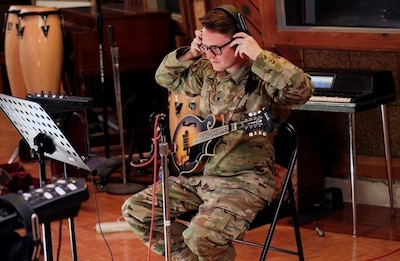
stepped inside Fame’s Studio A, where his soldiers were ready to stake their
own place in musical history. The AMC Band was capturing its sound and marking
its legacy with several recordings in Muscle Shoals. The musical collection,
which will be available to the public, will be the lasting testament to the
band’s time in the Tennessee Valley.
The band came to Redstone Arsenal in 2011, moving with the
Army Materiel Command headquarters as a result of the 2005 Base Realignment and
Closure. While the headquarters moved from Fort Belvoir, Virginia, the band
transferred from Aberdeen Proving Ground, Maryland.
Community Performances
Since the band arrived in Huntsville, it has integrated with
the community and has made a tradition of connecting with local talent. Playing
upward of 300 performances a year, it is common to see members of the
community, university musicians and other local groups performing alongside the
uniformed band members at public performances.
Building on the band’s tradition of community involvement,
Bettencourt reached out to both fellow musicians and the legendary Muscle
Shoals music community to pitch in on a project that will live on, long after
the band is gone.
Over the period of several months, the band collaborated
with top talent, including the Army Field Band’s acoustic group, the Six String
Soldiers; Oakwood University’s famed Aeolian choir; and country and bluegrass
legend Ricky Skaggs. The final result will be recordings engineered at Muscle
Shoal Sound, Wishbone and Fame Recording Studios.
On a September day, when the Six String Soldiers were in
town to lay down tracks for a cover version of "Country Roads,"
engineers at Fame Recording Studios quietly acknowledged the abnormality of the
situation.
“This is the day the Army invaded Fame Studios,” said
singer, songwriter and producer Michael Curtis.
Skilled soldiers riffed on guitars, plucked a bass and
strummed banjos and mandolins as they took in the surreal setting.
Overlooking the studio from behind the soundproof glass of
the elevated control room, sat Jimmy Johnson -- an original member of The
Swampers. A black baseball cap that says “Muscle Shoals” covered his gray hair,
and reading glasses settled loosely in his T-shirt pocket.
Army Veteran
To his knowledge, Johnson said this is the first time an
Army band has recorded in Fame. And for him, the time communing with the
soldiers brings back his own military memories.
“I was in the Army in the ‘60s,” Johnson said. He went to
basic training and spent six months in the National Guard. “That was enough for
me. I was a 120-day wonder.”
Johnson spent much of that decade playing guitar with the
likes of Aretha Franklin and Wilson Pickett and engineering tracks for groups
like the Rolling Stones. After more than a half-century of success in the music
business, Johnson credits his short stint in the Army for teaching him
discipline.
“I still fold my socks the same way,” he said.
The respect and admiration the soldiers expressed during
their time in Muscle Shoals, Johnson said, is mutual. Assisting the AMC Band
form its lasting legacy is a point of pride for the producer.
“They say they’re honored to be here,” Johnson said. “That
definitely goes both ways.”





 Posts
Posts

