Friday, December 08, 2017

DoD Salutes Acquisition Workforce at Pentagon Ceremony


By Terri Moon Cronk DoD News, Defense Media Activity

WASHINGTON, Dec. 7, 2017 — The Defense Department honored 17 individuals and two organizations within the department’s acquisition community yesterday in the Pentagon’s Hall of Heroes.

Deputy Defense Secretary Patrick M. Shanahan, who hosted the 2017 Defense Acquisition Workforce awards ceremony, said the 165,000 acquisitions professionals within the Defense Department comprise a group that gets things done behind the scenes.

“Today is about recognizing the strength that we’ve built up in … acquisitions,” the deputy secretary said.

“In 2016, we did 269,000 contracts. That’s unbelievable,” Shanahan said. “All of you in the acquisition system… are simultaneously improving it.”

Congratulating the awardees, he said, “You’re an inspiration to those of us who are new to the Pentagon. You’re the people we’ll go to and listen to, and you’ll help [DoD] become even more competitive than we are today.”

Ellen M. Lord, undersecretary of defense for acquisition, technology, and logistics thanked the award winners and told them, “You’re making a difference both here in the Pentagon, to our nation, and to all of our allies and partners around the world.”

Winners in the individual achievement awards category are:

-- Skip Hinman, Air Force, requirements management;

-- Marine Corps Gunnery Sgt. Tamalia Adams, acquisition in an expeditionary environment;

-- Melissa Panarelli, Defense Contract Audit Agency, auditing;

-- Gary Trimble, Navy, contracting and procurement;

-- Wilson Rosa, Navy, cost estimating;

-- Air Force Lt. Col. Andrew Vrabec, Air Force, earned value management;

-- Daniel Carroll, U.S. Southern Command, engineering;

-- Valerie Clinkenbeard, Army, facilities engineering;

-- Jeffrey Martin, Air Force, financial management;

-- Michael Cirillo, Marine Corps, information technology;

-- George Graham Jr., U.S. Special Operations Command, life cycle logistics;

-- Navy Capt. Charles Stuart, Navy, production, quality and manufacturing;

-- Marine Corps Lt. Col. Thomas Atkinson, Socom, program management;

-- Charles Bass Jr., Army, science and technology manager;

-- Ulises Cartaya, Socom, services acquisition;

-- Lee Rosenberg, Missile Defense Agency, small business; and

-- Thomas Sachse, Navy, test and evaluation.

Winners in workforce development innovation awards are:

-- Large organization: Defense Contract Management Agency, Fort Lee, Virginia; and

-- Small organization: U.S. Army Contracting Command, Orlando, Florida

Safeguarding Against Workplace Violence


By Elaine Sanchez Brooke Army Medical Center

JOINT BASE SAN ANTONIO-FORT SAM HOUSTON, Texas, Dec. 7, 2017 — Army Capt. Katie Ann Blanchard ran into trouble with her civilian employee from the start. He was combative, defiant and at times, explosive.

“I kept telling myself it will get better,” the Army nurse said.

Instead, it got worse. Clifford Currie grew erratic and aggressive, to the point where Blanchard feared for her life. Today, she bears the scars of his final violent act, when he doused her with gasoline and lit her face on fire while standing by her desk at work.

Blanchard is just one of the over 2 million victims of workplace violence reported each year, according to the Occupational Safety and Health Administration website. The Department of Defense defines workplace violence as “any act of physical violence, threats of physical violence, harassment, intimidation, bullying, verbal or nonverbal threat, or other threatening disruptive behavior that occurs at or outside the work site.”

A Downward Spiral

Blanchard never expected her life would so quickly derail after becoming a first-time supervisor of 15 military and civilian employees at Munson Army Health Center in Kansas. After identifying issues, she encouraged Currie to improve his work performance to ensure the best care of his customers. However, in time, the young lieutenant became alarmed by Currie’s defiance of authority and lack of willingness to improve on the job.

“One day he lost his temper, cornered me and started shouting,” she said. “I was fortunate I was able to call for help.”

Blanchard consulted with civilian personnel and her leadership and started keeping copious notes and records about Currie’s behavior. She placed him on a performance improvement plan but the situation continued to worsen. “He was blowing up twice a day or not coming into work,” she said.

Various events in the workplace can trigger workplace violence including “anger over disciplinary actions, loss of a job, or disagreement with policy or practices,” according to the newly released Regional Health Command-Central Workplace Violence Guide.

Warning Signs

Warning signs of potential workplace violence can include aggressive behavior, conflicts with co-workers or supervisors, statements showing fascination with workplace violence incidents, statements indicating desperation over finances or family issues to the point of suicide, direct or veiled threats of harm, substance abuse, and extreme changes in normal behavior. It can be difficult to determine whether or not a situation will escalate; however, it’s better to “err on the side of safety,” the guide notes.

If there’s any suspicion a situation will escalate, people should notify the employee’s supervisor or other leader as soon as possible, the guide advises. Supervisors should take these concerns seriously and consult with experts, to include the threat assessment team and the human resources department.

“One common thread exists in preventing workplace violence: strong leadership,” the guide notes.

“Supervisors play a key role in recognizing potentially violent situations and taking proactive measures to reduce the negative impact of such incidents.”

Best Course is Prevention

Overall, the best method to end workplace violence is early prevention. To start, agencies should implement a “sound” prevention plan, the guide recommends. This should include required training for employees and supervisors on the signs of and reporting methods for workplace violence, the role of the multidisciplinary threat assessment team, and resources such as Alternative Dispute Resolution and the Employee Assistance Program.  

While she’d seen and reported the warning signs for months, Blanchard didn’t have time to react the afternoon Currie approached her at work. She had just texted her husband that she was heading home for family time with her three young sons when he walked into her office.

She saw the plastic bottle filled with a brownish-tinged liquid in his hand and felt a sudden rush of fear. As she stood up to run, he threw the liquid in her face and tossed two lit matches at her. All she saw was flames. “I thought I was going to die,” said Blanchard.

Currie continued his attack, stabbing at her with scissors, until Blanchard’s colleagues were able to subdue him.

Road to Recovery

A year later, Blanchard continues to recover, cherishing her time with her family. She has become an advocate for workplace violence prevention, especially the need for education and awareness among supervisors. She’s a key member of the newly formed RHC-C Workplace Violence Working Group, which is taking swift action within the region to add more security to military healthcare facilities and working to institute workplace violence prevention education for supervisors and employees.

Blanchard shares her message every chance she gets alongside fellow victim Army Capt. John Arroyo.

A Fellow Survivor

Arroyo was blindsided by a workplace incident in 2014 at Fort Hood, Texas. The Green Beret, who weathered three deployments unscathed, had just stepped out of his car at brigade headquarters when Army Spc. Ivan Lopez pulled up and shot Arroyo in the neck from about 15 yards away. Driven by thoughts of his family, Arroyo held his neck to staunch the bleeding, pulled himself to his feet and began searching for help. At that moment, Lopez walked right by Arroyo without seeing him, an act the Green Beret credits to God.

Lopez killed three people and wounded 15 others that day before turning the gun on himself.

Arroyo was told he’d never speak again, but he overcame the odds and today uses his voice to encourage others who are dealing with adversity and the aftermath of violence.

While he is healing physically, Arroyo said the tougher part was the emotional healing, which is tied to his faith and ability to forgive.

“I love the man who shot me and I love his family,” he said. “People are surprised to hear that but I mean it. God picked me up off the ground that day and restored my life for a reason.

“Both Katie and I plan to use our second chances for good.”

A Message of Hope

Earlier this month, Blanchard’s attacker was sentenced to 20 years in prison without chance of parole. But this news did not signal an end to Blanchard’s journey. She and Arroyo hope to team up to share their stories and message of hope across the military and civilian sectors.

“If I can help prevent even one workplace violence incident from happening,” she said, “then my pain will have been worth it.”

Sailors Honored at USS Utah Ceremony


By Navy Petty Officer 2nd Class Gabrielle Joyner, Navy Public Affairs Support Element Detachment Hawaii

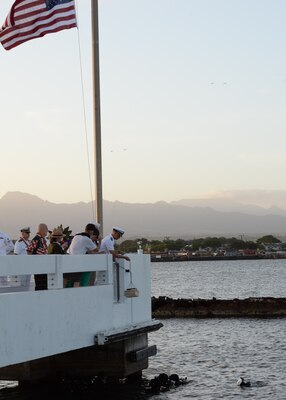
PEARL HARBOR, Hawaii, Dec. 7, 2017 — A sunset ceremony is held here every year to pay tribute to the crew of the battleship USS Utah, and often, to inter the ashes of recently deceased sailors who survived the ship’s sinking 76 years ago, so that they may be reunited with their shipmates already entombed inside the sunken vessel.

Service members, families and friends gathered at sunset around the USS Utah Memorial on historic Ford Island to honor victims of the Pearl Harbor attacks with a ceremony and interment service yesterday.

“Each year we gather to honor the 58 sailors who lost their lives when the USS Utah was hit by two Japanese torpedoes, one of the first ships to go down in Pearl Harbor that day, and we remember their sacrifice,” said Jacqueline Ashwell, superintendent of the World War II Valor in the Pacific and Honouliuli national monuments.

Ashwell opened the ceremony by recounting the harrowing story of Peter Tomich, a sailor stationed onboard the Utah at the time of the attack.

“We remember the valor of men such as Peter Tomich, who, after realizing the ship was capsizing, did not run for safety, but instead decided to stay at his post. He knew if he could stabilize the boilers, a lot of people would be able to escape with their lives,” Ashwell said. “So he stayed and allowed for others to go on to fulfill long lives. Today is particularly special. Today we celebrate the lives of two men who were able to escape the capsizing of the ship that you see behind me, thanks to the teamwork of Tomich and other shipmates.”

‘He’s Home’

This year, Lt. Cmdr. Clark J. Simmons and Aviation Machinist’s Mate Harry Hohstadt were interred. Both crewmen rose to the challenge and overcame great obstacles that day and in the years that followed.

“My dad loved Pearl Harbor and he loved the USS Utah. He brought me here for the first time when I was very young,” said Claudette Simmons, daughter of Clark Simmons. “When I look at this place, I know he’s home, and I know that God has him now.”

Simmons joined the Navy in 1939, a time when segregation was in full effect, making it difficult to move ahead in many career fields, including the Navy. He did not let this deter him from his goals. He received a Purple Heart after being shot by Japanese aircraft during his escape from the Utah, and after serving for 29 years, retired from the Navy as a lieutenant commander.

Hohstadt was also no stranger to adversity, being the youngest of nine children during the Great Depression. After the assault on the Utah, he saw action in many subsequent battles, including the pivotal struggle for Guadalcanal in November 1942. After being honorably discharged from the Navy, Hohstadt went on to start a large family, and owned his own business for 40 years.

“My dad would have been especially impressed with the young people, because he loved to see young people go into the service and serve their country,” said Hohstadt’s daughter, Teresa Teague. “He also would have been quite taken with the officers because he was enlisted, and to see all the officers here to honor him, he would have been quite taken by their support.”

‘Steadfast’ Loyalty

During the ceremony, Ashwell recognized one more sailor, who has also volunteered to rise to a unique challenge presented at Pearl Harbor. Jim Taylor, a retired master chief, was honored for his work as a volunteer liaison and friend to the Pearl Harbor Survivors and their families for many years.

“Today, we also would like to honor the man that does the honors, a man who has been here for 20 years, steadfast, to honor all of those who choose to return to Pearl Harbor when they die,” Ashwell said. “For the past eight years, Jim Taylor has been here to coordinate events for our Pearl Harbor survivors and ensure that the USS Utah is not a forgotten ship. The employees of the U.S. National Park Service have enjoyed partnering with you over all these years, and we have learned a great deal from you as well. We will continue in this partnership to ensure that the USS Utah is never a forgotten ship. That is our promise, that is our vow.”

The 76th anniversary events of the attacks on Pearl Harbor and Oahu, co-hosted by the U.S. military, the National Park Service and the state of Hawaii, will provide veterans, family members, service members and the community a chance to honor the sacrifices made by those who were present Dec. 7, 1941, as well as throughout the Pacific theater.

Since the attacks, the U.S. and Japan have endured more than 70 years of continued peace, a cornerstone of security and prosperity in the Indo-Asia-Pacific region. As a Pacific nation, the U.S. is committed to continue its responsibility of protecting the Pacific sea lanes, advancing international ideals and relationships, and delivering security, influence and responsiveness in the region.