Tuesday, November 28, 2017

King Neptune Cleanses USS Wasp Sailors as They Cross Equator


By Navy Petty Officer 1st Class Jessica Bidwell, USS WASP

AT SEA ABOARD USS WASP, Nov. 28, 2017 — Nearly 900 sailors aboard the amphibious assault ship USS Wasp were "cleansed of their slime" Nov. 25 after participating in the age-old ceremony of crossing the equator.

The "crossing-the-line" ceremony is an exclusive maritime experience from the days of hardened sailors aboard wooden ships courageously venturing out into the unforgiving environment of the open ocean.

The tradition holds that King Neptune, a mythical god of the sea, detects an infestation of "pollywogs" -- those who have not crossed the equator before -- he deems it necessary to take control of the ship to rid it of this plagued condition. A "shellback" is a sailor who has previously crossed the line, and the most senior shellback aboard the ship plays the role of King Neptune in the ceremony.

Navy Master Chief Petty Officer Thomas Kreindheder, who earned the title of shellback in 1993, was King Neptune for the Nov. 25 ceremony.

Ceremony Has Evolved

"The ceremony has changed a lot since I went through," he said. "Our ceremony lasted 48 hours, and it was more of an initiation than a camaraderie event. Our goal with this ceremony was to make sure the sailors were challenged both mentally and physically, but were also smiling and laughing the whole way through. The photos of the event prove that we accomplished that goal."

Wasp pollywogs were guided through a series of physically and mentally challenging obstacles, led by the 137 shellbacks aboard. Upon completion, pollywogs were summoned by King Neptune and his royal court and relieved of their slime, successfully completing their journey to shellback.

'A Cool Experience'

"It was a cool experience," said Navy Airman Apprentice Skyler Senteno. "I was skeptical at first. But there were a lot more events than I thought, and I really enjoyed it. It was an honor to be part of the tradition and become a shellback."

The crossing-the-line ceremony traces its origin to a time when such a feat was a grave undertaking. Today's technology allows sailors to be more at ease with their sea travels, the time away from family, especially around the holidays, can take its toll.

"Ceremonies like crossing the line are invaluable for the crew. They instill pride and a sense of accomplishment that links Sailor to those that have gone before us," said USS Wasp Command Master Chief Petty Officer Greg Carlson. "The ceremony has evolved to over the years to one of teamwork and unity, which allows sailors to craft memories that they will cherish forever."

Wasp is transiting to Sasebo, Japan, to conduct a turnover with the USS Bonhomme Richard as the forward-deployed flagship of the amphibious forces in the U.S. 7th Fleet area of operations.

U.S. Forces Ready to Fight, Win, Says Chairman’s Enlisted Advisor


By Lisa Ferdinando DoD News, Defense Media Activity

WASHINGTON, Nov. 27, 2017 — The military’s top enlisted advisor said today that on the worst day of his military career, he knew he was in good hands with the U.S. armed forces.

“We were pinned down, under fire, and when [we] called for a quick reaction force, I was not worried about what race, what gender, or who the other person was on the other end,” Army Command Sgt. Maj. John Wayne Troxell recalled about the events of July 19, 2007.

That day, his patrol came under attack in Iraq; one of his soldiers, Army Cpl. Brandon Craig, was killed, and another was severely wounded.

“I just knew there was an American voice on the other end that said ‘sergeant major, we’re coming to get you’ -- and that’s the bottom line, and that’s why the U.S. armed forces is what it is today,” he said.

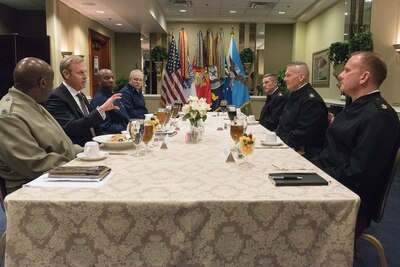
Troxell and the enlisted service chiefs spoke at a Pentagon press briefing following the first day of meetings for the Defense Senior Enlisted Council -- an annual executive-level conference to address issues impacting the joint enlisted force.

Discussions on Enlisted Force

Troxell was joined by Sgt. Maj. of the Army Daniel A. Dailey; Sgt. Maj. of the Marine Corps Ronald L. Green; Master Chief Petty Officer of the Navy Steven S. Giordano; Chief Master Sgt. of the Air Force Kaleth O. Wright; and Master Chief Petty Officer of the Coast Guard Steven W. Cantrell.

“It’s an incredible opportunity for all of us to be here today all at one time to talk about the backbone of our armed forces -- that being our enlisted force,” he said.

Discussions included policy, enlisted leader development and personnel readiness, which includes the manning, equipping and training of forces, especially under the ongoing budgetary constraints, he said.

Despite budgetary and other challenges, the U.S. armed forces remain the world’s premier fighting force, the sergeant major said.

“From an overall perspective, we can say that our U.S. armed forces are always ready to fight and win our nation’s wars,” Troxell said, “but readiness under a resource-constrained environment takes its toll over the years.”

Members across the total force feel the budget constraints, he said. A takeaway from his conversations with troops around the globe is that consistency and predictability -- whether in pay and entitlements, or training and operational deployments -- are factors in keeping morale high.

Despite the challenges, the military is always ready to fulfil its commitments to the nation, he said.

“We absolutely still, as a U.S. armed force, can defend our homeland and our way of life. We can absolutely meet our alliance commitments and support our partners,” Troxell said. “We absolutely have warfighting advantages in every warfighting domain, specifically in the human domain.”

The services are tasked with the monumental job of manning, training and equipping the force to perform warfighting, peacekeeping and humanitarian tasks, he said.

“Our nation depends on our ability to be in the right place at the right time with the right qualities and capacities to protect our nation,” he said.

Human Domain Advantage

The men and women who serve, Troxell said, are the most important aspect of the armed forces.

“We know that without a doubt our people are not only our most valuable resource but they are also our greatest competitive advantage when it comes to fighting and winning our nation's wars,” he said.

Further, how the military educates, develops and empowers its enlisted leaders will be the decisive factor in accomplishing the missions the country asks of the military, the sergeant major said.

Troxell and the combatant command senior enlisted leaders are scheduled to hold a news briefing tomorrow, with a focus on joint operations, global integration and international partnerships.

Monday, November 27, 2017

Proud Navajo Sailor Follows Her People’s Path


By Navy Petty Officer 2nd Class Elesia K. Patten, Carrier Strike Group 11

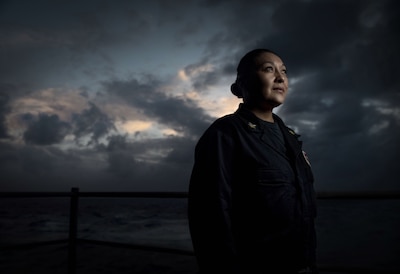
AT SEA ABOARD USS NIMITZ, Nov. 27, 2017 — When Navy Petty Officer 1st Class Denise Alamo introduces herself to other people from the Dine or Navajo tribes in their native language, the introduction translates to: "Hello, my name is Denise. I'm Towering House Clan, born for Tangle Clan, my maternal clan is Salt People, and my paternal clan is Coyote Cross Path."

"In Dine culture, you must know what your four clans are because they make who you are," Alamo said. "For instance, when I introduce myself to another Dine, I would say my clans in the following order: my mother's clan, my father's clan, my maternal grandfather's clan, and paternal grandfather's clan.

A proud Navajo woman, Alamo also is a proud U.S. Navy sailor, assigned to Destroyer Squadron 9 of Carrier Strike Group 11 as an operations specialist. She's serving aboard the aircraft carrier USS Nimitz on a six-month deployment to the Western Pacific. Since 1994, the Navy has reserved November to celebrate and honor Native Americans and Alaska Natives.

Throughout her 18-year career, Alamo said, she has crossed paths with several other sailors who belong to her tribe. Military service is fast becoming a tradition in her family; her brother is serving in the Marine Corps and her grandfather was a Navy Seabee. Alamo said his service motivated her to join the Navy.

"[My grandfather] always talked about traveling and seeing different parts of the world," she explained. "I also wanted to travel. Being a Native American sailor holds much integrity and pride back on the reservation."

Early Life

Alamo grew up on the Dine Nation Reservation, an area near Sweetwater, Arizona. Her family owned two houses; one was near the main road in Sweetwater, and the other was more remotely snuggled in the Carrizo Mountains. During the school year, she said, they lived in the house on the main road. Come summer, the family moved to the isolation of the mountain house, where they herded livestock and raised crops.

"Our nearest neighbor was about a mile away," Alamo said. "That house had no electricity or running water. We had a farm that we maintained during harvest season, and we planted fruits and vegetables such as corn, apricots, grapes, strawberries, watermelon, cabbage, tomatoes and avocados."

Alamo's Navy life and her life on the reservation share some similarities. While deployed, she trades her life on land for a life in a more secluded environment. Just as up in the mountains, the ocean distances her from grocery stores, movie theaters and other home comforts. The many customs and traditions that are so heavily ingrained in the Navy also mirror Alamo's way of life on the reservation.

Her grandparents enjoyed attending ceremonies and traditional dances, so during her childhood Alamo attended many dances, she said. And just as her grandparents ensured the traditions of her people were passed on to her, she added, she proudly passes on Dine tradition to her children.

Proud of Her Heritage

"I'm proud to be Dine, and that I know my language, culture and tradition," Alamo said. "Dine people are also called the 'Holy People'. We have many taboos that we are told to abide by. However, that tradition is dying with the younger generation. I tend to pass on the taboos of our tribe on to my kids along with the folk tales and many stories of Coyote the Trickster. I will also make sure that they know their clans."

Alamo said she draws inspiration and strength from her people, and that she employs them to inspire her throughout her Navy career. A saying in her tribe translates to "In beauty I walk," she added.
"To me this means, 'No matter what obstacles are thrown at you, always strive to better yourself professionally and personally,’" she said.