Monday, November 27, 2017

Proud Navajo Sailor Follows Her People’s Path


By Navy Petty Officer 2nd Class Elesia K. Patten, Carrier Strike Group 11

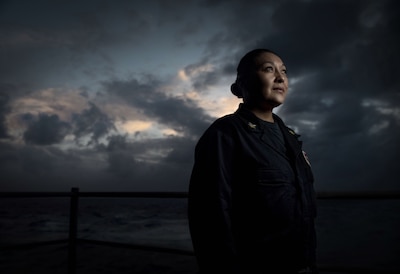
AT SEA ABOARD USS NIMITZ, Nov. 27, 2017 — When Navy Petty Officer 1st Class Denise Alamo introduces herself to other people from the Dine or Navajo tribes in their native language, the introduction translates to: "Hello, my name is Denise. I'm Towering House Clan, born for Tangle Clan, my maternal clan is Salt People, and my paternal clan is Coyote Cross Path."

"In Dine culture, you must know what your four clans are because they make who you are," Alamo said. "For instance, when I introduce myself to another Dine, I would say my clans in the following order: my mother's clan, my father's clan, my maternal grandfather's clan, and paternal grandfather's clan.

A proud Navajo woman, Alamo also is a proud U.S. Navy sailor, assigned to Destroyer Squadron 9 of Carrier Strike Group 11 as an operations specialist. She's serving aboard the aircraft carrier USS Nimitz on a six-month deployment to the Western Pacific. Since 1994, the Navy has reserved November to celebrate and honor Native Americans and Alaska Natives.

Throughout her 18-year career, Alamo said, she has crossed paths with several other sailors who belong to her tribe. Military service is fast becoming a tradition in her family; her brother is serving in the Marine Corps and her grandfather was a Navy Seabee. Alamo said his service motivated her to join the Navy.

"[My grandfather] always talked about traveling and seeing different parts of the world," she explained. "I also wanted to travel. Being a Native American sailor holds much integrity and pride back on the reservation."

Early Life

Alamo grew up on the Dine Nation Reservation, an area near Sweetwater, Arizona. Her family owned two houses; one was near the main road in Sweetwater, and the other was more remotely snuggled in the Carrizo Mountains. During the school year, she said, they lived in the house on the main road. Come summer, the family moved to the isolation of the mountain house, where they herded livestock and raised crops.

"Our nearest neighbor was about a mile away," Alamo said. "That house had no electricity or running water. We had a farm that we maintained during harvest season, and we planted fruits and vegetables such as corn, apricots, grapes, strawberries, watermelon, cabbage, tomatoes and avocados."

Alamo's Navy life and her life on the reservation share some similarities. While deployed, she trades her life on land for a life in a more secluded environment. Just as up in the mountains, the ocean distances her from grocery stores, movie theaters and other home comforts. The many customs and traditions that are so heavily ingrained in the Navy also mirror Alamo's way of life on the reservation.

Her grandparents enjoyed attending ceremonies and traditional dances, so during her childhood Alamo attended many dances, she said. And just as her grandparents ensured the traditions of her people were passed on to her, she added, she proudly passes on Dine tradition to her children.

Proud of Her Heritage

"I'm proud to be Dine, and that I know my language, culture and tradition," Alamo said. "Dine people are also called the 'Holy People'. We have many taboos that we are told to abide by. However, that tradition is dying with the younger generation. I tend to pass on the taboos of our tribe on to my kids along with the folk tales and many stories of Coyote the Trickster. I will also make sure that they know their clans."

Alamo said she draws inspiration and strength from her people, and that she employs them to inspire her throughout her Navy career. A saying in her tribe translates to "In beauty I walk," she added.
"To me this means, 'No matter what obstacles are thrown at you, always strive to better yourself professionally and personally,’" she said.

Face of Defense: USS Lake Erie Sailor Writes From the Heart


By Navy Petty Officer 3rd Class Lucas Hans, Carrier Strike Group 11

ABOARD USS LAKE ERIE, Nov. 27, 2017 — "Poetry is how I let it all out," Navy Petty Officer 3rd Class Antwoun Stevens said in a soft, but matter-of-fact way. "It's my heart."

Stevens stands 6 feet tall. He's strong, with the short, well-kempt hair you'd expect from a U.S. Navy sailor. He cracks jokes with the guys and dreams of being home with his newborn son, Immanuel, whom he has yet to meet.

Stevens is a yeoman aboard the guided-missile cruiser USS Lake Erie. He's on deployment in Subic Bay, Philippines, after spending several months in the Persian Gulf supporting combat operations. He processes reams of forms, letters and orders for more than 300 sailors aboard Lake Erie. Everything has to be perfectly formatted to Navy writing standards: precise, exact and perfect. There's no room for error or creativity.

What most of Stevens' shipmates don't know is he's also a self-published poet.

"When you think 'military,' you don't think 'poetry,'" Stevens said. "So it's an unnerving experience putting something out there for your peers to see and possibly judge."

Putting Emotions on Paper

Stevens developed a love for words early on and found sanctuary in putting his emotions on paper. He grew up on the north side of St. Louis, one of nine children. Money was tight, and his parents did the best they could with a large family to feed. His siblings often talked about what they wanted to be when they grew up, but to Stevens it seemed to be all talk. He knew he had to be different; he had to make his move.

"I always wanted to be a rapper," Stevens said. "On a dare, I got myself into spoken-word poetry. Words have always meant something to me, and poetry is what I loved the most. By the time I was 16, I was teaching poetry at a camp. Kids would come in really hesitant, but by the time they left, they had a love for it."

From then, his affinity for poetry just took off, he said. He made up his mind that he wanted to be a published poet, but didn't know how and when.

Determined to Achieve His Dream

By the time Stevens joined the Navy in 2014, he had yet to try his hand at writing a book, despite having already made a name for himself in his hometown as a poet. He had embarked on a new journey as a sailor, but he was determined to achieve his dream of getting published. He set to work putting his heart onto paper in the little time he had between shifts and studying for his job.

"I would write in my rack or get up in the middle of the night to find a free computer to type and edit," he said.

Stevens finally finished his book in July and used an online service to get it published.

"Publishing was actually a lot easier than you might think," said Stevens. "The most difficult aspect was making sure the book was in the right format. I sent in the 43 poems along with my cover design and signed the contract. When I finally received my hard copy, I couldn't stop smiling. This was it. This was my book. It was proof of something I created all by myself."

Titled, "When the Clock Strikes Twelve," Stevens' book is about his own life story -- his journey from growing up a big city to the sailor, man and father he has become.

"When my son asks me what I wanted out of life, I want to be able to tell him exactly what I wanted and the steps I took to achieve my dreams," he said. "I want him to understand who his dad was at that moment in time."

Seeking to Inspire

Modest about his writing, Stevens is working up the nerve to deliver the message of his poems to his shipmates, and that he hopes his words will be more than just read.

"I want people to take something away from the book," said Stevens. "Maybe someone is dealing with something internally that they can't tell anyone about. I hope that they find something in my book that helps them or gives them the strength to deal with it. Maybe the fact that the book is self-written and self-published inspires them. It might just inspire them to achieve something they've always wanted to do."

Navy Petty Officer 3rd Class Shanice Harrison from Ypsilanti, Michigan, a quartermaster assigned to USS Lake Erie, recently read Stevens' poetry and said she admires his work.

"It was real and raw, and I am so amazed by what he was able to create," Harrison said. "The fact that he wrote and published the book while on deployment floors me. So many people look up to Stevens, and I can't wait for everyone to read it. He has inspired me so much."

Now, as Stevens looks forward through deployment toward his new adventure as a father, he continues to write and is already well on the way to completing his next book of poetry.
"I'm taking an entirely different approach," he said. "It won't be anything like ‘When the Clock Strikes Twelve.' I hope people take to it."

Friday, November 24, 2017

Cameroon’s Troops Learn About Counter-Bomb Operations


By Army Sgt. 1st Class Alexandra Hays U.S. Army Africa

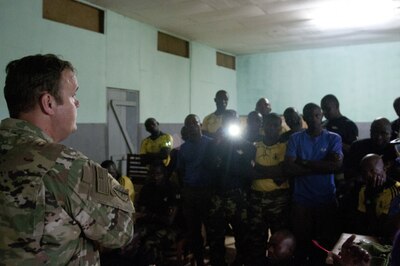
DOUALA, Cameroon, Nov. 24, 2017 — With his uniform shirt soaked with sweat, Army Staff. Sgt. Joshua Crenshaw calmly halts the Cameroonian soldier in front of him.

“Stop, you’re dead,” Crenshaw said.

It’s 9 a.m. in Douala, and the humidity is pervasive. Crenshaw, an explosive ordnance disposal technician and team leader, is overseeing a practical exercise -- one in which the real-life applications can mean life or death.

Crenshaw is one of a handful of explosive ordnance disposal soldiers from the 764th Ordnance Company from Fort Carson, Colorado, who came to Cameroon at the request of U.S. Army Africa during Counter Improvised Explosive Device-Defeat Phase I training. The training, held Oct. 23-Nov. 17, was designed to help Cameroonian troops learn more about IEDs and how to dispose of them safely.

Terrorists’ Weapon

IEDs are a favorite weapon among terrorist organizations. Cameroon’s armed forces regularly deploy to northern Cameroon -- an area where the violent extremist organization Boko Haram operates. According to the United Nations, attacks by Boko Haram have displaced up to two million people in the countries of Cameroon, Nigeria, Chad, and Niger, and have claimed the lives of up to 15,000 people since 2009.

Crenshaw and his team, many with experience countering IEDs in Iraq and Afghanistan, are deployed here providing potentially lifesaving training in the fight against violent extremism.

“We’re here passing on the knowledge that will hopefully save these guys’ lives,” Crenshaw said. “It will make them slow down; make them think about it before they just run into a situation.”

Crenshaw explained that the students in the course come from different military departments -- engineers, presidential guard, and the rapid response brigade -- and have had little to no IED-specific training in the past.

“We’re trying to help them get ahead of the game -- teach them how bad it could be, and teach safe methods now,” he said.

Different Types of IEDs

The American soldiers taught the Cameroonian troops the types of IEDs they might encounter, including vehicle-borne IEDs, suicide vests, IEDs buried in the ground, weapons caches and more.

“This training is relevant,” Crenshaw said. “When we start our training we usually ask what the threats are. Their leadership told us that the big threats they’re seeing are vehicle-borne IEDs and suicide vests.”

Crenshaw said it was rewarding to see the growth in the students from the first day of the four-week course to graduation.

‘The Training is Essential’

“This training is essential,” said Cameroonian Armed Forces Maj. Rene Didier Bekada, deputy commandant of the Cameroonian Armed Forces engineering school. “And it is really the heart of the struggle against groups who are waging asymmetric warfare [in Cameroon].”

Bekada said the training increased the Cameroonian soldier’s capacity.

“The U.S. instructors have vast experience … and so during this training we are really profiting from their experience in counter-IED,” he said.

Partnering Missions

Army 1st Lt. Jacob Schall, platoon leader for the 764th, said his team is one of many partnering with militaries in other West African nations and conducting similar training.

“We come here and we teach them the very basics of IED defeat … hopefully they can take that expertise and take it to wherever they are deployed to and help educate their fellow soldiers,” he said.

Schall said he also witnessed clear improvement in the Cameroonian troops’ counter-IED skills through the training.

“They have a firm grasp of being as safe as possible, which is the whole point here -- to increase your survivability and freedom of movement,” Schall said.

This is the first phase of the exercise in fiscal year 2018 -- the 764th team is scheduled to return to Cameroon in the spring to run two more cycles of the same exercise with new groups of Cameroonian soldiers.

“We’re very concerned about the long-term fight that they’re going to have,” said Crenshaw, explaining that IED threats become more complex as extremists gain experience.

“It means a lot to me personally,” Crenshaw said. “I’ve done the fight; I’ve done what they’re going to do. And I know how dangerous it is. I’ve been on both sides of the effects of it, so it means everything [to me].”