Friday, November 24, 2017

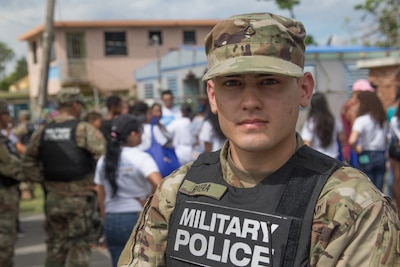
Face of Defense: Soldier Helps Others in Hurricane Maria’s Aftermath


By Army Spc. Samuel Keenan, 65th Press Camp Headquarters

SAN JUAN, Puerto Rico, Nov. 24, 2017 — Army Pfc. Roberto Rivera was in his bedroom when Hurricane Maria moved into the municipality of Naguabo, Puerto Rico.

“I was at home, trying to sleep,” the 20-year-old Rivera said. “Then, I heard a loud boom. When I got up and looked, all the windows in the house were starting to explode.”

The pressure of the storm had shattered the glass and flung all of the doors of the house off their hinges, he said.

Hurricane Maria ‘Destroyed Everything’

“The wind blew all of the rain inside the house and destroyed everything,” Rivera said.

Rivera and his father rushed his mom, sister and dog into the only room in the house that was not damaged. They all took shelter there until the storm passed.

When the rain and wind finally stopped, Rivera did not have any time to process what had just happened. As a military police officer with the 480th Military Police Company in the Puerto Rico Army National Guard, his neighbors desperately needed him.

“As soon as the hurricane was over, I came in,” Rivera said.

One of Rivera’s first missions in the aftermath of Maria was the rescue operations at Levittown, where floodwaters trapped local residents.

The water had risen so high that only heavy duty military vehicles could pass through, said Army Sgt. Milton Serrano, Rivera’s supervisor.

Rescuing Others

Rivera and others from his unit rescued over 300 residents from the dangerous situation.

“I just believe people need more help than I do,” Rivera said. “A lot of people need our help and I joined to serve.”

Since Hurricane Maria, Rivera has become part of the Governor’s Package, a unit of twenty soldiers that are under the direction of Army Brig. Gen. Jose Reyes, the adjutant general of the Puerto Rico National Guard, and Gov. Ricardo Rosselló, governor of Puerto Rico.

“We have been doing almost everything,” said 1st Lt. William Godalupe, commanding officer of the 480th MP Company and the officer in charge of the Governor’s Package.

Post-Hurricane Relief Missions

The soldiers have been running convoy operations as well as other various tasks as directed for the last 52 days since the storm, Godalupe said.

Rivera is enjoying his time with the unit, and actually sees serving as a way of escape.

“[My unit] is like a family to me,” Rivera said. “They’re always joking around. It’s a way to relieve the mind.”

Rivera plans to stay on active duty until the recovery efforts in Puerto Rico are complete and is trying to financially support the rebuilding of his family home.

Once the work on his house is finished Rivera wants to go to the mainland United States and earn a degree in criminal justice to become a Customs and Border Protection agent.

“He’s committed to the Army, to the citizens and lives the Army values 200 percent,” said Godalupe about Rivera. “It’s a privilege to lead that kind of soldier.”

Airmen, Other Troops Receive President’s Thanksgiving Greetings


By Air Force Staff Sgt. Jason Huddleston 39th Air Base Wing

INCIRLIK AIR BASE, Turkey, Nov. 24, 2017 — Airmen with the 74th Expeditionary Fighter Squadron deployed here were among the U.S. troops serving at home and overseas who received Thanksgiving Day greetings and thanks from President Donald J. Trump yesterday.

Trump praised the airmen and told them that they and other service members serving the nation are “very, very special people to me, and to everybody in this country.”

The president also saluted military families.

The president spoke to the service members via video teleconference from the Mar-a-Lago resort in Palm Beach, Florida, where he and his family are celebrating the holidays.

He talked to service members assigned to five military units deployed in different parts of the world.

This marks the first time a president has conducted a holiday video teleconference call with deployed personnel during the holidays in lieu of the traditional telephone call.

The Army was represented on the president’s video conference call by the 1st  Brigade Combat Team of the 82nd Airborne Division that’s currently deployed in Kandahar, Afghanistan.

Also yesterday, Trump and First Lady Melania Trump visited with Coast Guard members in Riviera Beach, Florida.

Wednesday, November 22, 2017

Missile Defense Soldiers Scan the Stratosphere


By Army Sgt. 1st Class Claudio Tejada, 94th Army Air and Missile Defense Command

HONOLULU, Nov. 22, 2017 — With the threat of ballistic missile launches by North Korea, the Army maintains Army-Navy/Transportable Radar Surveillance systems, or AN/TPY-2, in Japan to keep a watchful eye on the skies above.

The responsibility falls to a small group of soldiers stationed in Kyogamisaki and Shariki, Japan. The radar sites are unique in that they provide regional defense for Japan while also significantly improving the defense of the United States.

The soldiers in these units operate high resolution, phased array, X-band radars designed and built specifically for the U.S. missile defense missions. The radars can perform air surveillance to very high altitudes and identify and track aerial targets, including incoming ballistic missiles. The radar also has the ability to differentiate between warheads or space debris.

Mission

The 10th Missile Defense Battery, located at the Shariki Communications Site, has been operational since 2006. This was the first AN/TPY-2 Radar installation in Japan and also the first new U.S. military installation to open there since the end of World War II.

The AN/TPY-2 radar is integrated with the Terminal High Altitude Area Defense, or THAAD, system, and serves as its primary sensor. The radar's mission is to track the late stages of the missile course, enabling missiles fired by the system to intercept both outside the atmosphere and once a reentry vehicle enters the atmosphere.

The 14th Missile Defense Battery is the newest radar unit. Located at the Kyogamisaki Communications Site, it has been operational since October 2014. Since then, both units have been in the constant watch with recent events in the Korean peninsula.

Their mission is to pass highly accurate missile track data to sensor managers in the Air and Space Operations Center at Joint Base Pearl Harbor-Hickam, Hawaii, and sensor managers throughout the United States.

“We provide the strategic-level early warning for all ballistic missiles launched from North Korea that have the potential to impact the United States homeland,” said Army 1st Lt. Seth Bond, the 14th Missile Defense Battery executive officer.

The information received by the AN/TPY-2 radar is critical data.

Shared Information

Both units also works closely with the 100th Ground-Based Midcourse Defense Brigade based in Colorado Springs, Colorado, feeding data and cueing various radar sensors throughout U.S. Strategic Command and U.S. Pacific Command.

The data collected is shared with other services and nations to provide early warning and detection of hostile missile launches as part of Pacom’s missile early warning architecture, which greatly enhances the defense of Pacom assets and the United States.

“This information cues the various sensors located throughout the Pacific to ensure any intercept vehicle will accurately engage the warhead,” Bond said.

Once a possible threat has been detected, either through space based, naval, or elevated sensors, soldiers from the 94th Army Air and Missile Defense Command can either engage the threat or pass the engagement to an asset that is able to range the target.

“The 14th MDB has successfully tracked and processed all ballistic missile launches originating from North Korea,” Bond said. “The unit is extremely efficient and we provide updates to entities across [U.S. Army Garrison Japan], Pacom, Stratcom and [U.S. Northern Command].”
With the increase of threats from North Korea the soldiers from the 10th MDB and 14th MDB remain focused on being the nation’s first line of defense.