By Shannon Collins DoD News, Defense Media Activity
WASHINGTON, Nov. 22, 2017 — The Naval Medical Center San
Diego’s Comprehensive Combat and Complex Casualty Care, or C5, celebrated its
10th anniversary in October.
NMC-SD is one of three hospitals in the Defense Department
providing rehabilitation care to service members who are severely injured or
ill, especially in overseas operations. The other two are Walter Reed National
Military Medical Center in Bethesda, Maryland, which also works with the
National Intrepid Center of Excellence, and San Antonio Military Medical
Center, which used to be called Brooke Army Medical Center.
C5 is a program of care that manages severely or ill
patients from medical evacuation through inpatient care, outpatient
rehabilitation and eventual return to active duty or transition from the
military. Program components include: trauma service, which coordinates the
overall inpatient clinical management of the injured service member;
orthopedic, reconstructive plastic surgery and wound care; amputee care,
prosthetics and rehabilitation; physical, occupational and recreational
therapy; mental health assessments and care; traumatic brain injury care;
pastoral care and counseling; and family support and career transition
services.
“We are a multidisciplinary, one-stop shop and if it’s not
within C5, we simply just get on the phone and call the specialist we need,”
said Navy Lt. Cmdr. (Dr.) Carter Sigmon, acting department head and medical
director of the C5 department.
Since 2007, C5 has taken care of approximately 3,500
patients, “approximately … 20 percent of all the active duty [Operation Iraqi
Freedom, Operation Enduring Freedom and Operation New Dawn] service members
with war-related limb amputations,” he said. Sigmon said over the years, the
mission has evolved and now the team sees service members with injuries from
vehicular and training accidents.
Jackie Moore, a former Army major, helped stand up the C5
program. She had served as a physical therapist at Walter Reed and brought what
she knew over to NMC-SD. “I was sent out here special to get C5 started,” she
said.
“Nothing existed out here so we were instrumental in
developing the program and setting it up how we wanted to, based on our
experience that we had from Walter Reed,” Moore said. “When we first stood it
up, there were a lot of service members coming back with combat injuries,
primarily amputations, so when it began, that was our focus. Over time, it
morphed into more poly trauma. We are the rehabilitation experts here at Naval
Medical Center San Diego in poly trauma rehab.”
Project Care
Navy Capt. (Dr.) Craig Salt, founder and director of Project
Care, plastic surgeon, said Project Care, under C5, is the only one of its kind
in the DoD. “Project Care is a multidisciplinary medical and surgical program
designed to facilitate the restorative care of patients who have been
traumatically disfigured,” he said. “We take people who have varying degrees of
trauma and then we work to revise, repair and replace what has been damaged or
lost versus the traditional rehab model. We look at the patient, top to bottom,
figure out what they’ve lost, what their disfigurement is, what their cosmetic
deformity is, and then in conjunction with all the other rehab that’s
happening, we work to repair, replace and correct deformities.”
He said this can be anything from using lasers on scars to a
hand transplant and the disciplines include plastic surgery, dermatology,
orthopedic hand surgery, oculoplastic, ophthalmology, ENT fascial plastics, and
reconstructive urology.
“The rehab center and all the different disciplines at this
hospital are working to get the patient the best possible recovery we can get
them so we’re committed to providing the medical and surgical care and
psychological support. So whatever’s wrong with them and whatever they’ve lost,
we’re going to see to it they get the best possible functional recovery, the
best psychological recovery and the best aesthetic result they can get,” he
said. “Everybody in the hospital that can help the patient look better, feel
better, recover, function, whatever, is involved in their care, and we
coordinate all of that. All of us in the program are really passionate about
that goal.”
One-Stop Shop
Dr. Chad Rodarmer, the traumatic brain injury program
manager for C5, served 24 years in the Army as an enlisted field artilleryman,
a physical therapist and health care administer, retiring as a major. He said
because patients with TBI may require specialists ranging from speech language
pathology to vestibular therapy to audiology, he works to coordinate the
patient’s care within C5.
“On a weekly basis, we have our interdisciplinary team
conference, and we bring up the patients currently enrolled and talk about when
someone’s due for their follow up, what the plan is, how good they are at
meeting the goals we and the patients have set. We can see their progress. We
get together regularly to make sure we’re all on the same sheet of music and
moving toward the same goals,” he said.
Rodarmer said they’ll also have support groups and bring in
subject matter experts to talk to the patients to help alleviate anxieties such
as going back to school while having a TBI.
Patient Care
Navy Petty Officer 1st Class Jordan True, a master at arms
stationed at Naval Weapons Station Seal Beach, California, was injured Aug. 12,
2016, in a motorcycle accident.
“They told me I had a traumatic brain injury, a lot of
internal organ injuries, broken ribs, a spinal injury and that my foot was
crushed. I knew I might have to amputate it,” he said. “They flew my parents
out here from Iowa because I had a less than 40 percent chance that I was going
to live. They helped me make some long-term decisions.”
He’s working with the C5 prosthetics department to get a
brace for his leg and with physical therapy so that he can begin running again.
He said each of the doctors and staff he has worked with has taken the time to
help him, especially since he has to drive down to make his appointments.
“Here, they have a day dedicated to primary care or Project
Care. Me coming down from Long Beach, they would help me out,” he said. “I
would ask one of the doctors if they would be willing to do one of these
appointments on one of these days, and they were really flexible with me and
helped me reduce a lot of stress, especially since southern California traffic
is harder for me than it used to be. Any time I need a referral for anything
closer to Long Beach, they would get it in. It didn’t matter who was doing it.
It would get done really quickly. I was excited about that.”
True said what he liked most if that even though he was
being stubborn about trying some of the services C5 offered, the doctors kept
encouraging him to try them until he did. “They didn’t give up on me,” he said.
“Especially the speech therapy, they just kept pushing me and that helped me go
back to school and now I have a 4.0 GPA. They actually listen to what your
issues are. I was taking a neuropsych exam one day and this person stayed like
an hour and a half late just so I could finish my test so I wouldn’t have to
reschedule and drive back down. It really made my life easier. My
neuropsychologist, he was looking things up for me, like how I can get take the
LSAT and get a private room.”
Navy Seaman Chris Krobath, an aviation electronics mate, is
also a patient assigned to NMC-SD. He has a below the knee amputation on his
left side from a motorcycle accident. He said his leg was amputated in May 2016
and after going into rehabilitation in June, he had his first leg. He’s been
working with physical therapist Moore.
“They are all really helpful,” he said. “If I ever have a
problem with anything, I can just come here to physical therapy or to
prosthetics, and they’re always willing to help me. It’s pretty cool. It’s
convenient to have everything together.”
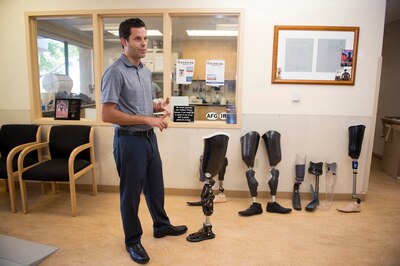
Brian Zalewski, head of the prosthetics department at
NMC-SD, said the artificial limb is a “unique and customized process” and that
he and his team make every effort to cast the patients and turn around with a
socket in the same day or the next day.
Zalewski said they’ve had unique challenges along the way.
“We had the first bilateral above the knee amputee come out of here and go back
and do a deployment which was incredible,” he said. “Our approach here is that
everything’s custom.
“We work closely with the manufacturer,” he continued. “We
had a Navy diver who wanted to stay on active duty. His list of requirements,
he had to be able to walk to the water, get in the water and put on fins. Well
that’s pretty hard to do with one type of leg so we worked with a manufacturer
to make a foot with a button you push so that it goes flat and then you put the
fin on it so you can dive. We did some testing, and it worked great.”
Zalewski said the diver went out and performed some missions
and then called and asked about pressurization with deep dive.
“I told him, ‘You’re the only one who’s doing this so you
tell us, and we’ll write the text book later. You’re the one pushing the
limits,’” Zalewski said. He said he’s had a lot of patients he and his team
have worked with who’ve received customized prosthetics from his team and who
continue pushing the limits from climbing Mount Everest to competing in the
Paralympics.
“We’re providing a multidisciplinary approach because our
ability to work with other providers to take care of the whole patient, from
the mental side to the physical side and constantly addressing those needs so
that they’re not sitting there wondering what they could be doing or if they
could be getting something better,” Zalewski said. “We never just give them a
device and say, ‘Here you go, enjoy that.’ It doesn’t work that way. We’ll give
you so much more to make you that much better. It’s a whole approach and
practice from a team of medical professionals.”





 Posts
Posts

