Wednesday, November 22, 2017

From Puppy to Protector: How the Air Force Raises Military Working Dogs


By Air Force Airman 1st Class Lane Plummer, 27th Special Operations Wing

CANNON AIR FORCE BASE, N.M., Nov. 22, 2017 — Candy is a military working dog with six deployments under her collar, and on Nov. 9, she was finally able to rest her paws when she officially retired from duty during a ceremony here.

Her career, like hundreds of canines before her, serves as a reminder of how powerful a four-legged airman can be.

For most of these working dogs, it all starts across the Atlantic Ocean. The Military Working Dog Buying Program will travel to European kennels to purchase canines for the Defense Department. In some cases, however, MWD’s are born and raised at Lackland Air Force Base, Texas, where training occurs for both canines and their aspiring handlers. The way to tell the difference between foreign and domestic canines is in their name. For example, if their title is “MWD Kkeaton” or “MWD Ttoby,” the double consonant will signify they’re a dog raised through Lackland’s Puppy Program. Names without the double consonant are for all other adopted dogs.

After being adopted, the dogs live with foster families before the initial training regimen begins when they are 18-24 months old. Once they enter the training program, the dogs have 120 days to graduate.

Training Dogs, Handlers

During this training, they learn all the basics. Basic commands such as down, sit and stay are the starting point. Once they learn these commands, the canines begin learning more advanced techniques such as patrol work, detection and more. Successfully completing the four-month program means they’ll graduate and be assigned their base.

Simultaneously, aspiring dog handlers are training nearby. It was an experience that, for Air Force Staff Sgt. Kyle Pethtel, a dog handler with the 27th Special Operations Security Forces, was fun and filled with challenges for both canine and handler.

“It felt hard at times because you didn’t know how much work it takes to become [a handler],” Pethtel said. “I remember how nervous we’d be [when] pulling our first working dog.”

Before they get to handle their first working dog, the handlers must also learn the basics and proper commands. Not only that, they also must learn how to groom the dogs and keep them fit to fight.

When the newly trained dogs arrive at their first assignments, they will be assigned a handler and begin learning more advanced techniques.

Teamwork

From there, it’s all about strengthening the bond between handler and canine. Just like airmen in an office, team chemistry is a vital component for these working dog teams to accomplish the mission. Between base patrols and deployments, the bond only strengthens each time they put their bulletproof armor on.

“When we do convoys, canines lead,” said Air Force Staff Sgt. Paul Little, a 27th SOSFS dog handler. “When we’re downrange, dog teams lead the way. It’s one of the most vital components to any mission they’re involved in.”

It’s an honor that Candy, one of the most experienced and decorated military working dogs in the DoD, had one last time before she traded in those heavy vests for a simple collar and leash. After eight years of service, she received an Air Force Commendation Medal and retired to her new home in Colorado with Air Force Tech. Sgt. Joshua Fehringer, one of her former handlers.
From puppy to airman, the career cycle of these canine service members is long and arduous and requires as much sacrifice as the thousands of human airmen they serve and protect.

Tuesday, November 21, 2017

Face of Defense: Master Driver Steers Sustainment Brigade's Mission


By Army Spc. Elizabeth White, 3rd Sustainment Brigade

BAGRAM AIRFIELD, Afghanistan, Nov. 21, 2017 — Five days on an Oshkosh Defense mine-resistant, ambush-protected all-terrain vehicle, five days on the MaxxPro II MRAP, and two days on mine rollers: this is what it takes to qualify a master driver to the operator level.

With this qualification, Army Staff Sgt. Arturo Amaro, the master driver for the 3rd Special Troops Battalion, 3rd Infantry Division Resolute Support Sustainment Brigade, will become the lone soldier able to train drivers in his brigade.

At the operator level, master drivers are capable of teaching other certified drivers how to use any of the above equipment.

“I’m looking forward to getting to do hands-on training with soldiers,” Amaro said. “Right now it’s a challenge getting resources, such as classrooms and vehicles, but the 3rd [Special Troops Battalion] has been helping out.”

His classes could consist of up to 16 soldiers learning to operate any of the three vehicle platforms. Aside from driver training here, Amaro will also be responsible for inspecting other training courses around Combined Joint Operations Area Afghanistan.

Master Driver Classes

The master driver class was led by two Army civilians who travel to many different forward operating bases to administer this course.

“We teach master drivers and coalition forces preventive maintenance checks, on-road and off-road driving and night driving,” said Barry Gravely, one of the MRAP instructors for the course.

They also taught classes on the characteristics of each vehicle and safety procedures. The drivers then took the MAT-V and the MaxxPro II through the off-road course, which consists of rough, rocky patches, low ruts, high hills and a deep-water obstacle. These obstacles allow the future trainers to experience the capabilities of the vehicles as well as prepare them for any driving they may have to do outside of their base.
“It was a good experience driving the off-road portion,” Amaro said. “When we familiarize with this terrain it helps us with the terrain off post.”

Navy Deploys Unmanned Submersibles in Argentine Submarine Search


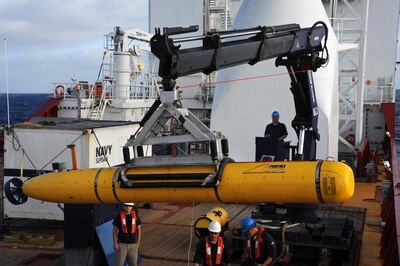
NAVAL STATION MAYPORT, Fla., Nov. 21, 2017 — The Navy has deployed unmanned underwater vehicles to join in the search for the Argentine navy submarine A.R.A. San Juan, which is missing in South Atlantic waters.

The equipment consists of one Bluefin-12D (Deep) UUV and three Iver 580 UUVs, which are operated by the Navy's recently established Unmanned Undersea Vehicle Squadron 1, based in Pearl Harbor, Hawaii.

The UUVs are uniquely capable to help in the search. Both types are capable of deploying quickly and searching wide areas of the ocean using side scan sonar, a system that is used to efficiently create an image of large areas of the sea floor. The Bluefin-12D is capable of conducting search operations at 3 knots [3.5 mph] at a maximum depth of almost 5,000 feet for 30 hours, while the Iver 580s can operate at a depth of 325 feet, traveling at 2.5 knots [2.8 mph] for up to 14 hours.

The U.S. is providing rapid response capabilities, including aircraft, equipment and personnel to assist Argentina in its search for the missing submarine.

In addition to the UUVs, the U.S. has deployed aircraft to assist in the search, as well as underwater equipment specifically designed for submarine search and rescue.

One Navy P-8A Poseidon aircraft is already in Argentina, where it joined a NASA P-3 research aircraft supporting the ongoing search efforts over the submarine's last known location.

U.S. Southern Command directed the deployment of this equipment and personnel to Argentina to support the country's request for international assistance aimed at locating the missing submarine and crew.
Southcom is one of the nation's six geographically-focused unified commands, with responsibility for U.S. military operations in the Caribbean and Central and South America.