Thursday, November 16, 2017

Face of Defense: Airman Sets Sights on Social Work Career


By Air Force Airman 1st Class Erick Requadt 23rd Wing

MOODY AIR FORCE BASE, Ga., Nov. 16, 2017 — For one Pennsylvania native here, taking care of families and others has always been a passion.

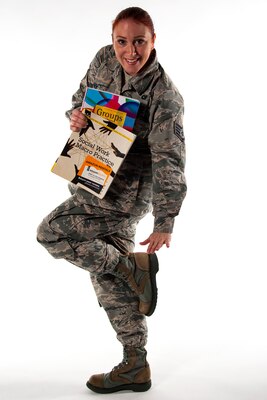
Air Force Staff Sgt. Samantha Murphy, 23rd Wing command post noncommissioned officer in charge of systems, said her desire and dedication to pursue social work first grew out of a love of helping people, and now extends to making a change with military members.

"Being a social worker makes sense, because it's in line with my views of being able to help fellow airmen who are struggling change the perception that seeking help was bad, and it will put me in a position to where I can help make a difference where it is needed."

Murphy's journey to such a career field was fueled by events during her childhood, when a social worker reunited her family. Her parents had struggled with substance abuse, resulting in Murphy and her siblings going into the foster system twice.

"As a child, you're comfortable living with your parents," Murphy said. "When I was separated, I had to readjust to a whole new family and a new set of ways they did things. You're constantly on edge, almost like a deployment. You don't know what to expect, and you don't want to make them mad. You're not really ever comfortable in someone else's home, and you want to be back with your parents and siblings. So that's what made it hard."

With the help of the social worker assigned to their case, Murphy's parents were rehabilitated, and the family reunited.

With her family back together, Murphy said, she grew up longing to help people.

Air Force Service

She carried this desire to help with her when she joined the Air Force in 2004 as a security forces airman. During her two deployments, she was exposed to the stresses airmen face and the need for those who can help. Still, it wasn't until talking with a friend who was commissioning as a social worker that Murphy concluded social work would facilitate her desire to enhance social functioning and overall well-being.

"When I deployed, I often [experienced] the same stress and anxieties like everyone else," Murphy said. "I can remember the first time a mortar hit close by. My whole body [tensed up], and I hit the floor. So there's that heightened sense of awareness you have, and you carry it your whole deployment. I saw the fear of getting help, because of the perception that we were weak or we couldn't handle it."

Seeing the need to find better ways of helping to break the stigma attached to seeking help, Murphy has tried to assist those in need any way she can. She in her second year of a master's degree program in social work, and aspires to gaining a commission and serving as a clinical social worker.

"I wanted a bigger platform to make a change," she said. "That's the ultimate goal. As a commissioned officer in social work, [I'll be] making that change on a bigger level [and making] a bigger impact.

Shaping a More Effective Team

"I'm excited to see how I can contribute and how I can help shape the Air Force so we're a more effective team," she continued. "You have to take care of yourself mentally, physically, emotionally and spiritually. If you've got something going on internally and you don't get it resolved, you bring that to work, and then it's a bad day."

Recently, Murphy spent three days in Spring Hill, Florida, to help counsel homeless veterans at an event designed to aid homeless and at-risk veterans.

Courtney Wiest, a university professor and one of Murphy's teachers, said Murphy goes above and beyond the call of duty to help the veterans. "She's really been able to engage with [veterans], and just provide that support and a listening ear," she said.

Murphy, from her experiences as a youth to her time in the Air Force, has learned to deal with the hard situations she could face as a social worker. With only a year and a half left until she obtains her degree, she said, she hopes to assist those who cannot make the voyage alone.

"I want to make a difference," she added. "One life saved is worth your entire time in the Air Force."

Alaska Natives Defended Their Territory 75 Years Ago


By Sean Kimmons Army News Service

KWETHLUK, Alaska, Nov. 16, 2017 — When the Japanese raided and occupied parts of Alaska during World War II, the Army called on native Alaskans to defend the northern territory.

Given no pay, more than 6,300 Alaskans from 12 to 80 years old signed on to be sentries for the newly created Alaska Territorial Guard.

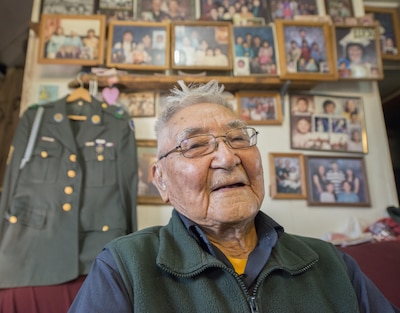
Retired Army Sgt. 1st Class Sam Jackson, who still lives in Kwethluk, a small village in southwestern Alaska, was one of them. Now 93, the veteran recalled when Maj. Marvin Marston, an Army officer who formed the first units of the ATG reserve component, asked him and others to join the cause. "They called us the ears for the Army and eyes for the Army," said Jackson, who served in the Alaska National Guard after the territorial guard disbanded in 1947.

When Japanese forces invaded some of the Aleutian Islands in June 1942, Marston was tasked to travel to Alaska and recruit members for the new Army mission. He trekked across the tundra, often by dog sled in the winter, to spread the word and round up troops for the Alaska Territorial Guard, who were known as Eskimo Scouts.

Once enlisted, the Alaskan natives trained on Army tactics so they could defend the territory from an attack, if needed. They even made decoys using barrels and logs to resemble cannons to Japanese aircraft flying overhead.

'Follow Your Training, Save Your Life'

At night, a blackout was practiced throughout the villages to deter an enemy invasion. As a young man, Jackson said he helped keep the windows of buildings covered so no light could be seen from the outside.

"They told us to follow your training and it will save your life," Jackson said of his Army instructors, who supplied the scouts with a rifle, uniform, snowshoes and other gear. "That's how we trained."

Years later, Marston wrote in his book, "Men of the Tundra: Alaska Eskimos at War," that the scouts proved helpful in safeguarding terrain around the lend-lease air route, which the United States used to supply aircraft to its Russian ally.

They also secured Platinum, an Alaskan village south of Kwethluk, which was the only source of the strategic metal with the same name in the Western Hemisphere. In addition, he wrote, they stockpiled survival caches along vital transportation routes.

Recognized for Efforts

In 2010, the scouts were finally recognized for their efforts and given veteran status when President George W. Bush signed a bill into law that ordered the defense secretary to issue honorable discharges to the Alaskan natives. Alaska's Department of Military and Veterans Affairs then set up a task force to notify and assist former members, their families and dependents on how to obtain the benefits entitled to them.

"Our goal is to locate 100 percent of the ATG members, begin correcting the oversight of the past, and allow future generations access to their ancestors' service records," according to the department's website.

Soon after, federal funds were allocated to ensure the actions of the thousands of Alaskans who volunteered to protect the territory would not be forgotten.

Memorial Park

As statues and plaques began to be unveiled across the state, a group of U.S. military veterans in nearby Bethel used the funds to build a memorial park to enshrine the ATG veterans in 2012.

"They volunteered, some of them as young as 12, to guard the people of western Alaska. There was no military presence here," said Stanley Rodgers, a former Army sergeant who served in the Vietnam War.

Born and raised in Bethel, Rodgers said he is related to probably 70 former ATG members. Those relatives, he said, would tell him stories of Japanese ships off the Bering Sea coast or of spies who had come ashore. "Whatever they saw that was not appropriate, they would report it," he added. "Everyone was a sentry."

If the Japanese had invaded, he said, they would have faced heavy resistance in a harsh land. "They would have never made it," he said. "[The ATG] would have beaten them back."

As he stood next to a statue of an Eskimo Scout overlooking a wall of plaques inside the memorial park, Rodgers said the place is not only to honor what the scouts, like Jackson, did. It can also serve as a reminder of selfless service for generations to come, he noted.

"It will be here forever," he said. "The people may be gone, but the names will still be there."

Wednesday, November 15, 2017

Trauma Chief Praises Medical Response to Sutherland Springs Shooting


By Elaine Sanchez Brooke Army Medical Center

JOINT BASE SAN ANTONIO-FORT SAM HOUSTON, Texas, Nov. 15, 2017 — The community teamwork and medical response here the afternoon of the Sutherland Springs shooting was "extremely heartwarming," the trauma chief at Brooke Army Medical Center said.

"When people heard about the shooting, we didn't have to do a recall. People came in immediately and pitched in, … not to watch, but to help," said Army Col. (Dr.) Kurt Edwards, who received patients and directed care that night.

"We ended up with more medical staff in the operating rooms, emergency department and [intensive care units] than we needed," he said.

BAMC received eight victims -- six adults and two minors -- from the Nov. 5 mass shooting in the small community church in Sutherland Springs, about 30 miles east of San Antonio. One adult patient was discharged last week, and seven remain in BAMC's care.

The Initial Call

Air Force Maj. Belinda Kelley, the shift leader that night in the ER, received the initial call. "We were told we were possibly getting quite a few patients after a shooting at a church," Kelley recalled. "We weren't sure how many were coming here, but were told there were potentially 30 shot." Kelley later learned that 26 people had been killed and 20 injured that Sunday afternoon.
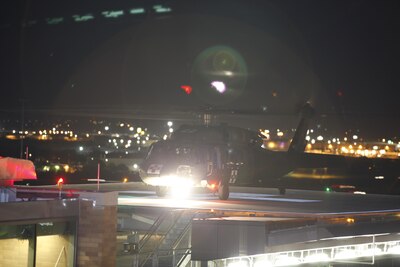
Emergency Department entrance at Brooke Army Medical Center.

The situation was well controlled at BAMC, Edwards noted. "We had about a 30-minute warning. We started prepping for any eventuality to ensure adequate coverage. We opened up 15 trauma bays in preparation."

BAMC received four patients at first, then an additional four not long after.  "It was disheartening to see that the injuries were not dissimilar to those in combat," said Edwards, who has deployed multiple times to Iraq and Afghanistan. "To see people who had been sitting in a church having similar injuries to those in a combat zone [is] not something you want to see."

The seven patients' conditions currently range from good to critical. "They are all getting better," Edwards noted.

Team Effort

Edwards praised the first responders and the trauma partnership within the city that led to an effective response. BAMC and University Health System are the only Level I trauma centers in the San Antonio region, caring for civilian trauma patients over a 23,000-square-mile radius. On average, BAMC cares for 3,000 trauma patients each year.

"Both BAMC and University provide the highest level of trauma care together, and we do it every day," he noted. "It's an amazing partnership, especially when we are working together to care for people after a devastating tragedy."

"The staff response has been professional, efficient and caring," said Army Col. Michael Ludwig, deputy commander for inpatient services. "I could not be more proud of the staff -- everyone from housekeeping to the technicians to our senior leaders."

Kelley said she's proud to work at the military's only Level I trauma center.
"As a nurse, it's a very emotional place," she said, "especially when I pick up the phone and someone is looking for a loved one. If I walk out of here and can't cry, then I can't come back, because that means I don't care any more.  Caring is what I do."