Monday, November 13, 2017

Dual-Status Air Reserve Technicians Perform Vital Roles


By Air Force Tech. Sgt. Ryan Labadens, 403rd Wing

KEESLER AIR FORCE BASE, Miss., Nov. 13, 2017 — Air reserve technicians, or ARTs, play a vital role in the Air Force mission to fly, fight and win in air, space and cyberspace.

According to Col. Robert Stanton, 403rd Wing vice commander and senior air reserve technician for the wing here, ARTs are Air Force reservists who serve in a dual status for the Defense Department.

“It’s a full-time federal service position matched with a military position, so it’s two positions under one title,” Stanton said. “You’re only on one status at a time though, either as a civilian working 8 a.m. to 5 p.m. for example, or when you’re called up for duty -- you’re in a military status.”

Identical Mission, Training Requirements

Just like traditional reservists, ARTs also participate in unit training assemblies and perform annual tours alongside traditional reservists, and are required to meet all of the same mission and training requirements for their Air Force Reserve careers. The 403rd Wing currently has 379 members fulfilling these requirements.

However, one of the main differences between ARTs and traditional reservists is that ARTs work as civilian employees during the week to continue maintaining and operating their units between once-monthly weekend unit training assembly, or UTA, weekends, Stanton said.

“The main thing the ARTs offer is stability,” said Stanton. “It’s setting up the homefront, setting up the structure for the training environment so that the traditional reservists who don’t work here full time can just plug right in and get their training done.”

The ART program is also designed to offer a sense of continuity between UTAs.

“We’re here to keep the mission going during the week when the traditional reservists aren’t here,” said Air Force Senior Master Sgt. Brett Blanchard, 403rd Wing force development superintendent.

Part of Blanchard’s responsibilities as a member of the 403rd Wing education and training office is to help wing members apply for formal Air Force schools and receive credit for higher education courses taken through civilian universities, which can be applied as credit toward receiving their Community College of the Air Force degrees. The office he serves in also helps reservists to apply for tuition assistance through programs such as the GI Bill and the Post-9/11 GI Bill.

“We can help them get the ball rolling for a lot of these processes during the UTA, and then follow up during the week to make sure everything is running smoothly and find out what else needs to be done to help them accomplish what they want education wise,” Blanchard said.

Air Force Senior Master Sgt. Ingrid Anderson, 403rd Aeromedical Staging Squadron medical technician, said the work her squadron does during the weekend UTA flows right into the work week for the ARTs in her squadron.

‘Our Job Never Stops’

“All the ARTs here have different roles in reference to what they do as reservists, so our job never stops -- everything just flows together,” said Anderson, who was hired as an ART to update and take care of the medical requirements for 403rd Wing members. “So for example, we just came out of the October UTA, and we just immediately started prepping for November UTA.”

Of course, since the mission of the Air Force is to fly, fight and win, the Air Force Reserve also seeks to hire ARTs who can help maintain and fulfill that flying mission continuously throughout the year. The 403rd Wing has two flying squadrons: the 53rd Weather Reconnaissance Squadron “Hurricane Hunters,” which flies the WC-130J Super Hercules, and the 815th Airlift Squadron “Flying Jennies,” which flies the C-130J version.

Air Force Tech. Sgt. Jon Holderness is a member of the 803rd Aircraft Maintenance Squadron. As a dedicated crew chief and ART with the unit, Holderness said one of the main goals of ARTs, on the maintainer side, is to train reservists to make sure their qualifications are up to date so they can ensure the wing’s aircraft are ready to fly.

Holderness noted since ARTs make the Air Force Reserve their full-time careers, this allows them to build up a wealth of experience to offer to their units and the Air Force as a whole.

“This unit has a lot of experience in the weather reconnaissance mission, a lot of experience with the tactical mission … so the Air Force gets the benefit of that longevity and experience, which can stay here at Keesler, but still be passed on to others so that these airplanes can be well taken care of,” Holderness said. “My own training expertise increases every year because I become more of an expert at giving that knowledge to the younger individuals.”

For Holderness, being an ART also gives him the opportunity to do something he loves full time -- working on aircraft.

“I love my job. This is what I wanted to do when I was a kid, so working on aircraft is something I get to do as long as I want to,” he said.

Face of Defense: First Sergeant Leverages First-Responder Skills


By Air Force Senior Master Sgt. Charles Delano 153rd Airlift Wing

CHEYENNE, Wyo., Nov. 13, 2017 — Air Force Senior Master Sgt. Thomas Turner is a firefighter here. During the week, he responds to fire calls and provides emergency medical assistance to the city's residents. On drill weekends, he responds to the needs of the airmen and families of the Wyoming Air National Guard's 153rd Airlift Wing as a first sergeant.

"When I was growing up, I always wanted to become a firefighter," Turner said. "I like helping people, so becoming a first sergeant was a natural fit."

Turner began his career in the Wyoming Air National Guard as a C-130H engine mechanic. Four years later, he applied to change careers to become a firefighter. He attended the fire academy at Goodfellow Air Force Base, Texas, before the Sept. 11 terrorist attack. Witnessing the selfless acts of first responders during the attack and its aftermath affirmed his decision to pursue his dream job as a firefighter, he said.

Watching the televised images of first responders attending to the injuries of the people in New York and reminded of an injured woman he helped while he was driving down a dirt road in 2000, Turner said. She was badly injured from a robbery and was left bleeding in her vehicle when Turner stopped to render aid and drive her to the hospital.

"The feeling I had that night and watching those first responders on 9/11 really helped solidify my decision to help people and become a firefighter," he said.

Road to a Civilian Career

Although he became a firefighter with the Air National Guard, it was still only one weekend a month and two weeks in the summer, he noted, adding that he worked various jobs as a server, retail clerk and with the railroad before accepting a full-time position with Cheyenne Fire Rescue.

After being hired by the city, Turner attended firefighter training at the Front Range Fire Consortium Fire Recruit Academy in 2007. Since then, he has performed duties as acting lieutenant, has taken on additional duties as part of CFR's public relations committee, and has assisted with community fundraising projects.

"Tom supports the department in many ways thanks to his experiences in the military," said Lt. Jarrett Demello, Cheyenne Fire Rescue lieutenant of operations. "He is always reliable and willing to help anyone who needs him."

Although he was a first responder with his civilian employer and with the Wyoming Air National Guard, Turner said, he wanted to help airmen more than just as a firefighter. He was approached in 2010 by Air Force Senior Master Sgt. Sarah Brewster, 153rd Airlift Wing human resource advisor, who was a first sergeant at the time. She encouraged him to apply his first responder skills as a first sergeant.

"You care about people and take pride in helping others," Brewster said, "so put a diamond on and let your airmen be your priority."

Turner finished the First Sergeant Academy in 2010 and was assigned as the first sergeant for the 153rd Logistics Readiness Squadron. As the needs of the wing changed, he became the security forces squadron's first sergeant and finally took the first sergeant position for the wing staff. He will retire his first sergeant diamond in December after 20 years with the Wyoming Air National Guard, but he'll still be responding to the needs of the residents of Cheyenne in his civilian career.

Artemis Strike 2017 Exercise Concludes in Crete


By Army Capt. Robert Durr, 10th Army Air and Missile Defense Command

CHANIA, Greece, Nov. 13, 2017 — More than 200 U.S. soldiers from the 10th Army Air and Missile Defense Command participated in Artemis Strike 2017, a German-led multinational tactical live-fire exercise held Nov. 2-9 at the NATO Missile Firing Installation here.

Soldiers from 5th Battalion, 7th Air Defense Artillery Regiment worked with more than 650 German airmen from the Surface Air and Missile Defense Wing 1 to create an integrated air and missile defense system construct as part of a NATO tactical evaluation.

Army Col. David Shank, commander of the 10th AAMDC, said this year’s exercise gave soldiers a chance to work with partners and allies in an environment that replicates real world conditions.

Constant Training

“This is a great opportunity for soldiers to do what they came in the Army to do, and that’s to put steel on targets,” Shank said. “We consistently train not only with our German allies but across the continent of Europe.”

For soldiers in 10th AAMDC, Artemis Strike 2017 has been a year in the making.

“The planning for this event began well over a year ago, during the last live-fire exercise here in Crete,” Shank said. “There is quite a bit of planning and execution.”

The 5-7 ADA out of Smith Barracks in Baumholder, Germany, deployed with two Patriot battery minimum engagement packages, along with soldiers from Headquarters and Headquarters Battery to support their German allies during the multinational event.

“It’s about integration and it’s about having an integrated air and missile defense capability,” Shank said. “This is what soldiers train for and this is how we improve our craft. Our No. 1 priority is to get better every day. We’ll continue to support our allies and our partners.”

Mission Success

For the soldiers participating in the exercise, rehearsals and training have played a key role in the success of the mission.

Army Spc. Nathaniel Murray, a Patriot launcher crewmember with Bravo Battery, 5-7 ADA, said one of the most significant things about the exercise is being able to operate with NATO partners and allies.

“They have the same weapon platform that we do, but theirs varies a little bit,” Murray said. “One of the best things about being out here is actually being able to see the missiles fire off. We train everyday with simulations, but it’s great actually being able to finish the crew drill, unlock and connect the missiles and see the product of all of our hard training.”

Army Sgt. Zach Nacarato, an assistant section chief with Bravo Battery, 5-7 ADA, said working with U.S. allies and partners has been mutually beneficial to both the U.S. and German forces participating in this year’s exercise.
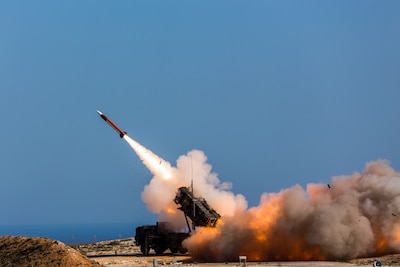
German soldiers assigned to Surface Air and Missile Defense Wing 1 fire the Patriot air defense missiles at the NATO Missile Firing Installation during Exercise Artemis Strike 2017 in Chania, Greece.
German soldiers assigned to Surface Air and Missile Defense Wing 1 fire the Patriot air defense missiles at the NATO Missile Firing Installation during Exercise Artemis Strike 2017 in Chania, Greece, Nov. 8, 2017. Artemis Strike is a German-led multinational air defense exercise. German air force photo by Officer Candidate Sebastian Apel

“It’s a really great opportunity for soldiers to do this,” Nacarato said. “It’s the best training I think anyone could ever receive -- especially working with our brothers in Patriot.”

German air force Col. Arnt Kuebart, commander of the Surface Air and Missile Defense Wing 1, said working with U.S. forces is an essential part in Artemis Strike’s success.

“Integration in terms of air defense and air missile defense is absolutely key. No single nation is capable and able to perform air missile defense alone,” Kuebart said. “This is a truly joined and combined endeavor where different services and different nations have to come together and intertwine their services and their capabilities.”

Exercises like Artemis Strike improve integration training between NATO allies and partners, Kuebart said.

“The very big benefit of this exercise is that you are working in a tactical scenario therefore also proving your capability through a live firing with missiles,” he said.

Soldiers from 3rd Battalion, 4th Air Defense Artillery Regiment, 32nd AAMDC, 21st Theater Sustainment Command, 7th Army Training Command, 173rd Airborne Brigade, 2nd Cavalry Regiment, 16th Sustainment Brigade and the 30th Medical Brigade also participated in the exercise alongside their German counterparts.