Friday, November 03, 2017

Navy Committed to Correcting Mistakes that Led to Collisions, Deaths


By Jim Garamone DoD News, Defense Media Activity

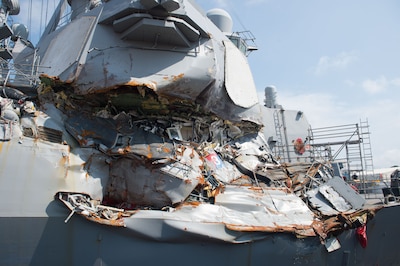
WASHINGTON, Nov. 2, 2017 — The chief of Naval Operations said today that the collisions in the Pacific that killed 10 sailors aboard the USS Fitzgerald and seven sailors aboard the USS McCain were entirely preventable, and the service is committed to correcting the actions that led to the accidents.

Navy Adm. John Richardson told Pentagon reporters that many aspects combined to cause the accidents, including lack of training, hubris, sleep deprivation, failures in navigation and failures in leadership.

The guided missile destroyers USS Fitzgerald and USS McCain sailed when they shouldn’t have, he said, and that decision falls on the commanders, who are responsible for conducting risk assessments.

The demand for ships, or any military capability, is defined by the security environment, Richardson said, adding that the Pacific has been a very demanding environment of late.

The demand of the security environment must match against the resources that can be applied. “When you have a gap between those two, that’s risk,” the admiral said. “It's all part of that … day-to-day assessment. Every commander has to wake up each day at their command level and say, what has changed in my security environment? What is my new risk posture? And how am I going to accommodate or mitigate that risk?”

Cultural Change

At some point, commanders cannot mitigate the risk, and they should say no to the mission, he said, but the present culture is such that commanders will assess the risk to be acceptable when it is not.

Changing that culture is one goal for the chief -- he wants commanders to be honest about assessments and the shortfalls they have.

While the changes are in the 7th Fleet area, the Navy is on all the seas. “A review of your Navy today shows that this morning there are 100 ships and 64,000 sailors and Navy civilians who are deployed,” Richardson said.

“This includes three carrier strike groups and their embarked air wings, three amphibious readiness groups, and their embarked Marine expeditionary units, six ballistic missile defense ships on station, 11 attack submarines, five [ballistic missile submarines],” he said. “The vast majority of these ships are conducting their missions, some of them extremely difficult, effectively and professionally, protecting America from attack, promoting our interests and prosperity, and advocating for the rules that govern the vast commons from the seafloor, to space, and in cyberspace.”

The Navy and its sailors are busy, and they have been integral to the wars America has fought since 9/11. “Recent experience has shown that if we're not careful, we can become overstretched, overextended. And if we take our eye off the fundamentals, we become vulnerable to mistakes at all levels of command,” the admiral said.

To address this, the Navy has taken some immediate actions, including restoring a deliberative scheduling process in the 7th Fleet, conducting comprehensive ready-for-sea assessments for all Japan-based ships, establishing a naval service group in the Western Pacific -- an independent body in Yokosuka, Japan that will keep their eye on readiness generation and standards for the Pacific Fleet commander -- establishing and using a near-miss program to understand and disseminate lessons learned, and establishing policies for surface ships to routinely and actively transmit on their automatic identification system, Richardson said.

Midterm actions will emphasize training, establishing comprehensive policies on managing fatigue and accelerating some of the electronic navigation systems upgrades, he said.

“Long-term actions include improving individual and team training skills, with an emphasis on basic seamanship, navigation and integrated bridge equipment; evaluating core officer and enlisted curricula with an emphasis on fundamentals [and] navigation skills,” the admiral said.

“I have to say that fundamental to all of this is how we prepare leaders for command,” Richardson said. “We will deeply examine the way that we prepare officers for increasing leadership challenges, culminating in assumption of command with the capability and the confidence to form, train and assess warfighting teams on the bridge, in the combat information center, in engineering and throughout their command.”

Thursday, November 02, 2017

Armenia, U.S. Celebrate Reopening of Zar Peacekeeping Training Area


STUTTGART, Germany, Nov. 2, 2017 — Armenian and U.S. leaders celebrated the reopening of the Zar Peacekeeping Training Area in Yerevan, Armenia, Oct. 31.

The training area is designed to increase the readiness and training of the 12th Peacekeeping Brigade, U.S. European Command officials said.

"By renovating this facility, the U.S. government is contributing to the Armenian Ministry of Defense's efforts to boost training readiness," said U.S. Embassy Armenia Charge d'Affaires Rafik Mansour. "This will have a noticeable impact on the 12th PKB's ability to deploy in support of peacekeeping operations worldwide."

Armenia and the United States have a long-standing partnership built on a common vision of a Europe that is whole, free and at peace, celebrating 25 years of diplomatic relations, officials said.

Symbol of Cooperation

"The opening of the Zar PTA is a strong symbol of the cooperation between the United States and Armenia," Air Force Brig. Gen. Dawne L. Deskins, Eucom's deputy director of partnering and missile defense, said at the ribbon-cutting ceremony. "We look forward to many more years together bringing greater security throughout the region."

The training area's goal is to establish a permanent cadre and support staff that will provide regional and international partners continuous use of the facility, Eucom officials said.

The 12th PKB is an Armenian unit that contributes troops to multinational peacekeeping missions. Mansour noted Armenia's contributions to international peacekeeping operations.
"Armenia's deployment of troops to places like Afghanistan, Kosovo and Lebanon has demonstrated a commitment to make the world a safer place," he said.

Partnership Enables Sealift Relief Efforts for Puerto Rico


By Air Force Staff Sgt. William O'Brien Joint Base Charleston

JOINT BASE CHARLESTON, S.C., Nov. 2, 2017 — The first humanitarian relief supplies sealifted from here to Ponce, Puerto Rico, departed Oct. 31.

In the hours following Hurricanes Harvey, Irma and Maria, Joint Base Charleston C-17 Globemaster III transport jets responded, delivering more than 1,700 tons of aid, supplies and medical teams to affected areas. The C-17s can get to austere locations quickly, but the amount of cargo they can carry is limited.

"The 841st Transportation Battalion has been working with [the Federal Emergency Management Agency] and other interagency partners over the past couple of weeks to move critical equipment and supplies to aid in recovery efforts in Puerto Rico," said Army Lt. Col. Chad Blacketer, 841st Transportation Battalion commander. "That effort culminated when we finished loading the [USNS Brittin] and it departed."

More Trips Planned

The Military Sealift Command ship is scheduled to travel between here and Puerto Rico several times over the next few months. The first trip is bringing essentials such as food, water and vehicles to get aid to areas where mudslides have created access issues. Later deliveries will provide the equipment to restore utilities and rebuild the infrastructure on the island, officials said.

"We plan to take the USNS Brittin on several rotations in support of the rebuilding efforts in Puerto Rico. The devastating hurricanes destroyed their power grid and much of their infrastructure," said Shawny Dallam, a FEMA transportation specialist. "On this first rotation, we have sourced specialized electrical maintenance equipment and other support supplies while still sending over basic survival support needs such as refrigeration units to cool food and medications."

The ship's captain, Alfred Murray, a Coast Guard veteran, has been part of numerous cargo shipments in his career. But this particular mission is more meaningful to him, he said, because he experienced the devastation of a natural disaster firsthand when his Mississippi home was destroyed during Hurricane Katrina in 2005.

"They were hit hard by a natural disaster. The first things needed to get back to a normal life are food, water and to begin rebuilding, and this is a big part of that," Murray said. "People are suffering, because power and water are big parts of civilization and what we rely on to live. These are fellow Americans in need, and we are here to help them get their lives back to normal."

Efforts Continue

As the first shipment makes its way through the Atlantic Ocean, FEMA's cargo receiving efforts continue at the installation support base here in preparation for future sealifts. As the recovery efforts continue, the deliveries will begin to shift from essentials to the equipment and supplies required to rebuild the damaged infrastructure.

"FEMA continues to work with all of our military and private partners to send support equipment to help Puerto Rico," Dallam said. "The Army Corps of Engineers diligently works to improve the compromised dam and, in future returns, the ship will bring telephone poles to allow electricity to return to the island."

Blacketer said he is proud all these agencies came together to help those in their time of need and serve a purpose greater than themselves. "To all my fellow Americans in Puerto Rico, help is on the way," he added.