Thursday, November 02, 2017

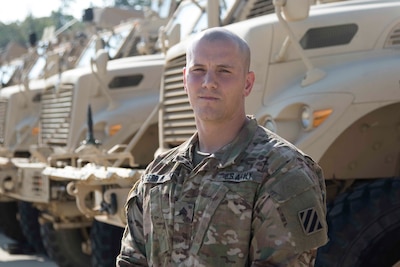
Face of Defense: Soldier Finds Unique Experiences in New Army Brigade


By Army Staff Sgt. Sierra A. Melendez 50th Public Affairs Detachment

FORT BENNING, Ga., Nov. 2, 2017 — Growing up in Springfield, Missouri, Army Sgt. Jeston L. Perryman never envisioned being a skilled operator of foreign military-grade weapon systems. Even after enlisting, he imagined he would primarily troubleshoot malfunctions of infantry weapons and towed artillery.

Perryman's assumptions would be correct – in a typical Army unit.

However, Perryman serves in the Army's 1st Security Forces Assistance Brigade, an exclusive specialized unit made up of soldiers selected based on qualifications and experience.

"It has, hands down, been the greatest opportunity I have had in my career," Perryman said. "I have done things in the short amount of time I have been assigned here that many don't get to experience once in their time in the Army."

As part of Army Chief of Staff Gen. Mark A. Milley's initiative, the brigade is designed to conduct security force assistance operations to train, advise, assist, accompany and enable partner-nation security forces in support of combatant command requirements worldwide.

In the past, advise-and-assist missions were conducted primarily by brigade combat teams. The creation of security forces assistance brigades will allow brigade combat teams to shift their focus back on readiness for warfighting against near-peer threats.

Elite Fighting Force

Perryman touts the security forces assistance brigade as building an elite fighting force with a caliber of training and leadership surpassing any other unit he has served with.

"It has been constant specialized training events, one after the other," he said. "Myself and other soldiers have had the opportunity to attend Army schools that I know I wouldn't have had the opportunity to in a traditional line unit."

For example, Perryman, along with all other soldiers in the brigade, have attended the Military Advisor Training Academy.

"We've already done some simulated key leader engagements with soldiers acting as role players as Afghan counterparts during the MATA," said Perryman. "It's unlike anything I have ever done before."

Additionally, Perryman had the opportunity to attend foreign weapons training, receiving close to the same experience the Army's special operations community has on the subject.

"We were able to get familiarized with Afghan weapon systems such as the AK-47, the Rocket Propelled Grenade 7 and the DShK," Perryman said. "This way, we are adequately prepared to train our foreign-national counterparts on their own weapons."

Latest Equipment

Foreign weapons familiarization is not the only incentive that soldiers have  to look forward to if they make the decision to apply for the premier, volunteer-only unit. Security forces assistance brigade volunteers will receive the latest personal equipment and arrive to the battlefield using vehicles that include a combination of up-armored Humvees; mine-resistant, ambush-protected vehicles and light medium tactical vehicles.

Volunteers will receive training that includes common core operations, advising, communications, foreign weapons, and foreign language training, culminating with division-level sponsored capstone exercises at one of the Army's combat training centers prior to deployment.

Higher Deployment Tempo

Like many soldiers who raise their right hand to serve, Perryman knew he wanted to deploy – soon and often. Although much of the Army has seen a decline in frequency in overseas and combat deployments, security forces assistance brigades will deploy to combat and will likely have a higher deployment tempo than other conventional Army units.

Perryman urged his peers to obtain more information if they think they are interested in the opportunities the new brigade has to offer.
"My company has 51 people, so you really get to know each other," he said. "There is a type of unit cohesion that is unlike any other unit that I have served with. It's great. You know everyone here deserves to be here."

Navy to Christen Guided-Missile Destroyer Delbert D. Black


The Navy will christen the newest guided-missile destroyer the future USS Delbert D. Black (DDG 119), Saturday, November 4 during a 10:00 a.m. CST ceremony at Huntington Ingalls Industries Shipbuilding in Pascagoula, Mississippi. 

The future USS Delbert D. Black is the first ship to bear the name of a Master Chief Petty Officer of the Navy (MCPON) and is named for the first person to hold that office. Black began his 30-year Navy career in the spring of 1941. After completing recruit training, he reported to his first assignment USS Maryland (BB 46) in Pearl Harbor where he witnessed the Japanese attack that drew the United States into World War II. Over the next 26 years, he rose through the ranks to Gunner's Mate Master Chief before his selection in 1967 to serve as the first MCPON. The MCPON is the senior enlisted leader in the Navy and serves as an advisor to the CNO and to the Chief of Naval Personnel in matters dealing with enlisted Sailors and their families.

MCPON Steven S. Giordano, 14th and current Master Chief Petty Officer of the Navy, will serve as the principal speaker during the ceremony. Mrs. Ima Black, MCPON Black’s widow and a World War II Navy veteran herself, will serve as the ship’s sponsor and break a bottle of sparkling wine across the bow to formally christen the ship, a time-honored Navy tradition.

“It is a fitting tribute to the Master Chief who set the tone for all of us to follow as authentic, competent and courageous leaders,” Giordano said. “This ship represents the enlisted force perhaps more than any other ship in the Navy.”

Delbert D. Black will be the 69th Arleigh Burke-class destroyer and is currently the fifth of 13 ships currently under contract for the DDG 51 program. The ship will be configured as a Flight IIA destroyer, which enables power projection, forward presence and escort operations at sea in support of Low Intensity Conflict/Coastal and Littoral Offshore Warfare, as well as open ocean conflict.

Delbert D. Black will be equipped with the Navy's Aegis Combat System, the world's foremost integrated naval weapon. The ship will also incorporate Cooperative Engagement Capability that when combined with the Aegis Combat System will permit groups of ships and aircraft to link radars to provide a composite picture of the battle space effectively increasing the theater space. The capability is designed to provide the Navy with a 21st century fighting edge.

The nearly 9,500-ton Delbert D. Black is 509.5 feet in length, has a waterline beam of 59 feet and has a navigational draft of 31 feet. Four gas turbine engines will power the ship to speeds in excess of 30 knots.

Media may direct queries to the Navy Office of Information at (703) 697-5342. Additional information on Arleigh Burke-class destroyers is available online at http://www.navy.mil/navydata/fact_display.asp?cid=4200&tid=900&ct=4

Wednesday, November 01, 2017

Injured Marine Fulfills Dream of Learning to Surf


By Shannon Collins DoD News, Defense Media Activity

WASHINGTON, Nov. 1, 2017 — Growing up in Gardena, California, now-Marine Corps Cpl. Leighton Anderson recalled that as a boy his Navy father would take him to military airshows.

At that time, Anderson said he wanted to be a fighter pilot.

“I [later] realized I can’t do that because of my eyesight. But my dad took me over to [Marine Corps Air Station] Miramar, and I saw all of the aviation things and the people flying. I always wanted to be a part of the Blue Angels with their jets,” Anderson said.

Anderson didn’t get assigned with the Blue Angels maintenance and support team, but he did get become a crew chief with MV-22 tilt-rotor Osprey aircraft at Okinawa, Japan.

As an Osprey crew chief, Anderson said he inspected the aircraft, repaired the engines and replaced worn parts.

“While we’re flying, we back up the pilots. We load cargo and passengers as well,” he said.

Injury

In December 2016, after serving four years on Osprey aircraft, Anderson was severely injured in an Osprey crash during a training mission.

“We crashed at 200 mph, and I was strapped down,” he said.

Anderson said he received a concussion, and injured his jaw and one of his eyes. He said he was required to wear an eye patch over the injured eye, which required stitches.

Anderson said he also broke his right hand and right foot.

“I broke some ribs and collapsed my left lung,” Anderson continued. “I bruised my heart and fractured my right scapula.”

Anderson said he also has traumatic brain injury and post-traumatic stress disorder.

Surfing Clinic

Today, Anderson is a patient at Naval Medical Center San Diego, where he’s learned how to surf as part of his recovery.

Anderson said he looked at the other recreation programs the Naval Medical Center San Diego’s Health and Wellness Department’s Wounded, Ill and Injured Wellness division offers, but the surfing clinic stood out to him the most.

“I’ve always wanted to learn how to surf since I’m from California,” he said. “I tried it three times in my life and never did it. And I was like, ‘Let me try it through the program here.’ And then after that, I was hooked. It was pretty sweet.”

Anderson said the surfing clinic has helped him physically and mentally.

“I had so many barriers because once I was injured I was like, ‘I don’t know if I can do that. I might hurt myself,’” he said. “I have a little bit of PTSD, and I didn’t think I would enjoy anything.”

Anderson added, “Once I tried it, I broke down a lot of barriers I had mentally and physically. I had weak tendons in my hand and my foot, but with surfing they’re starting to get better. And mentally, it makes me happy. I love it. Everybody’s really supportive. It’s just something everybody should take on.”