Wednesday, November 01, 2017

Honor Guard Brings New Perspective for Airman


By Air Force Airman 1st Class Suzanna Plotnikov 81st Training Wing

KEESLER AIR FORCE BASE, Miss., Nov. 1, 2017 — A yearlong commitment to the honor guard here was not what Air Force Tech. Sgt. Benjamin Graham expected it to be.

The noncommissioned officer in charge of the honor guard’s Delta Flight, Graham said he didn’t know a lot about honor guard when he joined. “I just saw the face of the Air Force Honor Guard -- them doing shows, performing and twirling rifles. Now that I’ve gotten into it, it means a lot more.”

Each Keesler Honor Guard member goes through several months of training to be proficient in the skills required to post the colors and fold the flag and serve as a member of the firing party or as a pallbearer. Despite learning to maintain a stoic demeanor, execute precise facing movements and maintain a meticulous uniform, when it comes time to do their jobs, honor guard members can face unexpected challenges.

Arriving to his first funeral at a dark, cloudy rain-filled New Orleans cemetery Graham said he had to focus on keeping his military bearing to present the proper military honors for a grieving family.

Change of Plan

“It was raining several days prior to the funeral so the cemetery was run-down, the tombstones were folded over and weeds were growing everywhere,” Graham said. “There was two inches of muddy water throughout all the gravesites, so it gave it a really disturbing look. The whole group was trying to get our bearing to figure out each honor guardsman’s position.”

The final handing off of the flag to the next of kin can be one of the most memorable parts of a military funeral. Like some parts of life, not every situation goes to plan and for Graham, handing the flag to the mourning family at his first funeral was no exception.

“The family showed up to the funeral 30 minutes early so we had to improvise,” he said. “There were tons of people in a small area so it gave me a claustrophobic feeling. There was nowhere for the family to sit so I had to hand the flag to someone who was standing up instead of the norm of them sitting down.”

Looking into the eyes of someone you don’t know and handing them the U.S. flag may bring a sense of sadness to anyone, but according to Graham, this last moment of each military funeral reinvigorates each honor guardsman to perform better at each funeral.

“They’re crying and they’re thankful; you’re kind of healing their sadness a little bit,” he said. “It’s something I’ve been very appreciative of, and I think that’s what reignites the fire into most of the honor guard teams whenever they’re handing off that flag.”

Graham said he wouldn’t have had a chance to experience the sense of pride and patriotism that comes with performing honor guard duties if it weren’t for his superiors. After speaking to his mentor, Graham realized he was going to be a part of something much bigger than himself and possibly the last time some families have contact with the military.

“Most people who aren’t affiliated with military don’t really know what to expect from military members and this might be the first and last time they see a military member,” he said. “They can see how passionate we are and it instills some sense of pride in America and gives them hope that there are people who are still willing to do what needs to be done … even as an honor guardsman.”

Life With Lizzy: How a Service Dog Is Helping One Combat Veteran Reconnect


By Whitney Delbridge Nichels, U.S. Army Warrior Care and Transition

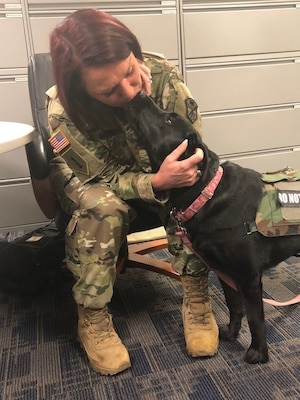
ARLINGTON, Va., Nov. 1, 2017 — The saying goes “all dogs go to heaven,” but for many service dogs, their time on Earth is spent helping people who have seen more than the average human being. Such is the case for Army Master Sgt. Leigh Michel and her service dog Lizzy.

After almost 29 years in the Army, Michel’s service has taken her across the world, including combat tours to Iraq and Afghanistan. Like many of her comrades, during her time overseas, the chaplain’s assistant saw things that left a lasting impact.

“I was in a medical command. Having to see serious injuries and death, that’s when it really started to affect me,” she said.

Michel says those close to her began to notice a change in her demeanor, prompting her to begin seeking treatment.

“I just compartmentalized. As caregivers, that’s what we do,” she said. “I didn’t trust people, couldn’t be around crowds. I got to a point where I shut everyone out.”

In the Warrior Transition Battalion at Fort Belvoir, Virginia, Michel began working to recover from her invisible wounds, as well as physical injuries to her neck and back. But just before to her arrival, she made an unexpected connection that would change her life for the better.

Finding Lizzy

Michel learned of a program called Semper K9, which provides dogs to veterans free of charge. The organization -- run by a Marine Corps veteran -- takes rescue dogs from shelters and puts them through all of the needed training to prepare them for duty as a service dog.

It took Michel some time to find the right four-legged partner, but after working with a few different dogs in training, she came across one that stood out from the pack.

“I took Lizzy home one night and it was like instant bonding,” Michel said.

After finishing her training, Lizzy, a two-year-old black Labrador retriever, came home to live with Michel for good.

“Our bond is ridiculous. She kind of knows what I need before I need it,” she said.

Some of those needs include picking things up around the house and bringing things to Michel to aid her mobility issues.

“She crawls all the way into the dryer to get clothes out. It’s a big help,” she said.

Companionship

But one of the biggest sources of support comes from Lizzy’s companionship and ability to get Michel to step outside her comfort zone.

The duo recently participated in a service dog Olympiad competition put together by Semper K9. The event featured agility courses and competitions to showcase the dogs’ ability to follow commands.

Michel says with no prior preparation, Lizzy gave an impressive performance, taking home three awards; first place in the walking course and rocket recall, and second place in retrieval.

For Lizzy’s handler, the competition provided an opportunity to get out around other people and face her fear of being in crowds.

“She’s made me more open,” Michel said. “People see her and want to stop and talk. Normally, I would just walk by, but now I stop and have those conversations.”

As she continues to develop her bond with Lizzy, Michel said she hopes to see other veterans benefit from the love and assistance of a service dogs.

“Having her in my life has been incredible and I hope to see that for other people,” she said.

Cadets Continue Mission in Puerto Rico


By Army Sgt. Avery Cunningham, 65th Press Camp Headquarters

SAN JUAN, Puerto Rico, Nov. 1, 2017 — Army ROTC cadets from the University of Puerto Rico returned to classes here yesterday. In the wake of Hurricanes Irma and Maria, some cadets used their skills to bolster the Army Reserve and National Guard from within their units.

“They offered me the chance to go to the states to continue my education in a different ROTC program, but I said I’m not going to leave [Puerto Rico], I’m going to stay and help as much as I can,” said Army Cadet Rafael Rivera, assigned to the Puerto Rico National Guard’s 480th Military Police Company.

Rivera’s unit deployed within a week of the hurricane.

“We were called to go to Fort Buchanan, and we were doing search and rescue missions,” Rivera said. “From there we started getting food and supplies to people. Our missions changed to convoy escort for gas and then security for gas stations.”

Living Army Values

Army ROTC builds character by developing leadership skills while students complete their civilian education. The Army instills its core values into cadets: leadership, duty, respect, selfless service, honor, integrity, and personal courage. Cadets demonstrated those values throughout recovery operations after the storm.

“The first week we didn’t have power, water, and food was limited. But you still had to work. You have to put your country and people first. You’re tired, but you have to keep going,” Rivera said. “First thing was getting food and water for my guys’ families so they weren’t worried and could work.”

Puerto Rico is still recovering. The University of Puerto Rico closed twice -- for Hurricane Irma and then Hurricane Maria. The school is overcoming challenges, such as damaged buildings and limited power as classes begin. The campus experienced flooding, broken windows, downed trees and mold growth.

“There was a day the cadets went to [the campus], and we cleaned up the trees and all the things that were destroyed by the hurricane,” Rivera said. "It was good to see other cadets that I didn’t see and catch up with them.”

Now -- a few days later -- light streamed into the classroom where only a few open windows offered light breezes as refuge from the heat. Pencils danced across notebooks, and the projector whirred. The cadets remain focused despite challenges presented following the storm.  “The cadets are performing well,” said Army Capt. Ivan Fuentes, an assistant professor of military science and leadership. “Some of the cadets were activated with their National Guard and reserve units, but they have been given the opportunity to continue with their studies while they are activated.”

The cadets are still ready to train, though there are minimal utilities.

“It will be more hands-on because there is no electricity or internet access,” Rivera said. “As a leader you have to adapt to new things.”

“It’s been hard, though,” he said. “We were saying how hard it is to be a survivor after Hurricane Irma, but after Maria hit, now we’re the survivors.”