Wednesday, November 01, 2017

Life With Lizzy: How a Service Dog Is Helping One Combat Veteran Reconnect


By Whitney Delbridge Nichels, U.S. Army Warrior Care and Transition

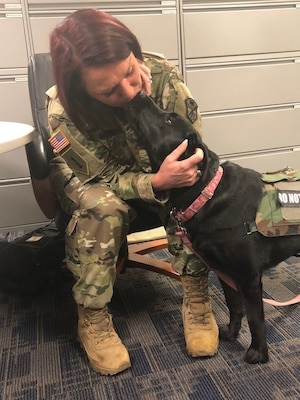
ARLINGTON, Va., Nov. 1, 2017 — The saying goes “all dogs go to heaven,” but for many service dogs, their time on Earth is spent helping people who have seen more than the average human being. Such is the case for Army Master Sgt. Leigh Michel and her service dog Lizzy.

After almost 29 years in the Army, Michel’s service has taken her across the world, including combat tours to Iraq and Afghanistan. Like many of her comrades, during her time overseas, the chaplain’s assistant saw things that left a lasting impact.

“I was in a medical command. Having to see serious injuries and death, that’s when it really started to affect me,” she said.

Michel says those close to her began to notice a change in her demeanor, prompting her to begin seeking treatment.

“I just compartmentalized. As caregivers, that’s what we do,” she said. “I didn’t trust people, couldn’t be around crowds. I got to a point where I shut everyone out.”

In the Warrior Transition Battalion at Fort Belvoir, Virginia, Michel began working to recover from her invisible wounds, as well as physical injuries to her neck and back. But just before to her arrival, she made an unexpected connection that would change her life for the better.

Finding Lizzy

Michel learned of a program called Semper K9, which provides dogs to veterans free of charge. The organization -- run by a Marine Corps veteran -- takes rescue dogs from shelters and puts them through all of the needed training to prepare them for duty as a service dog.

It took Michel some time to find the right four-legged partner, but after working with a few different dogs in training, she came across one that stood out from the pack.

“I took Lizzy home one night and it was like instant bonding,” Michel said.

After finishing her training, Lizzy, a two-year-old black Labrador retriever, came home to live with Michel for good.

“Our bond is ridiculous. She kind of knows what I need before I need it,” she said.

Some of those needs include picking things up around the house and bringing things to Michel to aid her mobility issues.

“She crawls all the way into the dryer to get clothes out. It’s a big help,” she said.

Companionship

But one of the biggest sources of support comes from Lizzy’s companionship and ability to get Michel to step outside her comfort zone.

The duo recently participated in a service dog Olympiad competition put together by Semper K9. The event featured agility courses and competitions to showcase the dogs’ ability to follow commands.

Michel says with no prior preparation, Lizzy gave an impressive performance, taking home three awards; first place in the walking course and rocket recall, and second place in retrieval.

For Lizzy’s handler, the competition provided an opportunity to get out around other people and face her fear of being in crowds.

“She’s made me more open,” Michel said. “People see her and want to stop and talk. Normally, I would just walk by, but now I stop and have those conversations.”

As she continues to develop her bond with Lizzy, Michel said she hopes to see other veterans benefit from the love and assistance of a service dogs.

“Having her in my life has been incredible and I hope to see that for other people,” she said.

Cadets Continue Mission in Puerto Rico


By Army Sgt. Avery Cunningham, 65th Press Camp Headquarters

SAN JUAN, Puerto Rico, Nov. 1, 2017 — Army ROTC cadets from the University of Puerto Rico returned to classes here yesterday. In the wake of Hurricanes Irma and Maria, some cadets used their skills to bolster the Army Reserve and National Guard from within their units.

“They offered me the chance to go to the states to continue my education in a different ROTC program, but I said I’m not going to leave [Puerto Rico], I’m going to stay and help as much as I can,” said Army Cadet Rafael Rivera, assigned to the Puerto Rico National Guard’s 480th Military Police Company.

Rivera’s unit deployed within a week of the hurricane.

“We were called to go to Fort Buchanan, and we were doing search and rescue missions,” Rivera said. “From there we started getting food and supplies to people. Our missions changed to convoy escort for gas and then security for gas stations.”

Living Army Values

Army ROTC builds character by developing leadership skills while students complete their civilian education. The Army instills its core values into cadets: leadership, duty, respect, selfless service, honor, integrity, and personal courage. Cadets demonstrated those values throughout recovery operations after the storm.

“The first week we didn’t have power, water, and food was limited. But you still had to work. You have to put your country and people first. You’re tired, but you have to keep going,” Rivera said. “First thing was getting food and water for my guys’ families so they weren’t worried and could work.”

Puerto Rico is still recovering. The University of Puerto Rico closed twice -- for Hurricane Irma and then Hurricane Maria. The school is overcoming challenges, such as damaged buildings and limited power as classes begin. The campus experienced flooding, broken windows, downed trees and mold growth.

“There was a day the cadets went to [the campus], and we cleaned up the trees and all the things that were destroyed by the hurricane,” Rivera said. "It was good to see other cadets that I didn’t see and catch up with them.”

Now -- a few days later -- light streamed into the classroom where only a few open windows offered light breezes as refuge from the heat. Pencils danced across notebooks, and the projector whirred. The cadets remain focused despite challenges presented following the storm.  “The cadets are performing well,” said Army Capt. Ivan Fuentes, an assistant professor of military science and leadership. “Some of the cadets were activated with their National Guard and reserve units, but they have been given the opportunity to continue with their studies while they are activated.”

The cadets are still ready to train, though there are minimal utilities.

“It will be more hands-on because there is no electricity or internet access,” Rivera said. “As a leader you have to adapt to new things.”

“It’s been hard, though,” he said. “We were saying how hard it is to be a survivor after Hurricane Irma, but after Maria hit, now we’re the survivors.”

Corps of Engineers Assesses Generators in U.S. Virgin Islands


By Rebecca Nappi, U.S. Army Corps of Engineers South Atlantic Division

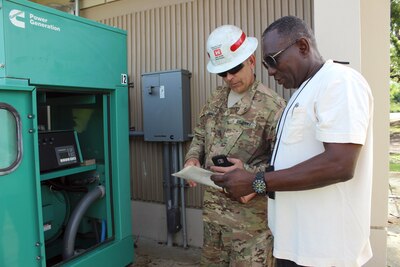
ST. CROIX, U.S. Virgin Islands, Oct. 31, 2017 — The U.S. Army Corps of Engineers’ 249th Engineer Battalion and the Corps’ Tulsa District power team are working together to provide U.S. Virgin Island facility generator owners with assessments to guide and assist them with the future maintenance generators.

“This is going to help the people here by giving them a guide regarding how to provide power or fix their existing generators in the event there is a catastrophic failure,” said Army Chief Warrant Officer Derek Ganley, the 249th Engineer Battalion power systems technician.

The combined team plans to complete more than 25 generator assessments for private facility generators, including for Boy Scouts of America facilities, a community health center, the University of the Virgin Islands and a hospital.

The assessments provide the facility generator owners with a preemptive analysis for generator maintenance requirements and capabilities in the event that the owner does not have a contractor available to perform maintenance on their equipment.

“We were called upon to do assessments of generators due to our vast expertise of operating and maintaining generators,” Ganley said.

The Corps is helping U.S. Virgin Islanders by ensuring these private generators for public facilities will remain serviced and operational until permanent power can be restored throughout the islands.

Ready to Respond

The 249th Engineer Battalion is a versatile power-generation battalion assigned to the Corps that provides commercial-level power to military units and federal relief organizations during full-spectrum operations.

During emergency events, the 249th and one of the Corps’ seven established power teams serve as the Federal Emergency Management Agency’s power engineers. Soldiers and power team personnel deploy to fill the power gap between the end of a storm event and the arrival of power and utility contractors, who install temporary FEMA generators to predetermined critical facilities.

When the 249th first deployed to the U.S. Virgin Islands with the Corps’ Memphis District power team after Hurricane Irma hit the islands in late September, they immediately got to work providing temporary power to critical facilities utilizing FEMA generators.

“The prime power team was here to assess the power requirements of critical facilities in the Virgin Islands in order to provide them with proper generators to fulfill their power needs for life, health and safety in the territories,” Ganley said.

These Corps personnel are subject matter experts in temporary power and can provide training requirements as necessary, as well as provide information needed for tools or equipment, making these teams an excellent resource for states or territories with little resources or expertise post-storm events.

“It’s truly been an honor for us to come to the Virgin Islands and be afforded the opportunity to help the people within this beautiful territory,” Ganley said.