Wednesday, November 01, 2017

Face of Defense: Airman Discovers His Trainer Supervised His Father


By Samuel King Eglin Air Force Base

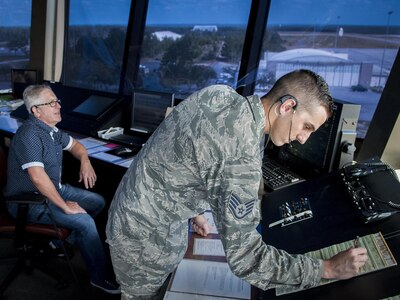
DUKE FIELD, Fla., Nov. 1, 2017 — At the top of the air traffic control tower here, F-35 Lightning IIs zip by at eye level. Air Force Staff Sgt. Brian Morris keys up his headset to tell those fighters where to go, when to turn and who to talk to next. A few steps behind Morris is Steven Kates. He monitors the action throughout the tower and keeps a keen eye out across the 360-degree spectrum of the bright blue yonder.

Morris is an air traffic controller with the 96th Operations Group. He’s new to the tower here and its ATC flight, and completed his qualification in the three controller positions -- flight data, ground and local -- here Oct. 4. This means he can control aircraft on his own, without being monitored by a trainer. Some of his training was conducted by Kates, the tower’s watch supervisor.

During Morris’s training, the trainee and his trainer discovered they shared a generational ATC bond, possibly dating to before the new staff sergeant was born.

“We were basically getting to know the new guy on the crew,” said Kates, who has controlled aircraft at Eglin and Duke Field for 20 years. “We discovered his father and myself were at Davis Monthan [Air Force Base, Arizona] tower at the same time in the early nineties.”

Like Father, Like Son

Kates remembered training and supervising Morris’s father in the tower between 1990 and 1992. Kates was a technical sergeant and Brian Morris Sr., was an airman first class.

“It took a bit, but my dad did remember a Sergeant Kates,” said Morris, who followed in his father’s footsteps to become an Air Force air traffic controller.

Kates joked about possibly seeing Morris as an infant at unit events or family functions. Morris, who was born in 1991, went even further, speculating that Kates may have signed his father’s leave paperwork so he could be at his son’s birth.

Right now however, Kates looks on as Morris issues a bird sighting to an incoming F-35 during his final tower evaluation. Kates helped both father and son become qualified air traffic controllers approximately 26 years apart.

Morris is one of a few new airmen assigned to the 96th Operations Group flight to help with the increased traffic above the Duke Field runway.

The 14 airmen and civilians on the day and night crews control aircraft from every base in the local area, to include Tyndall Air Force Base and Pensacola Air Station. This means a continuous rotation of all varieties of aircraft from helicopters to the F-22 Raptor. The bulk of their traffic is F-35s and Air Force Special Operations Command aircraft.

Something New Every Day

The demand for runway approaches at Duke Field challenges new controllers and keeps veteran controllers on their toes. Recently, Runway 18/36 has become the go-to path for unique training opportunities. The controllers work all requests for nonstandard approaches, atypical special operations landings, parachute drop training and night vision flights.

“It is something new every day we come to work,” said Kates, a retired master sergeant and Texas native. “The constant changes make it challenging and overall very satisfying work.”

He compared controlling aircraft to a 3-D chess board.

Kates also said when training a new controller he always tries to impart some wisdom from his years of experience that could benefit the trainee in his current position and possibly throughout their career.

“He really helped me grasp how different Duke Field traffic is from Eglin,” said Morris, who is now qualified at both locations. “He made me understand how the puzzle fits together.”

Kates estimates he’s trained more than 40 controllers over his 37-year career. He only has five more years before he can retire and he said he plans to keep sharing his knowledge and techniques until he finally hangs up his headset.

Morris has two more years in the Air Force and plans to again follow his father’s path and become an air traffic controller for the Federal Aviation Administration.

Troxell: U.S., South Korean Troops on DMZ ‘Ready’


By Jim Garamone DoD News, Defense Media Activity

WASHINGTON, Oct. 31, 2017 — South Korean and American troops on and near the Demilitarized Zone separating North and South Korea are ready, well-supplied, well-trained and prepared, the senior enlisted advisor to the chairman said following a visit over the weekend.
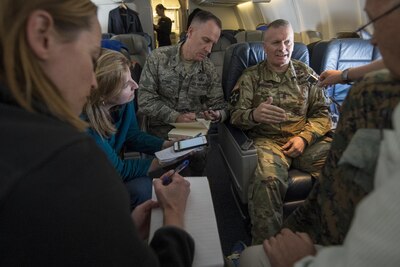
Army Command Sgt. Maj. John W. Troxell, the senior enlisted advisor to the chairman of the Joint Chiefs of Staff, speaks to reporters.

Army Command Sgt. Maj. John W. Troxell accompanied his boss, Marine Corps Gen. Joe Dunford, the chairman of the Joint Chiefs of Staff, to South Korea. But where the general participated in the Military Committee Meeting and Security Consultative Meeting with his Korean counterpart, Troxell used his time to get a feel for what life is like on “Freedom’s Frontier” in light of current tensions.

The DMZ is a place where North Korean troops are studying every action on the southern side. They continually probe, test and push for a reaction from the South Korean troops that man most of the DMZ.

The unit Troxell visited -- the 1st Republic of Korea Division’s 1st Reconnaissance Battalion -- was the victim of a North Korean intrusion across the DMZ three years ago and had soldiers wounded in a minefield laid by North Korean special operations forces.

Unfiltered Look at the North

“I felt the need to go up to the Demilitarized Zone outside of the Joint Security Area and go to an area where I could get an unfiltered look at the North Koreans and what their demeanor, what their disposition, what their posture was in light of all of this rhetoric,” Troxell said.

He also just wanted to talk with South Korean troops to get a feel for their morale and readiness, he said.

The sergeant major’s previous job was as the senior enlisted leader for U.S. Forces Korea and the Combined Forces Command.

He said he did not notice much difference in the North Koreans across the line. “They were on security,” he said. “They were observing into the South, especially when I got there -- a lot of folks with binoculars trying to figure out what we were doing. But their patrols did not seem like they were in any more enhanced readiness than what they normally are.”

Despite the rhetoric from North Korean leader Kim Jong Un, the North Koreans were carrying on business as usual, he said. On the North Korean side, there are heavy weapons in contravention of the U.N.-brokered armistice signed in 1953. The North kicked out the two armistice guarantor nations -- Poland and Czechoslovakia -- when the Soviet Union fell.

“We still have the Swiss and the Swedes in the southern part of the DMZ that are making sure that the [South Koreans] and the U.S. aren’t breaking any rules, in accordance with the armistice,” the sergeant major said.

The assumption in the south is that the North Koreans are breaking the rules and allied forces have to plan accordingly, he said.

‘Frail’ Troops

And there are a lot of North Korean troops. “There’s 750,000 North Korean troops on the DMZ, out of a more than 1.1 million man and woman force,” Troxell said. “But we haven’t seen them do a combined arms maneuver in 20 years. They fire about five to 10 rounds out of their rifles a year. And a good part of them have been diagnosed as being medically frail.”

“But there are 750,000 of them,” he continued. “So if you end up in conflict and you got full magazines of ammunition, you better not miss.”

And the North Koreans have been indoctrinated since birth on the infallibility of the Kim family. “If we have to go into high-end conflict, the North Koreans are going to fight,” Troxell said. “They’re prepared to fight and defend their country and defend who they call the Great Leader.”

On the South Korean side, the troops were patrolling and ready, the sergeant major said. They are a learning Army, he said, and have learned from the incident where the infiltrators came in. “They’ve really upgraded their positions,” Troxell said. “They’ve cut back all of the foliage from around their guard posts and the gates to get into the DMZ. They’ve also reinforced with, you know, better cameras and everything, so they have [fewer] blind spots that the North Koreans can exploit.”

‘Ready to Fight’

A bit farther back, the sergeant major met with American soldiers. “Obviously, they pay attention a lot more to the news than the [South Koreans] do, and certainly more than the North Koreans,” he said. “There was a lot more heightened sense of, ‘Hey, we got to be ready.’”

The rotational brigade -- now from the 1st Cavalry Division -- goes through a decisive action training rotation at the National Training Center in California and then deploys to the Korean Peninsula. “Those guys and gals are absolutely prepared for high-end conflict because they’ve been certified in it,” Troxell said. “They’re ready to fight.”

American units are training and focusing on potential threats, one of which is North Korea’s use of tunnels. “Subterranean warfare is something we have to continue to prepare for,” the sergeant major said. “As a matter of fact, the Army is making subterranean warfare part of their doctrine, and the Marines are going that way too.”

South Korean and U.S. soldiers serve together closely. The 2nd Infantry Division, which is the divisional headquarters there, is now a combined division, with South Korean and U.S. officers and noncommissioned officers on their division staff. “If you look at the 2nd Infantry Division patch, … it says combined division over their patch now,” he said.

The 2nd Infantry Division is also certified at all levels of combat.

Building Mil-to-Mil Relationships

The members of the division continually look for ways to enhance the military-to-military relationship, Troxell said, especially in their noncommissioned officer corps. The South Koreans are looking “to better develop their squad leaders and platoon sergeants to operate effectively at the decentralized level and operate off of commanders’ intent and apply discipline initiative to get after combat, if they have to,” he said. “They really look at the noncommissioned officer corps in the United States military, and they want theirs to be like that.”

There are cultural differences that have to be overcome and much of the South Korean military is made up of conscripts. But, South Koreans have served alongside the U.S. in every contingency since the Korean War, Troxell said, and they see that the American military expands the commander’s reach in the battlespace by empowering noncommissioned officers to act without being told.

This is especially needed in terrain like that at the DMZ, which is mountainous. “It’s a cluttered battlefield,” he said, “and it will call for decentralized execution to defeat the North Koreans. That means we’ve got to continue to have empowered enlisted leaders, because this will be a squad-level fight, more so than it will be a battalion/brigade-level fight.”

Tuesday, October 31, 2017

Trilateral Cooperation Needed to Combat North Korean Threat


By Jim Garamone DoD News, Defense Media Activity

WASHINGTON, Oct. 31, 2017 — The world is united against North Korea’s nuclear and missile threats and nations are working together to counter the dangers of Kim Jong Un’s ambitions, the chairman of the Joint Chiefs of Staff said Oct. 29 following the trilateral military meeting with South Korean and Japanese leaders.

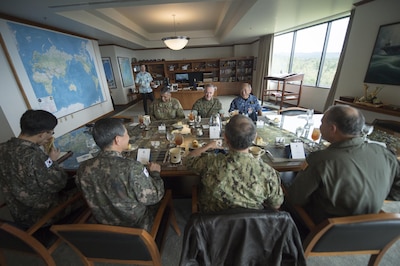
Marine Corps Gen. Joe Dunford hosted his counterparts -- South Korean Air Force Gen. Jeong Kyeong-doo, chairman of the South Korean Joint Chiefs of Staff, and Japan Maritime Self-Defense Force Adm. Katsutoshi Kawano, Japan Self-Defense Force chief of staff -- in trilateral talks at U.S. Pacific Command headquarters in Hawaii that focused narrowly on the threat posed by North Korea.

The chairman said the first thing the three military leaders did was establish a baseline of the threat. “One of the first discussions we had was on how we see [North Korea],” Dunford said to reporters traveling with him. “We have a common understanding of the challenge. As military leaders we have a common understanding about the coherent, collective response to that challenge. What we try to do is find ways to enhance our collective abilities.”

Trilateral, Multilateral Cooperation

To combat North Korea’s nuclear and missile threats, the military leaders agreed the nations need to work together both on a trilateral basis and in multilateral efforts. “That includes missile defense and any planning and focus on the nuclear threat posed by North Korea,” Dunford said.

South Korean leaders agreed, saying that trilateral cooperation is a proper response for missile defense and the nuclear threat. For ballistic missile defense, time is of the essence. Good communications among the nations is crucial to safeguarding the people of the region and the United States.

This was the fifth trilateral meeting since 2014, and cooperation has been easier each time, defense officials said. “Essentially, in the next year the chiefs of defense agreed to improve ballistic missile defenses, all wrapped up with better sharing of data, and to conduct routine exercises to ensure we have a coherent collective response to ballistic missile defense,” Dunford said.

The three leaders agreed to meet twice in the coming year.

“We had discussions two years ago about ballistic missile defense and information sharing and since then we have done a number of exercises and improved trilateral ballistic missile defense capability over the past two years,” Dunford said. “We talked about information sharing and we actually now have links to be able to provide information across the three countries in a much more effective way.”

Kim Jong Un tested intercontinental ballistic missiles in July -- alleging that the missiles can reach “anywhere in the world” -- and detonated a nuclear device Sept. 3. Two intermediate range missiles overflew Japan on Aug. 29 and Sept. 15. Kim has threatened to launch and detonate a hydrogen bomb over the Pacific, and world leaders must treat that threat as credible, defense officials have said.

Successful ballistic missile defense needs to have the United States, South Korea and Japan sharing information and intelligence quickly, and the three leaders promised to do so.

Japan Critical to Response

“If we do have to respond [to North Korea] militarily, Japan is a critical platform from which the United States is going to meet its alliance commitments to [South] Korea,” Dunford said. “We have more than 50,000 forces in Japan. It is a platform from which we project power in a South Korean response. So the military relationship between South Korea and Japan is very important.”

But multilateralism has additional uses, the chairman said, including maritime interdiction operations, humanitarian assistance and disaster response exercises and anti-submarine warfare. Nations in the region are concerned about the North Korean threat and will work with South Korea, Japan, the United States and others to enforce United Nations Security Council resolutions and the sanctions they impose on the Kim regime, Dunford said.

During the trilateral meeting, the military leaders discussed where already-planned U.S. Pacific Command exercises can be leveraged to improve multilateral capability in the region.

Pacom is part of a broader, regional meeting of chiefs of defense, where leaders discuss the full range of defense issues in the Indo-Asia-Pacific region.

“It is important that Japanese and South Korean military leaders are talking. From a deterrence perspective it is important that Kim Jong Un and [North Korea] see that they are facing a collective response from the international community, in particular those nations most affected,” Dunford said.

The chairman said the military-to-military relationship between Korean and Japanese forces is professional, but acknowledged that there are challenges that must be worked out.

Defeating the threat is tough, he said. The preferred solution is that Kim Jong Un realize the error of his ways and he steps away from nuclear and missile technology, Dunford said, adding that United Nations sanctions need time to bite, and perhaps that will convince the North Korean leader.

But ensuring defense also takes time, the chairman said. “You have to ensure that the path of capability development is on the ascent,” he said.

“From year to year, it is hard to measure incremental increases in capability development, but now I am able to look back over the two years that we’ve been meeting and I feel pretty good about it,” Dunford said. “We’ve put in place material changes to our ability to respond.”