By Air Force Staff Sgt. William O'Brien Joint Base
Charleston
JOINT BASE CHARLESTON, S.C., Oct. 26, 2017 — Joint Base
Charleston has been established as the central hub and reception area for
disaster relief supplies as part of sustained efforts in rebuilding Puerto Rico
in the wake of Hurricane Maria.
Joint Base Charleston was chosen because it’s one of the few
Defense Department installations with sea and aerial port facilities.
Different modes of transportation offer different benefits.
A sealift vessel is capable of moving more cargo, but at a slower speed than
airlift. And, while airlift is faster, no aircraft can hold as much cargo as a
ship. By combining the two modes of transportation, representatives are able to
airlift urgent items while sealifting large quantities of materials not
immediately needed.
“Joint Base Charleston was asked by the Federal Emergency
Management Agency through the [U.S.] Transportation Command to be an
installation support base,” said Air Force Col. Rockie Wilson, 628th Mission
Support Group commander. “An ISB is a reception area for disaster relief
supplies. The interesting thing about Joint Base Charleston is it's one of the
few places in the DoD where we can receive supplies by rail and road while
having access to aerial and sea port assets. Such access provides maximum
flexibility to FEMA to be able to send and receive needed supplies.”
Processing Cargo
FEMA and the Pennsylvania Emergency Management Agency
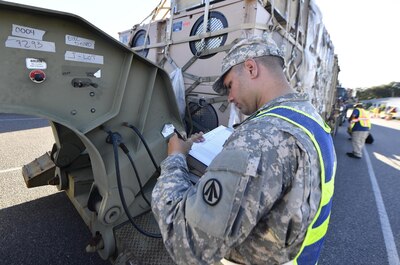
established an initial staging area where items are received, inspected and
measured. That information is put into the 841st Transportation Battalion’s
logging system, enabling them to create a stowage plan.
“We're receiving cargo from federal and state agencies from
all over the country,” said Shawny Dallam FEMA transportation specialist. “When
it arrives, it is inventoried and sent to the staging area to be transported to
the vessel when it docks or to the air base to be flown out.”
The Navy’s roll-on, roll-off vehicle cargo ship, the USNS
Brittin, which has a cargo capacity of 215,000 square feet, is scheduled to
make six trips from here to Puerto Rico over the next two months. Since items
are coming in from a wide range of agencies, some require repackaging before
loading onto the ship.
“Once the items have been received and consolidated, if
needed, the items are prioritized and a stowage plan is created,” said Navy Lt.
Brenton Breed, the 841st Transportation Battalion’s operations officer. “This
stow plan is then shared with the receiving agencies in Puerto Rico. The plan
allows them to know exactly what they’re getting, and what order it will come
off the ship, facilitating a smooth off load when the ship arrives.”
The primary mode of transportation for this mission is by
sea, but if perishable or urgent items arrive at the staging area, they can be
sent to Joint Base Charleston’s aerial port to be flown to their destination
within hours. Transporting cargo by air has the added benefit of being able to
land hundreds of miles from the shore.
“We can be ready as soon as we receive the assets,” said Air
Force 1st Lt. Rebecca Ryti, 437th Aerial Port Squadron air freight flight
commander. “Once a truck pulls up to our dock, we can unload it, inspect it and
get it out to the aircraft in under two hours. Aerial movement is quite amazing
because you can move things from one point to another much more quickly than by
any other means of transportation.”
Logistics Support
Members from units across the 628th Civil Engineer Squadron
provided the logistics support enabling the base to accommodate these
interagency partners in accomplishing their mission. This effort was led by Air
Force 1st Lt. Ana Smith, 628 CE emergency response flight commander. She met
with FEMA and PEMA representatives prior to establishing the staging area to
understand their requirements and identify the base assets to fulfill them.
“It has been a little bit of a chess game trying to
anticipate their requirements and making sure they have everything they need,”
Smith said. “We knew, in general, they'd need base access, a space to store
items waiting to be shipped and escort vehicles when shipments arrive at the
gate. Additionally, I also had to think beyond the surface and look at finer
details. For example, rest room facilities are needed because they are going to
be out here for extended periods of time each day.”
This partnership brings together professionals from a
variety of different agencies with different skill sets and backgrounds. The
team to works as a unit to solve any problems and continues to support the
people who are still suffering from the effects of Hurricane Maria.
“FEMA and PEMA are great partners,” Breed said. “We work
together well. I can provide the logistics expertise they need to ship things
because that's not their normal mission. We're looking forward to working
together with them to help the American citizens of Puerto Rico.”




 Posts
Posts

