Thursday, October 05, 2017

Missouri Air Guard Wing Supports Hurricane Relief Efforts


By Air Force 1st Lt. Phil Fountain, Missouri Air National Guard

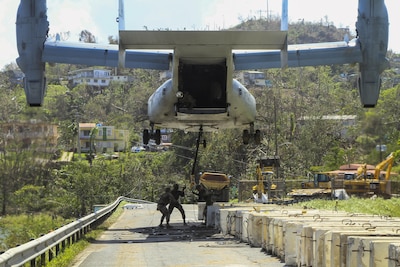
JEFFERSON CITY, Mo., Oct. 5, 2017 — For nearly a month, the Missouri Air National Guard’s 139th Airlift Wing has been proving its value as part of the operational reserve by performing more than 100 sorties in support of hurricane relief efforts in Texas, Florida, the U.S. Virgin Islands and Puerto Rico.

When Hurricane Harvey struck Texas, airmen from the St. Joseph-based 139th were among the first called to respond with their C-130 Hercules aircraft, said Army Maj. Gen. Stephen L. Danner, Missouri’s Adjutant General.

Helping Fellow Americans

“Our airmen were immediately ready to help their fellow Americans, first in Texas and Florida, and now in Puerto Rico and the Virgin Islands,” Danner said. “Bringing people and supplies to areas hit by these storms is a critical, immediate need and the fact our 139th was one of the first called and one of the most relied upon speaks to the wing’s professionalism and effectiveness.”

To date, the Missouri airmen have flown about 140 sorties in support of the relief effort, airlifting hundreds of thousands of pounds of cargo. The wing’s commander, Air Force Col. Ed Black, has flown a C-130 to the Caribbean islands. He was among the first to land on St. Thomas after Hurricane Maria.

“We all understand that our role is a serious one,” Black said. “We were able to land and put the 123rd Special Tactics Squadron [from the Kentucky Air National Guard] on the ground to open the airfield [on St. Thomas in the U.S. Virgin Islands]. Opening the field is critical to starting the flow of relief efforts.”

Black also discussed the personal impact of the mission.

“Those hills used to be green -- every tree was stripped clean,” Black said. “The St. Thomas you remember is no more. It leaves an impression. It compels us to volunteer to assist in any way possible.”

Another pilot to fly into the region was Air Force Col. Timothy P. Murphy, the 139th Operations Group commander, who had the opportunity to directly interact with local residents.

Grateful Citizens

“The resiliency of the people has been overwhelming,” Murphy said. “You see devastation all around you; no power, no timeline. Yet, they are still positive and just so grateful for every little thing we do. It is the attitude of everyone in the region that we encountered.”

Currently, the 139th has about 30 service members tasked to serve in the Virgin Islands. Their role is part of a larger mission being orchestrated by the joint-service 601st Air Operations Center, a component of the North American Aerospace Defense Command and U.S. Northern Command.

Coordinating the effort on the ground is Air Force Chief Master Sgt. Rhys L. Wilson, the air cargo superintendent for the 139th. He is currently serving as the senior chief air advisor for the Virgin Islands Air National Guard and is overseeing the aerial port operations in St. Croix, which includes nearly 50 airmen from multiple Air National Guard wings.

“The people here truly appreciate us,” Wilson said. “I have received more hugs from total strangers.”

‘Morale is High’

Wilson said his airmen are excited to be part of the mission.

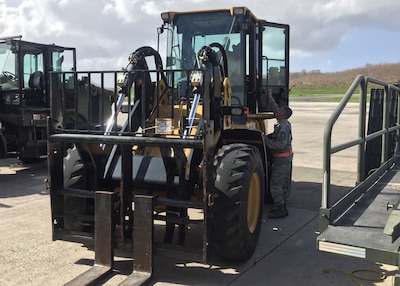
“The morale is high in the aerial port,” Wilson said. “They are working well downloading the airplanes and assisting the Army uploading trucks.”

Additionally, the National Guard Bureau has set up an aerial port in Savannah, Georgia, to coordinate Air National Guard assets flying into the region. The missions range from troop transportation to the delivery of food, water, generators, medical supplies and other needed supplies.

Even as the 139th supported hurricane relief operations, they’ve continued normal business and contributed greatly to a state mission in Missouri and have deployed airmen abroad.
“I’m very impressed with what our airmen have accomplished these past few weeks,” Danner said. “Even as they flew sorties to support fellow Americans affected by hurricanes, they mobilized dozens of members to support efforts for a recent mobilization to St. Louis, and have deployed dozens of airmen in support of overseas contingencies operations. Like the rest of the Missouri Guard, the 139th is a versatile, seasoned, ready force.”

Over 11,000 DoD Personnel Aid Puerto Rico Hurricane Relief Efforts


By Cheryl Pellerin DoD News, Defense Media Activity

WASHINGTON, Oct. 5, 2017 — More than 11,000 Defense Department personnel now are in Puerto Rico, helping the U.S. territory recover from the wrath of Hurricane Maria in the areas of logistics, medical support and aviation, Puerto Rico Gov. Ricardo Rossello said during a news conference in San Juan this morning.

DoD continues to expand a comprehensive island-wide commodities distribution and medical support network in support of the Federal Emergency Management Agency and the U.S. Department of Health and Human Services, according to today’s DoD update of activities in Puerto Rico.

The department’s response efforts focus on supporting FEMA priorities for distributing food and supplies, producing and distributing clean water, delivering generator fuel to hospitals, clearing roads and working on the Guajataca Dam spillway, the governor said.

DoD also is supporting the restoration of access to other essential city services, including sewage and wastewater treatment, he said.

“We have already signed a mission agreement with the U.S. Army Corps of Engineers to start reestablishing electrical transmission and distribution effectively in Puerto Rico,” Rossello said.

USNS Comfort

The Navy hospital ship USNS Comfort arrived in Puerto Rico Oct. 3 and docked in San Juan, the governor said, noting that the ship has 250 beds and capacity for 1,000 patients. More than 500 medical personnel are on board and can serve more than 200 patients a day.

“Right now it has about 64 patients,” he added, and has received an assignment based on an assessment completed yesterday by the PR Department of Health, DoD, HHS and FEMA “to make sure that we know what the needs are in each region in Puerto Rico so we can deploy the USNS Comfort appropriately, in a route that makes sense” for all patients.

The route includes several cities, and according to the DoD response update. The Comfort is en route to one of Puerto Rico’s largest cities, Ponce, at HHS request, to better meet the island’s medical requirements.

Rossello said the ship will pick up patients in need but also will deliver necessities to the cities where it will stop, including water, food, medicine and other resources.

“The USNS Comfort can also serve as a logistical mechanism to deploy food and services across Puerto Rico,” he added.

Logistics, Medical Support

U.S. Northern Command, based in Colorado Springs, Colorado, continues to deploy five force packages, each with enhanced logistics capacity centered on commodity distribution and medical support.

Force Package 1, for command and control, is on the ground in Puerto Rico. Force Packages 2 and 3 are sustainment/logistical units and associated command and control; elements of Force Package 2 deployed into Puerto Rico Sept. 30. More sustainment units and aviation elements deployed Oct. 1. Force Package 4 delivered helicopters Oct. 2-3, aviation command-and-control elements and medical units. Force Package 5 will provide more robust medical capacity.

Army Lt. Gen. Jeffrey Buchanan, head of Northcom's Joint Force Land Component Command, or JFLCC, integrated 114 recently arrived bulk fuel trucks and six propane trucks, all from the Defense Logistics Agency, into the logistical distribution plan. Buchanan is in command of DoD’s Hurricane Maria response and relief efforts in Puerto Rico.

Also part of the response, DoD has deployed a Veterans Affairs Medical Unit and is set to deploy an Army Combat Support Hospital and Expeditionary Medical Support Hospital.

The JFLCC surgeon is working with HHS, the Puerto Rico National Guard and the PR Health Department in continuing efforts to reassess and resupply hospitals across the country.

Air Force Surgeons Aid in Treating Las Vegas Shooting Victims


By Air Force Senior Airman Kevin Tanenbaum 99th Air Base Wing

NELLIS AIR FORCE BASE, Nev., Oct. 5, 2017 — "On Oct. 1, 2017, at 10:08 p.m., I was asleep in my bed like every Sunday before that," Air Force Maj. (Dr.) Charles Chesnut, a general surgeon assigned to the 99th Medical Group here said. "About an hour and a half later, I was awakened by the Air Combat Command emergency notification system: 'Avoid downtown Las Vegas – active shooter on the strip.'"
.
Chestnut, along with three general and three resident surgeons assigned to the 99th Medical Group, responded to the University Medical Center of Southern Nevada to help treat patients injured during the largest single-shooter massacre in modern U.S. history.

"Within two hours after the incident, all the resuscitation bays were full and six patients were being operated on by trauma surgeons," Chesnut said. "Everyone worked together taking care of these patients and do some good in the face of evil. We treated over 100 patients, ranging from surgical procedures to end-of-life care."

Working With Civilian Surgeons

The Air Force and civilian surgeons worked hand in hand through the night to treat patients' visible wounds in the operating rooms while also addressing invisible wounds at the bedsides.

"We held their hands as they charged their cell phones so they could reach out to family members, who feared for their lives," Chesnut said.

After a few hours, the doctor recalled, time blurred as the second wave of injured patients arrived around 3 a.m. from smaller hospitals that no longer had the capacity to treat them.

"The environment down there was controlled chaos, but the disaster response plan that the hospital had in place for a mass casualty worked," he said. "At no point did I feel like our capacity was overwhelmed."

As 7 a.m. approached, the influx of patients ended, and the University Medical Center began to settle.
"Days like we experienced at UMC are the toughest ones, when you have multiple patients injured while multiple patients are continuing to come to the hospital," said Air Force Col. (Dr.) Brandon Snook, a surgeon assigned to the 99th Medical Group. "Those are some of the toughest days, but also very rewarding. We all see a problem and do what we can to fix it to help out patients."