Wednesday, October 04, 2017

Tactical Gaming Teaches Warfighters Real-World Scenarios


By Sgt. Anthony Jones
45th Infantry Brigade Combat Team

Ukrainian army trainers at the Yavoriv Combat Training Center are adding a new tool to their skill set: tactical gaming programming.

A team of instructors from the U.S. Army’s Joint Multinational Simulation Center is at the base in Western Ukraine teaching the CTC’s simulations staff how to build and operate tactical training scenarios using the Virtual Battlespace Simulator 3.

    “Tactical gaming is not here to replace boots-on-the-ground training,” said Carl Lester, chief of tactical gaming for the JMSC and one of the instructors teaching the Ukrainian cadre how to use VBS 3. “It is here to facilitate specific training needs.”

The purpose of the training is to ready the CTC’s simulations staff to build realistic scenarios for the soldiers who will take part in 55-day training rotations where they will train on tasks ranging from individual soldier skills to battalion-level maneuvers.

Lester, a former U.S. Army senior noncommissioned officer, said when units go to the field, commanders can lose focus on training objectives when they have to split attention between training, life support and tracking equipment inventory, and simply cannot see how every soldier is reacting under pressure.

“Using tactical gaming – using real-world training objectives and actual Yavoriv terrain, leaders can train their soldiers without the stress of being in the field,” Lester said.


By training in a classroom with the VBS 3 system, commanders are able to see how every soldier performs. The scenario is projected onto a large screen for commanders and trainers to observe while everything is recorded for accurate after action reviews.

    “Virtual training gives leadership a better tool to access soldiers,” Lester said. “Commanders can see shortfalls if they can see it in a classroom, where in the real-world field a commander can’t see everything. This gives commanders a God’s-eye view.”

By teaching the CTC staff to build and run scenarios, the team is helping the JMTG-U build the Ukrainian army’s capability to train soldiers.

“This gives them the tools to implement training on their own,” Lester said. “They’re learning to assess warfighters to ensure they are getting the best results of the training.”

Face of Defense: For One Marine, Hurricane Irma Was Personal


By Marine Corps Cpl. Jonathan Sosner 26th Marine Expeditionary Unit

NAVAL AIR STATION KEY WEST, Fla., Oct. 4, 2017 — As Hurricane Irma made her way through the Atlantic Ocean last month, Marine Corps Sgt. Kevin Diaz, a supply warehouse clerk with the 26th Marine Expeditionary Unit, had something very important on his mind.

Diaz, a native of Caguas, Puerto Rico, was worried about his mother and sister, who were hunkered down in his hometown, preparing to weather the storm.

"I was concerned if they were all right," Diaz said. "Puerto Rico didn't get hit as hard as other places, but it was tough not knowing if they were OK."

The damage to Diaz's hometown, while not completely devastating, was significant and has made day-to-day life very challenging. "They had limited food and no water or electricity for four days," he said. "Compared to other people in the area, they got lucky."

Knowing how Hurricane Irma had affected his own home, Diaz said, he was motivated to be a part of the 26th MEU aiding the citizens of Key West, Florida, another area seriously affected by the storm, to get back on their feet in its aftermath.

Working Around the Clock

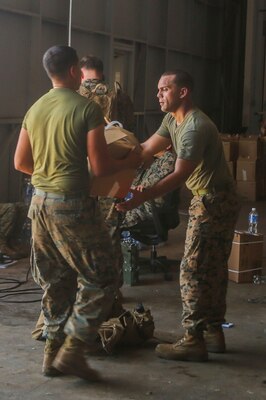
On Sept. 12, Marines and sailors from the 26th MEU arrived off the Key West coast, aboard the amphibious assault ship USS Iwo Jima just days after Hurricane Irma caused devastation across the region. While on the ground, they worked around the clock, clearing roadways and distributing food and water.

"It felt great to help people here who were experiencing some of the same issues that my family was facing back home," Diaz said. "What we did there made it feel like we made a big difference in their community."

As a supply warehouse clerk, Diaz was in charge of making sure the Marines and sailors in Key West were getting food and water, a critical part of staying alert and being ready to continue helping the affected community.
"Everything we did over there went really well," he said. "It was pretty amazing to see how much of a difference we could make in a few days."

Officials Dedicate Pentagon Corridor Honoring National Guard's History


By Air Force Tech. Sgt. Erich B. Smith National Guard Bureau

WASHINGTON, Oct. 4, 2017 — A new exhibit honoring the National Guard and its 380-year history opened Sept. 29 at the Pentagon.
Civilian and airman tour new National Guard display.

Air Force Gen. Joseph L. Lengyel, the chief of the National Guard Bureau, and retired Army Gen. Frank Grass, the 27th chief of the NGB, together cut the ceremonial ribbon to officially open the exhibit space.

"What a magnificent piece of work, telling a magnificent story about our nation and our military and about the continually evolving piece of who we are as the National Guard," Lengyel said during the ceremony.

Grass echoed Lengyel's sentiments about the importance and relevance of what the exhibit conveys.

"This tells our story since the first militia mustered in 1636, and you have to keep telling that story," Grass said.

In the Works Since 2013

The idea for an exhibit began in 2013, said Army Lt. Col. Jeff Larrabee, chief historian with the Guard Bureau and principal historical advisor for the exhibit's planning committee. After Pentagon officials approved the basic concept, committee members started expanding on ideas, drawing sketches and selecting appropriate visual media.

Larrabee said the group's collaborative effort focused on one thing: "What did we want people to leave with?"

Eventually, the committee established a goal of creating an exhibit that reflected the Guard's mission while highlighting key moments and campaigns in which the Guard has participated, Larrabee said. The group wanted to represent the 50 states, three territories and the District of Columbia in a fair manner, he added/

Past and Current Missions

The exhibit space features 17 reproductions of Guard heritage paintings and more than 60 photographs strategically placed throughout the corridor. One side of the hall, titled "Foundation," captures Guard participation in past conflicts in chronological order. The other side sheds light on the Guard's current missions and can be updated as needed, Larrabee said.

"We tried to keep it simple so that if you're focused on one side, you're going follow it from start to finish, ensuring that it makes sense and the history of the Guard flows to its current operations," he added.

Lengyel lauded the effort to secure a prime exhibition space that will be viewed by an estimated 121,000 visitors annually through the Pentagon's public tours.

He added that while the exhibit masterfully captured both the Guard's heritage and current operations, it also highlights its flexibility as an operational force.

Lengyel also noted the Guard's role in a constantly changing national and global environment.
"I know that in the future we will adapt and change," he said. "We are a warfighting reserve in the U.S. Army and U.S. Air Force and we are America's domestic crisis response force, and we are very proud of that."