Friday, September 29, 2017

Service Members Work With Puerto Rican, Federal Agencies to Help Island Recover


By Jim Garamone DoD News, Defense Media Activity

WASHINGTON, Sept. 28, 2017 — The Puerto Rican government is working closely with federal agencies -- including the Defense Department -- to recover from the catastrophe that was Hurricane Maria, officials on the island said via teleconference today.

DoD personnel were working with Puerto Rican authorities before the storm hit, and they have continued the efforts.

In a phone call with Puerto Rico Gov. Ricardo Rosselló today, Deputy Defense Secretary Pat Shanahan told the governor that DoD will stay aligned with the Federal Emergency Management Agency's plan to stabilize the situation and sustain life in Puerto Rico, Navy Cmdr. Sarah Higgins, a spokesperson for Shanahan, said.

Shanahan made clear that supporting the territory's citizens is a top priority, and that DoD will deploy all needed resources to do so, Higgins said in a statement summarizing the call. The leaders discussed the rapid deployment of additional response capacity, expanding airfield throughput, and positioning key DoD leaders in Puerto Rico, she added. U.S. Northern Command officials announced today that Army Lt. Gen. Jeffrey S. Buchanan, Northcom's land forces component commander, was on his way to Puerto Rico to serve as the DoD liaison to the FEMA effort.

Amphibious Ready Group

A Navy amphibious ready group built around the amphibious assault ship USS Kearsarge and containing the 26th Marine Expeditionary Unit were among the first to arrive at the island after the storm and immediately fell in with 2,500 members of the Puerto Rico National Guard and members of the U.S. Coast Guard.

Acting under the guidance of FEMA -- the lead federal agency for the disaster -- the sailors and Marines used onboard capabilities to launch search and rescue missions, Navy Rear Adm. Jeffrey W. Hughes, the group's commander.

The ships arrived on a devastated island. Maria has been blamed for 16 deaths, and there were no usable seaports or airports when the ships arrived. All electricity was down on the island, and all roads were blocked. There was no way to get water, food or medicines to the 3.5 million people on the island.

The Marines used their air-cushioned boats to come over the beach to begin the process of opening the air and sea ports. Soon after, Air Force transports were able to land to bring needed supplies and equipment to the island.

Roughly 4,500 service members are aiding the recovery effort in Puerto Rico.

The situation has improved, but there is still a long way to go, federal officials said. FEMA and DoD officials -- working side by side with Puerto Rican government leaders -- have reopened airports and seaports. U.S. Army Corps of Engineers electrical generators have been delivered, and food and water are getting to all the municipalities on the island.

Deliveries of food and water remain the highest priorities, officials said.

Army medical evacuation helicopters are arriving on the island, and DoD doctors are working with Puerto Rican medical officials to ensure the hospitals are safe to use. As of 3 p.m. today, 47 of the 69 hospitals on the island have been assessed. The Navy hospital ship USNS Comfort is sailing from Norfolk to provide aid and should arrive next week.

John Rabin, the FEMA coordinator, stressed that federal and commonwealth officials are working closely together. He said today was better than yesterday and that he hopes tomorrow will be better than today. All efforts are focused on the people of Puerto Rico and “saving lives, sustaining lives and protecting lives,” Rabin said.

Georgia Training Center Goes Operational for Hurricane Relief Support


By Air Force Tech. Sgt. Amber Williams, 165th Airlift Wing

SAVANNAH, Ga., Sept. 29, 2017 — For the first time in its history, the Air Dominance Center, a training facility at an Air National Guard base here, is being used in an operational capacity in support of hurricane relief operations.

The is postured as a training facility for units to conduct air-to-air combat training missions for fourth- and fifth-generation fighters for the Air National Guard and the active duty Air Force, as well as for the Navy and Marine Corps.

"We usually have airlift aircraft arrive for exercises along with the fighter jets -- usually to transport personnel and equipment to maintain the fighters," said Air Force Chief Master Sgt. Brian Saxon, chief enlisted manager of the Air Dominance Center. "The 165th Airlift Wing has a ramp that is painted for C-130 Hercules parking. The ADC, on the other hand, has a ramp painted for fighter jets. This means the airfield management and transient alert crews really have to be highly skilled to watch for things like wingtip safety and clearances."

Around-the-Clock Manning

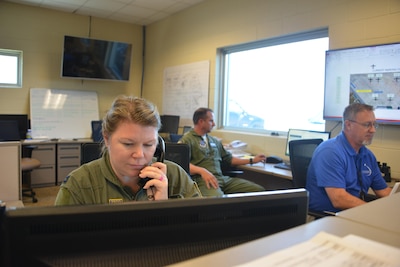
The ADC has staff manning the personnel support for contingency operations line. The base's dining facility and billeting office are being manned 24 hours a day.

"When we were first told that we would be going into 24-hour operations, my first thought was, 'Yes! This is what I joined the guard for,'" said Air Force Master Sgt. Tameitra Bryant, the center's financial management superintendent.
"I couldn't be more proud of our team," said Air Force Col. Emmanuel Haldopoulos, commander of the Air Dominance Center. "We've perfected the exercises that we host. But there was no playbook for our most recent mission. We relied on our team's hard-work, experience, creativity, and determination of the airmen of the ADC and the 165th AW to make it happen."

Morale Dog Improves Well-Being of Airmen


By Air Force Airman Rhett Isbell, 19th Airlift Wing

LITTLE ROCK AIR FORCE BASE, Ark., Sept. 29, 2017 — A staff member pads down the chapel aisle as the sanctuary lies still. He’s tired, but cheerful, after getting up early to support the combat airlift mission here.

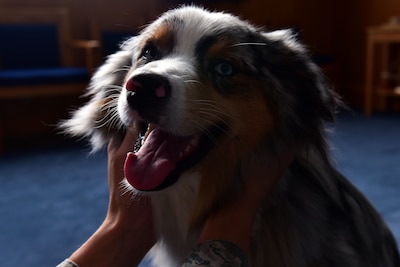
Milo, the 19th Airlift Wing’s morale dog, shakes a sense of wakefulness into his stride and readies himself to begin his work day. With the guidance of his handler and after extensive training, Milo helps the chapel staff care for airmen here.

“We had some airmen helping us with something and when I looked around I saw an airman tearing up as he pet him,” said Air Force Staff Sgt. Kolton Rottinghaus, the noncommissioned officer in charge of plans and programs at 19th Airlift Wing. “I’m sure that airman shared some thoughts with him, which no one else had been allowed to hear until then. There are times when people are going through their own personal issues, and while I may not be able to support them too much, he’s able to connect with them almost instantly.”

Epiphany

“As chapel staff, we’re charged with taking care of airmen -- not just the spiritual side, but the mental and social sides as well,” Rottinghaus said. “I was at home thinking of ways to do just that, while I was playing with Milo and I realized something: I’m having fun right now. I’m having fun and I know tons of people that would have fun doing this too.”

After his epiphany, Rottinghaus knew a morale dog was missing from the base chapel staff and that he’d have to jump through a few hoops himself to get one. The process involved having to send Milo away for three and a half months for obedience training, and Rottinghaus went to Louisiana for a week of handler training. Afterward, he started pushing to bring the morale dog program to the base.

“It’s a creative way to provide that bridge between members of the chapel and the airmen we’re trying to help,” said Chaplain (Lt. Col.) David Knight, the 19th Airlift Wing chaplain. “Our role is providing for the spiritual fitness of Team Little Rock, and Milo really helps people open up and tell us how we can best do that.”

Milo has shown himself to be a key member of the team, one that is able to reach airmen who may be emotionally inaccessible to the chapel staff.

“He can help you connect with pretty much anybody,” Rottinghaus said. “He’ll put his paws on someone’s lap and open himself up to appreciation or attention from individuals he senses may be having a hard time.”

Milo serves as a resiliency tool for the chapel staff and a friend to the other members of Team Little Rock, performing feats his fellow team members are incapable of.
“There’re times when no words will suffice to help bring someone into the state of mind that they can open up to you,” Rottinghaus said. “Milo helps break that barrier with a wag of his tail or a lick of the hand. He’s a lifesaver.”