Friday, September 22, 2017

Gold Star Mother’s Day: Who They Are, What It’s All About


By Katie Lange, Defense Media Activity

When an active-duty service member dies, his or her mother automatically becomes a Gold Star Mother. It’s a distinction that no mother wants, but it’s one they wear proudly.

Many outside the military don’t know what a Gold Star Mother is. Since this Sunday is Gold Star Mother’s Day, we thought we’d tell you who these women are.


How Gold Star Mothers Came About

The tradition of the Gold Star began during World War II. During the early days of the war, a blue star was used on service flags and hung in homes and businesses to represent each living active-duty member. As men were killed in combat, the gold star was superimposed on the blue star to honor the person for his ultimate sacrifice to the country. Eventually, the mothers of those fallen service members became known as Gold Star Mothers, and their families Gold Star Families.

There’s an Organization to Help Them


While all mothers of fallen service members are considered Gold Star Mothers, there’s a veterans service organization they can join for support, known as the American Gold Star Mothers. The group, which currently has about 1,000 active members, was started in 1928 by one woman – Grace Darling Seibold. Her son disappeared fighting in World War I, so she spent years working at veterans hospitals in hopes of finding him.

“She met all these other women who were thinking the same thing – they hadn’t heard from their children and went to find them,” said Sue Pollard, the national president of American Gold Star Mothers. “What they found was other children and other mothers who they could support.”

Seibold eventually learned of her son’s death but continued her community service, organizing a group of mothers of the fallen so they could comfort each other and care for those veterans confined to hospitals far from home.

One Mom’s Story

Pollard has been a member of the organization since 2008, in memory of her son, 21-year-old Army Spc. Justin Pollard. Justin had enlisted on Sept. 11, 2001, as a result of the terrorist attacks, and he loved what he was doing for the country. He was deployed to Iraq in April 2003. That December, just before the New Year, he was tragically killed by friendly fire.

“He died doing what he loved to do,” Pollard said, reflecting on her son. “Justin had the best heart. From the time he was in preschool, he always defended the underdog, and he was always there for the kids who got picked on. … To this day, people say, ‘This is what I remember about Justin. This kid was picking on me at school, and Justin stepped up to the plate.’”


Pollard, a California native, and another Gold Star Mother eventually met and began meeting regularly. They learned of more women like them, so they began to meet as a group. At the time, they didn’t even know about the official organization.

“We had no idea what a Gold Star Mother was,” Pollard said. “We started meeting before we knew what we were.”

It’s All About Support

So why do these women join American Gold Star Mothers? It’s pretty simple – to get support from others who know their pain.

“These moms – all of us remember each other’s children,” Pollard said. “We try to remember their birth dates and death dates, and we try to send a text or email or even a card [to their families] and say, ‘We’re thinking of you,’ because we know these are difficult days.”

No matter when you start the journey, it’s a long one, and it’s never over.

“Some of us have been doing this for 14 years. Some have been doing this for 14 days,” Pollard said. “In those time periods, though, we all have peaks and valleys, and we all sometimes take a couple of days … to just sit back and reflect and do things our children would be proud of.”

The Group Has Goals


These Gold Star Mothers raise funds for veterans, active-duty service members and their families, as well as other Gold Star families. They’re active year-round, visiting veterans at homes and hospitals, taking them snacks and gifts, reading them stories and letting them know someone is always there for them. Around the holidays, they raise funds for Wreaths Across America.

“We want to honor all vets who fought and died for this great country,” Pollard said. “We want to give back, because this is what our children did – they gave. This is to keep their memories alive.”

Commemorating Gold Star Mother’s Day


“This year, at the national level, we’re trying to make people aware of military suicide,” Pollard said.

Many of the mothers are meeting in Washington, D.C., to host a walk-a-thon from the Disabled Veterans Memorial to the Vietnam Memorial on the National Mall.

If it weren’t for that, Pollard said she would be at home in California, celebrating her son.

“My family usually goes to the cemetery in California where they honor Gold Star Mother Sundays,” she said. “And we usually go to lunch or dinner at Justin’s favorite restaurant. … We eat what he would eat, we have a shot of tequila, and we honor him the best way we can.”

How Can Other Mothers Get Involved?

Sometimes new Gold Star Mothers contact the organization, but other times, the organization has to let them know they’re there. Due to privacy issues, it’s not always easy.

“We as individual moms have to find these moms ourselves,” Pollard said.

Any Gold Star Mothers interested in joining American Gold Star Mothers can contact a chapter in their area. There are also organizations for Gold Star Wives.

Africom-Led Forum Discusses Women’s Roles in Global Security, Peacemaking


By Rick Docksai DoD News, Defense Media Activity

WASHINGTON, Sept. 22, 2017 — Africa’s women are disproportionately the victims of their continent’s armed conflicts, but they have also been increasingly leading the way in recent years in ending conflicts and negotiating peace.

This was the consensus of participants attending the “Women, Peace and Security” forum consisting of women military officers, defense analysts and conflict-resolution specialists from the United States and seven African nations.

Building Regional Security

The forum examined women’s roles as soldiers and civilian activists in building lasting regional stability.

The forum was organized by U.S. Africa Command’s command, control, communications and computer systems directorate and took place Sept. 19 at the Africa Center for Strategic Studies at Fort McNair here.

The Africa Center is a Defense Department institution, established and funded by Congress for the study of security issues relating to Africa and serving as a forum for bilateral and multilateral research, communication, training, and exchange of ideas involving military and civilian participants.

‘It’s Also a Dialogue’

“Today is an opportunity to talk about peace and security issues with female leaders from a diverse part of Africa spread across the continent,” Ben Crockett, associate dean of the Africa Center for Strategic Studies, said in an interview. “And it’s also a dialogue. This isn’t just the United States providing some PowerPoint briefings. This is an opportunity to hear from them and have a two-way conversation.”

The attendees included 12 female military officers from Botswana, Chad, Comoros, Ghana, Madagascar, Malawi, and Uganda. All 12 were military communications specialists visiting Washington as part of the Women’s Communications Forum, an annual training program run by Africom, according to Marine Corps Gunnery Sgt. Hector Milan, communications program manager with Africom’s Engagements and Exercises branch.

Established in 2014, the program explores communications technologies and practices in use within the U.S. military and participants’ home-country militaries, Milan said.

Working Together

“A main goal for this program is to show not only what do we have, but why do we use it, and how we can work together,” he said. “We want to give the partners ideas that they can take back to their countries and implement.”

He described a past attendee who created her own cybersecurity program after the event, and another who convinced her military superiors to start producing maternity uniforms for women personnel who were mothers-to-be.

More recently, the program has broadened its curriculum to include wider discussions about peace and security, said Malgorzata Makuchowski, also a program manager for Africom’s engagements and exercises branch. She explained that the forum featured these discussions.

“We wanted to take these events to a higher level and implement peace and security into the program, as well as professional development,” Makuchowski said.

Including More Women in Peacekeeping Efforts

Forum attendee Neyla Arnas, a senior research fellow at the Defense Department’s Center for Strategic Research, discussed the benefits of including more women in peacekeeping efforts. She referenced a study showing that women civilians are more likely to report crimes -- especially sex crimes -- to same-sex security officers and generally confide more in female personnel.
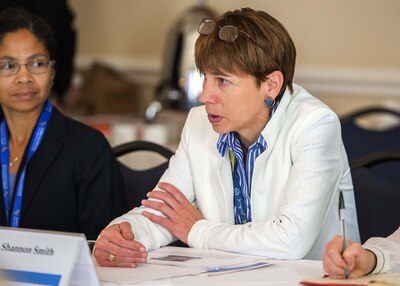
Neyla Arnas, senior research fellow at National Defense University’s Center for Applied Strategic Learning, discusses the benefits of fully including women in peace negotiations and post-conflict peacekeeping efforts.

Arnas also said that peace accords are statistically 35 percent more likely to last 15 years or longer when they include local women as meaningful participants from the very beginning. She attributed this to women participants calling attention to social issues that heavily impact prospects for peace, such as health care and poverty relief.

“Women enlarge the scope of those agreements to include the broader set of critical societal priorities and needs required for lasting peace,” she said. “They’re thinking about the accords not only as the cessation of violence, but what they mean in terms of reintegration of combatants, education, social welfare programming -- those types of notions are better integrated into a peace agreement.”

Negotiations for Peace

Shannon Smith, professor and director of engagement at the Africa Center for Strategic Studies, described in another presentation instances of women making more headway than men in brokering peace negotiations, as well. For example, in south Sudan, she said, local women leaders have started community-to-community dialogues that caused some warring factions to cease fighting in order to talk.

“Local women were able to cross a border to create communities to build peace among the south Sudanese, and they did so in ways their male counterparts have never been able to,” she said.

Women’s roles in their countries’ armed forces were also a discussion topic, Smith said. Women remain a small presence in Africa’s militaries, she said, and the question of women serving in combat remains controversial in Africa as it is in other parts of the world.

Smith noted that the United States’ military opened up many combat roles to women just last year.

“I think it’s something that’s continuing to evolve, and I think that understanding the role that women are playing in the uniformed services is maybe one piece of changing minds and opening up opportunities,” she said.

Smith said she hoped the forum’s attendees could help advance the cause of women within their countries’ militaries and across society in general.

“Every country is different,” she said. “But you are all women leaders, and you are all rising women in your systems. And, it’s going to be up to all of you to create the change that you want to see.”

Military Officials Outline Hurricane Relief Efforts


By Terri Moon Cronk DoD News, Defense Media Activity

WASHINGTON, Sept. 22, 2017 — The numerous natural disasters of the past couple of weeks have cut a wide swath across the United States from Florida and the Caribbean region to the West Coast, Air Force Maj. Gen. Derek P. Rydholm, deputy to the chief of the Air Force Reserve told Pentagon reporters today.

“Until the [hurricane] and wildfire seasons are over, we’ll be there as a supporting agency in the Department of Defense,” Rydholm said “and to our partner agencies during this difficult time.”

Appearing with him to give an update on support to hurricane relief efforts was Army Brig. Gen. Diana M. Holland, U.S. Army Corps of Engineers South Atlantic Division commander.

Yesterday, Navy Adm. Kurt W. Tidd, U.S. Southern Command commander, said the U.S. military’s assistance was requested because of its “unique capabilities, and the speed and flexibility that are needed most in the critical, early stages of disaster relief operations,” during a media roundtable at the Pentagon.

Corps Expertise

Holland noted examples of the Corps’ expertise in the cleanup after the storms: performing high-volume debris removal, infrastructure assessments, temporary emergency power restoration, temporary roofing and temporary housing.

And in collaboration with the Coast Guard and the National Oceanic and Atmospheric Administration, the Corps is working with ports authorities to help those ports that are closed, she said.

The Corps is also working with NOAA and the Coast Guard to survey channels to confirm they are safe to open.

Corps military and civilian personnel were positioned in Puerto Rico and the Virgin Islands ahead of Irma’s landfall, Holland noted, to quickly assess the damage and begin to plan for required support.

“Had we not been on those islands in advance along with the other agencies, we would not have been timely,” she said. “We would have been subject to the same delays that others faced because the airports and ports were closed.”

The San Juan airport in Puerto Rico has just opened, to military traffic, Holland said.

Widespread Damage

“[There are] of course a lot of power outages, roads blocked by debris and water damage,” she said.

The Corps’ assessments will continue over the next several days in support of the Federal Emergency Management Agency, the Corps will look at ports in Puerto Rico and the Virgin Islands, and assist FEMA with the islands’ emergency repairs at airports and assess power on both islands. Power assessment will be a priority at hospitals, health clinics and wastewater treatment plants, Holland said.

In the coming weeks and months, Holland’s team will make sure the Corps has capabilities in place and that the agency is balanced across all of its regions as the recovery continues.

“We’re just over halfway through the hurricane season,” she said, adding that Nov. 1 usually marks the end of the season.

“Although we’re focusing our attention on the response to Irma and Maria, we also must remain prepared and flexible in the event we have another storm, Holland said of the Corps’ response mission.

“There’s a long road ahead, but as a representative of the Army Corps of Engineers, I can say we’re committed to this no matter how long it’s required,” Holland said.