By Army Staff Sgt. Leah R. Kilpatrick, 3rd Armored Brigade
Combat Team, 1st Cavalry Division
MOHAMED NAGUIB MILITARY BASE, Egypt, Sept. 22, 2017 — Across
a vast landscape speckled with shrubbery, two armies met on a battlefield
intent on defeating a common adversary.
From planning and coordination all the way through to
execution and battle tracking, U.S. and Egyptian forces collaborated during
Exercise Bright Star 2017 here Sept. 10-20.
About 200 soldiers from the 2nd Battalion, 7th Cavalry
Regiment “Ghost,” 3rd Armored Brigade Combat Team, 1st Cavalry Division
deployed from Camp Buehring, Kuwait, to take part in the bilateral U.S. Central
Command exercise hosted by the Egyptian Minister of Defense to enhance regional
security, promote interoperability and improve interoperability.
The first Bright Star exercise took place in 1981, and this
particular exercise is the first one since 2009.
Showcasing Interoperability
“Exercise Bright Star is a chance for the United States and
the Arab Republic of Egypt to reaffirm our commitment to each other and to
regional stability,” said Army Capt. Bryan Groves, commander of Charlie
Company, 2-7 CAV, 3rd ABCT. “I feel like Bright Star is a great chance to
showcase interoperability between our two nations going forward and trying to
show our commitment to providing long-term stability for this region.”
The exercise was conducted in three parts -- a command post
exercise, a field training exercise and a senior leader seminar, all designed
to prepare partner forces do that they are ready to meet challenges at the
tactical level.
The exercise kicked off with the CPX while the company’s
tanks, Humvees, M88 Recovery Vehicles and other necessary support equipment
were offloaded from the ship and onto heavy equipment transport systems at the
port of Alexandria.
U.S.-Egyptian Teamwork
Meanwhile, at Mohamed Naguib Military Base, officers and
noncommissioned officers of the Ghost Battalion staff went through the steps of
the military decision-making process with their Egyptian counterparts, planning
a simulated battle of coalition forces against an unconventional threat down to
the smallest details.
“We were trying to have both sides -- U.S. and Egyptian --
participate together and lead the battalion in their mission, so they could see
how we run a battle staff, and so that we could see how they run a battle
staff,” said Army 2nd Lt. Alan-Michael Alvarado, the battalion’s assistant
intelligence officer.
Alvarado said all the staff sections -- U.S. and Egyptian --
collaborated, shared information and gave the commanders a good, accurate
picture of what was happening on the simulated battlefield so they could make
decisions with the best information available.
‘It Was Really Decisive’
“I feel like it went pretty good,” said Alvarado, a native
of San Antonio, Texas. “It was really decisive.”
“I think the ultimate benefit was different nations
understanding each other’s staff functions,” said Army Capt. Lukas Rennebaum,
the battalion assistant operations officer. “There was a shared understanding,
valuable experience and working with a different perspective. They had
different perspectives on things that we didn’t have.”
That same spirit of cooperation and collaboration bled over
into the field training exercise during which Groves’ soldiers maneuvered
through offensive and defensive lanes with their Egyptian counterparts.
“This was a chance for my company to get after its training
here in Egypt,” said Groves, a native of North Kingstown, Rhode Island. “We
wanted to focus on hitting some of our mission essential tasks. One of the big
things we were able to get after was our area defense lane. We did this in
conjunction with the Egyptian army. Great success on that -- being able to
collaborate on many different levels from our [command-and-control] nodes to
our actual battle positions. It was a great chance for our two countries to get
together and show that not only can we get after larger strategic tasks, but we
can get after operational tasks, too.”
Viewing Common Problems
Interacting with their Egyptian counterparts helped the
soldiers of Charlie Company view common problems in a different way.
“[This experience] has shown them where we are as far as our
own personal training and also how an allied nation is with its training,” said
Army 1st Lt. Thomas Bouras, platoon leader of 3rd Platoon, Charlie Company, 2-7
CAV. “Their tactics are very different from ours, and it showed [the soldiers]
how different people approach problem sets that we’ve been working on this past
year.”
Bouras came into the Bright Star experience with very
specific lessons he wanted his soldiers to glean from working with a partner
nation.
“It’s important to see on this grand scale with the open
desert like this, you can actually see the thought process that commanders have
in moving their forces across the battlefield, and you can see our differences
in our maneuver patterns,” said Bouras, a native of Rowlett, Texas. “The
significance is opening both our partners and us to the other’s tactics and
their priorities in thinking.”
“I came with an open mind just trying to learn the way [the
Egyptian soldiers] live and what are the differences in our militaries,” said
Army Spc. Ashton Munroe, a gunner assigned to 2nd Platoon, Charlie Company, 2-7
CAV. “I think I got a lot of training out of the exercise. It was fun working
with the Egyptians, getting to see their tanks and weapon systems. It’s been a
pretty cool experience.”
Good Training Experience
Groves said the soldiers ultimately benefitted from seeing
their counterpart as not-so-different from themselves -- different faces,
different names, different tactics, same goal.
“I think the soldiers take a lot away from exercises such as
Bright Star,” Groves said. “I think it’s one thing to brief how the U.S. plays
a role in this region in terms of stability and security, but it’s another
thing for the soldier to actually see it on the lowest level, to be able to
internalize it by actually watching their Egyptian counterpart, whether that be
a private first class or a sergeant or a lieutenant, actually conducting the
same operation as they are.”
Relationships were forged, and mutual trust was built as
Egyptian soldiers came and offered to help the Ghost Battalion soldiers with
their maintenance tasks.
“I already knew when we got off the plane that this was
going to be a good experience just by the way they interacted with us and the
way that they seemed to love to help us with everything,” said Munroe, a native
of Miami, Florida.
“I’ve enjoyed working with the Egyptians,” said Army Sgt.
Michael Bishop, a gunner assigned to 1st Platoon, 2-7 CAV. “They are very, very
friendly. I was really excited to come to Egypt and to get to train with them.”
Learning About Egypt
The soldiers got an opportunity to experience some Egyptian
scenery and culture on a day off before the hard work began.
“Already my company was able to attend a day at the beach
down in Alexandria,” Groves said. “It was a great event and a great way for our
soldiers to take in more than just the training area adjacent to Mohamed Naguib
Military Base. They were able to interact with local Egyptians and take in the
scenery, the culture, the cuisine, all great factors in helping my soldiers
build a better picture of exactly what and who the Egyptians are.”
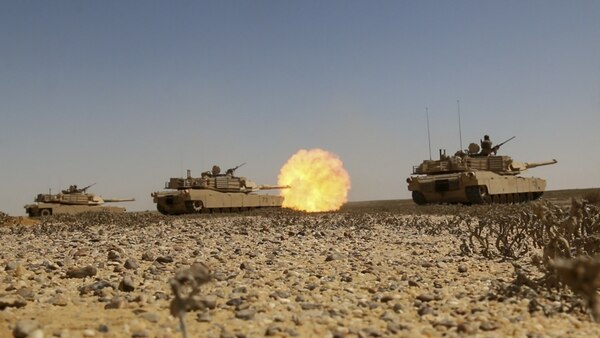
With the soldiers refreshed and after maintenance, mission
planning, rehearsals, more maintenance, more planning, and more rehearsals, 14
tank crews from Charlie Company mounted up and headed for the live-fire range,
where they would be joined by two Egyptian air force F-16 Fighting Falcons,
four Mil Mi-8 Hip helicopters, air defense artillery assets, mortars, armored
personnel carriers loaded with mechanized infantrymen and 22 M1A1 Egyptian tank
crews.
Aircraft fired missiles. Mortar men hung rounds. Tank crews
engaged targets. It all came together in a symphony of booms and bangs.
In the end, the “battlefield” was awash with dust kicked up
from the tracks of 70-ton behemoths, smoke from the smoldering targets, some
riddled with holes, some engulfed in flame.
“I had high expectations coming into Bright Star 17, just
because this operation has been going on for many years since 1981 up until
2009,” Groves said. “It has a storied and great legacy here, and I know that
the Egyptian army is a professional and well-trained army, so coming into this
I knew that this would be a well-resourced, well-planned, and well-executed
event. I wasn’t disappointed. The Egyptian army is a truly well-trained army.
They are professionals in every sense of the word, and their commitment to
making this exercise safe, deliberate and well-executed has shown through and
through.”




 Posts
Posts

