Tuesday, September 05, 2017

Time Tested: Airman serves 21 years on same aircraft


By Master Sgt. Eric Sharman, 386th Air Expeditionary Wing Public Affairs / Published September 04, 2017

SOUTHWEST ASIA (AFNS) -- (This feature is part of the "Through Airmen's Eyes" series on AF.mil. These stories focus on a single Airman, highlighting their Air Force story.)

Since entering active military service in 1956, the C-130 Hercules has earned its place in the storied history of air power, time and time again. From Vietnam all the way up through Operation Inherent Resolve, the C-130 has always made a name for itself by providing critical airlift.

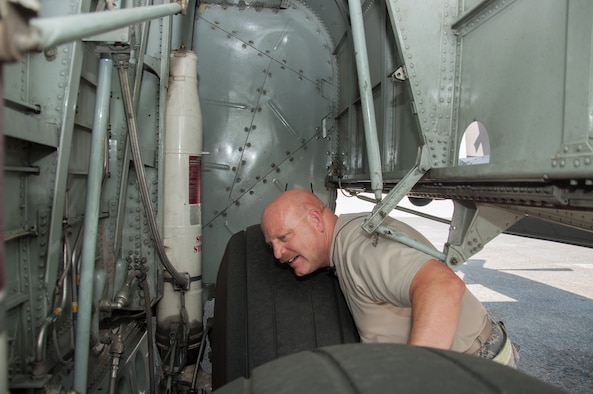
For Master Sgt. Norbert Feist, a 386th Expeditionary Aircraft Maintenance Squadron C-130H crew chief, one C-130 in particular has a special place in his personal Air Force storybook.

Feist, a Minnesota Air National Guardsman deployed from the 133rd Airlift Wing, has worked on tail number 1004 for 21 of the 30 year he’s been in service. He’s been the lead crew chief on that aircraft for the last 12 years.

“I’ve been with this aircraft since it was almost brand new,” Feist said. “One guy did the factory acceptance inspections on it, and I’ve been running it ever since. I definitely have a really good bond with her, and I’m glad I never had to switch airplanes.”

As would be expected over the 21 years, Feist has developed a sense of ownership and responsibility toward the airplane he’s spent more than two-thirds of his career with. Not unlike an Airman with a long service record, tail 1004 has its own personality quirks.

“The crew door has always been tough to open. It’s been tough since it was new,” said Feist. “After so long, you get to know a plane, and the little intricacies that come with it. And we always get the weird stuff, like right now we are repairing a bird strike, when just a few years ago we hit one in Yuma (Arizona). It flies really well for a while, and then something odd like that happens.”

Regardless of random birds, stubborn doors, or other oddities, tail 1004 has coincidentally been mission-ready when needed.

“I call it the bilge pump, because it’s always been there to bail another plane out,” boasted Feist. “The minute it sits spare, I know that another plane is going to have an issue, and mine will get called up. If it is on alert status, it always seems to get called up to save the day.”

It’s that resilience that gives Feist a sense of pride in his mission and his aircraft. Currently on his ninth deployment, Feist has a keen understanding of the impact he and his aircraft have on the mission.

“Deployments are when you get to do the job that you’ve trained for, and it’s a lot of work to keep these airplanes flying in these austere conditions,” said Feist. “It’s either solid with people or solid with pallets, and always at max weight between cargo, people and fuel. We’re at full utilization, no doubt about it.”

The C-130 primarily performs the tactical portion of the airlift mission. The aircraft is capable of operating from rough, dirt strips and is the prime transport for airdropping troops and equipment into hostile areas, according to the official Air Force fact sheet on the aircraft. This versatility and demand take a toll on the time-tested but venerable aircraft.

“The mission over here is hauling beans, bullets and people. We go up-country, and what we do is very important,” said Feist. “Our mission is important because we are getting people to the fight, and we’re hauling the materials that are required for the fight, so we’re definitely very much part of the mission for sure.”

HSC-7, HSC-28 Transition Support of Hurricane Harvey Relief Efforts


By Mass Communication Specialist 1st Class Ernest Scott, Navy Public Affairs Support Element East

COLLEGE STATION, Texas (NNS) -- Sailors assigned to Helicopter Sea Combat Squadron (HSC) 7 and HSC-28 began transitioning support of Hurricane Harvey relief efforts, Sept. 2, to HSC-21 and HSC-23.

Since arriving in Texas, HSC-7 and HSC-28 flew 49 sorties accumulating 225 flight hours, including 65 hours at night. They combined for 358 rescues while saving 22 dogs, 5 cats, conducting 9 personnel transfers and delivering 1660lbs of water and food.

With the demand of search and rescue (SAR) missions decreasing, HSC-21 and HSC-23 are expected to focus largely on logistics support and supply delivery.

"What we are seeing is a shift from SAR, to a relief posture," said Lt. Steve Niets, a pilot assigned to HSC-28. "Our crews are working together, integrating with each other, and preparing for the swap."

Although the primary mission may be changing, Lt. Cmdr. Spencer Fishman, the officer in charge of HSC-28, said the squadrons are always prepared to carry out rescue operations.

"Our Sailors are highly trained and always ready to conduct search and rescue," said Fishman. "Even when we are delivering supplies, our crew is fully prepared to help those in harms way."

Texas Governor Greg Abbott and Air Force Gen. Lori J. Robinson, commander of U.S. Northern Command, announced during a press conference, Sept. 1, that while many areas are still hazardous, food and water is being continuously delivered to seven major distribution locations.

Ensuring these centers remain stocked is an all hands effort.

"Something we do very well in our squadrons and as a Navy is work as a team," said Fishman. "We are out there flying, operations is planning, and our maintainers work around the clock to get the job done."

The full transition of support between squadrons will take approximately 24 hours to complete. During this time, HSC-7 and HSC-28 will share with their replacements region specific logistics and lessons learned.

"These squadrons understand humanitarian relief and [Defense Support of Civil Authorities], it's something we train for," said Fishman. "The number one thing we pass on is our lessons learned - who's the point of contact for specific situations, what's the battle rhythm you can expect from your team - all the little details that will ensure our turnover is seamless."

For the Sailors departing, their time in Texas has been a truly memorable experience.

"Everything about this has been so humbling," said Aviation Ordnanceman 2nd Class Amber Ford, assigned to HSC-7. "Getting the call at night to leave the next morning was when I realized 'Ok, this needs to be done.' You hear it on the news, but being here you see how important this relief is. That, along with how supportive the entire community has been makes me proud to be here and proud to be in the Navy."

Face of Defense: Officer Returns to Port Hueneme to Engineer New Future


By Brian Melanephy, Naval Surface Warfare Center, Port Hueneme Division

PORT HUENEME, Calif., Sept. 5, 2017 — In the early 1980s, a young, smart and motivated teen from New England was looking down the road to his future. College was his next step.

Michael Ladner was looking for the best. At first, he had the Massachusetts Institute of Technology in his sights. However, he quickly realized that the cost of an education at the prestigious university was out of his reach.

Summers in Massachusetts as a child often involved going to the coast, and the ocean had an allure. Looking close to home and close to the water, Ladner found the perfect match: the U.S. Naval Academy in Annapolis, Maryland.

He was selected and entered the academy, becoming part of a group of young patriots who would become the Class of 1989. Their unofficial motto quickly became "Out the door in '94" -- give five years of service to Uncle Sam upon graduation, and then move on to other things.

An Offer

The early years of his career went quickly, and suddenly it was 1993. Ladner was thinking about getting out until he received an offer he couldn't refuse. He remembers the phone call vividly.

"[I] called the detailer and they said, 'We can send you to Monterey, California, to go get a master's degree from the Navy," Ladner, who’s now a Navy captain, recalled. "I said, 'Wow, how do I turn that down?'"

And off he went.

Toward the end of his two-plus years in Monterey, a Master of Science in Physics degree in hand, Ladner received a lateral transfer to the engineering duty officer community and found himself at Naval Surface Warfare Center, Port Hueneme Division here. It was his first shore assignment where he served as the combat systems ship qualifications trials officer.

Ironically, Ladner would spend more time underway during this shore tour than he did aboard his first three ships. For the three years he was here, he estimates he was at sea for close to 2.5 years.

From here, Ladner moved on to become the first standard missile program manager's representative at the Raytheon Missile Systems plant in Tucson, Arizona. Moving from the sea to the sand, he served what he didn't yet know would not be his last assignment in the desert. From there, he moved on to Program Executive Office Integrated Warfare Systems 3.0, where he served as the Standard Missile 6 project engineer.

Service in Iraq

After his next assignment as executive assistant to the Navy's director of surface warfare, he volunteered to go to Iraq for nine months as an individual augmentee at Joint Crew Composite Squadron 1. There, he touched all facets of the fielding and testing of countermeasures to disrupt and disable remote-controlled improvised explosive devices. His efforts were highly successful, resulting in safer travels for service members outside the wire.

His deployment did not go unnoticed. At the end of his tour, Ladner was hand-picked by the commander of Naval Sea Systems Command to be his executive assistant. After this eye-opening experience, he moved on to become the major program manager for Program Executive Office Integrated Warfare Systems 10.0, which evolved into the Ship Self-Defense System, Integrated Combat Systems Program Office.

Major Program Manager Assignments

Ladner then served in consecutive major program manager assignments at Program Executive Office Integrated Warfare Systems 3.0 (Surface Ship Weapons). At the end of these back-to-back tours, he got word he was returning here as the department officer for the chief engineer and land and sea test department.

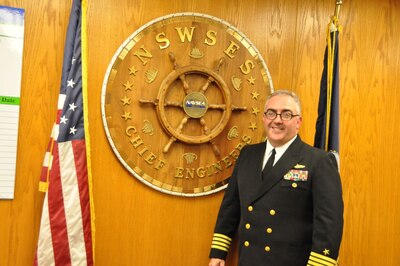
Happy to be back at the division, Ladner beams with pride when he looks at the wheel-shaped plaque hanging in his office.

"I am looking at the wheel on the wall, which has all of the chief engineers that have been here at Port Hueneme," Ladner said. "It's inspiring for me to think that I am sitting in the same room where I did my engineering duty qualification board."

Ladner cut his teeth here 20 years ago, and now has an opportunity to shape and mold its future from a place at the top.
"It is now my time to give back to the community, the station [and Naval Sea Systems Command] for all of the great things they have done for me," he said.