Thursday, August 31, 2017

30,000 More Guardsmen Ready to Respond in Hurricane Relief Effort


By Army Sgt. 1st Class Jon Soucy National Guard Bureau

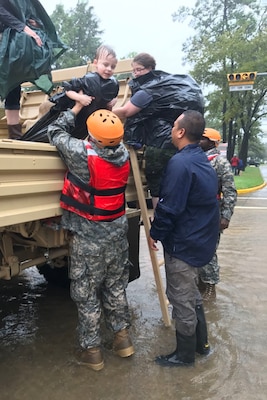
ARLINGTON, Va., Aug. 30, 2017 — The National Guard response to Hurricane Harvey will be a long-term, sustained effort, a senior National Guard official said today, adding that up 30,000 Guard members stand ready to assist with those efforts if needed.

"We are leaning as far forward as we possibly can to ensure that military assets are postured to support the needs of Texas and, potentially, Louisiana," said Air Force Maj. Gen. James C. Witham, the director of domestic operations at the National Guard Bureau here.

More than 4,300 Guard members were on duty in Texas as of this morning, primarily assisting local authorities with search and rescue operations. Texas Gov. Greg Abbott has called up the entire Texas National Guard, numbering around 12,000 soldiers and airmen, who may be brought on duty gradually over the next few days as needed, Witham said.

As of yesterday afternoon, Guard members had taken part in more than 3,500 rescues of those affected by the storm, mostly in the Houston area.

"Most [rescues] have been by some type of boat, but these also include almost 300 hoist rescues [by helicopter], which are very technically difficult," Witham said, adding that weather conditions initially prevented helicopter crews from flying.

Helicopters Support Efforts

Some 30 helicopters are now in use by Guard aircrews, the general said, and additional helicopter assets have been requested through the Emergency Management Assistance Compact, which allows Guard elements from one state to assist in other states in emergencies.

Aircrews are supporting not only airborne search and rescue efforts with hoist capacity, but also medical evacuation capacity as required, Witham said.

Guard elements from 10 states are supporting Hurricane Harvey response operations, with some coming from as far away as Alaska.

"As you talk response and recovery, our response is very sustained," Witham said, adding that the storm's unprecedented amount of rainfall has made for a different sort of hurricane response.

"When the Guard responds to hurricane-type events, normally we talk about that first 72 to 96 hours for the lifesaving and life-sustainment that takes place. Then, we're into the recovery effort," he explained. "Due to the nature of this storm as it spun across southeast Texas for days and dumped historic levels of rainfall, our response has been very different than what we've looked at before."

Second Landfall in Louisiana

Meanwhile, in Louisiana, the storm made its second landfall early today as it continues to move eastward. Soldiers and airmen with the Louisiana National Guard pre-positioned equipment and supplies in advance of the storm, Witham said. About 400 soldiers and airmen are currently on duty, he added.

But Louisiana Guard members were busy in other ways before the storm made landfall.

On Aug. 28, soldiers with the Louisiana Army National Guard's 3rd Battalion, 156th Infantry Regiment rescued more than 100 people in the Lake Charles area, roughly 35 miles east of the Texas border. Unit members assisted local first responders with the rescues, and are anticipating additional rescue efforts in the coming days.

"In the next 24 hours, I think they predicted anywhere from 5 to 10 inches of rain," said Army Maj. Aaron Duplechin, commander of the unit. "So it just kind of depends on when those bands hit and where."

Witham said the response in Louisiana was no different from response efforts in Texas, and that soldiers and airmen continue to respond as needed.

"We are very proud of the Texas Guard [members] who have responded at this point," he said. "The soldiers and airmen have been working around the clock … to alleviate the pain and suffering that has been experienced by the citizens in Houston and southeast Texas."

Wednesday, August 30, 2017

Secretary Mattis Remarks at Bilateral Meeting with Republic of Korea Defense Minister Song Young-Moo


Remarks as Delivered by Secretary of Defense James Mattis, The Pentagon, Washington, DC, Aug. 30, 2017

Welcome Minister, your Excellency Ambassador Ahn, and military officers, members of the delegation. Welcome to the Pentagon. You are most welcome here.

Thank you for traveling to Washington so soon after your assignment to this post. It is good to meet you in person after we had already spoken earlier this month. This says a great deal about the priority you and your President place on our relationship to come so soon.

The Republic of Korea-U.S. alliance has played an enduring role in regaining and maintaining South Korea’s security since 1950. As President Moon remarked earlier this week, our alliance serves as the foundation of peace on the Korean Peninsula. Our countries share a commitment to democratic values, and we work together to maintain a stable environment in which all pacific nations can prosper.

For 64 years, our countries’ mutual defense treaty has provided a rock-solid basis for collaboration on defense measures – measures designed to keep that peace, to protect the South Korean people and uphold vital American interests.

As we have seen the threat to security in the Northwest Pacific become more severe, our nations’ defense relationship thus becomes more important than ever and a bedrock for international efforts to temper North Korea’s aggressive actions. The recent United Nations Security Council sanctions and ASEAN communique demonstrate the international community’s resolve against North Korean actions. Last evening’s Security Council actions show that the world will not stand for North Korea’s reckless and intolerable behavior.

Here in Washington we are keenly aware that South Korea is on the frontline and we cannot be complacent. We note with confidence that you have pledged to increase defense spending under President Moon. In the interest of keeping our alliance fit for these times, we must continue to deepen our military relationship, building on the high level of trust that exists between our two nations.

As you say in Korean, katchi kapshida, or “we go forward together.” Minister Song, I look forward to the usual transparent dialogue on how we will work together, in what you called an honest and candid conversation.

Again Minister, Excellency, and members of the delegation, welcome to the Pentagon.

Mattis Announces Panel Will Review President’s Transgender Guidance


WASHINGTON, Aug. 30, 2017 — Defense Secretary Jim Mattis said yesterday in a statement that the Defense Department has received President Donald J. Trump’s memorandum addressing the military service of transgender persons.

DoD will carry out the president's policy direction in consultation with the Department of Homeland Security, Mattis said. The memorandum, dated Aug. 25, 2017, and entitled "Military Service by Transgender Individuals," directs DoD to develop a study and implementation plan that will “contain the steps that will promote military readiness, lethality and unit cohesion, with due regard for budgetary constraints and consistent with applicable law,” the defense secretary said.

“The soon-arriving senior civilian leadership of DoD will play an important role in this effort,” he said. “The implementation plan will address accessions of transgender individuals and transgender individuals currently serving in the United States military.”

“Our focus must always be on what is best for the military's combat effectiveness leading to victory on the battlefield. To that end, I will establish a panel of experts serving within the departments of defense and homeland security to provide advice and recommendations on the implementation of the president's direction,” Mattis said. “Panel members will bring mature experience, most notably in combat and deployed operations, and seasoned judgment to this task. The panel will assemble and thoroughly analyze all pertinent data, quantifiable and non-quantifiable. Further information on the panel will be forthcoming.”

Once the panel reports its recommendations, Mattis said he will consult with the secretary of homeland security before providing advice to the president concerning implementation of his policy direction.

“In the interim, current policy with respect to currently serving members will remain in place,” the defense secretary said. “I expect to issue interim guidance to the force concerning the president's direction, including any necessary interim adjustments to procedures, to ensure the continued combat readiness of the force until our final policy on this subject is issued.”