Tuesday, August 29, 2017

Trident Warrior 2017 Paves the Way for Future At-Sea Experimentation


By Commander, Third Fleet and Space and Naval Warfare Systems Command

SAN DIEGO, Aug. 29, 2017 — In its 15th year of execution, the Trident Warrior exercise explored innovative solutions through fleet experimentation during various evolutions off the coast of Southern California from June to August 2017.

Directed by the Navy Warfare Development Command and Space and Naval Warfare Systems Command, and supported by the Third Fleet, TW17 featured at-sea experimentation of more than 20 critical maritime initiatives.

Participants in TW17 included organizations such as Naval Warfare Systems Command, Systems Center Pacific; the Program Executive Office for Command, Control, Communications, Computers and Intelligence; Naval Information Forces; Johns Hopkins University Applied Physics Laboratory; and the Office of Naval Research.

TW experiments are designed to fast-track the introduction of new capabilities, innovative technologies, and tactics, techniques and procedures to aid maritime forces in all domains of warfare -- air, land, sea and cyber.

Unique Exercise

“Trident Warrior is exceptionally unique,” said Dan Hallock, the exercise’s deputy director. “The event provides a venue to dynamically experiment with new ideas and innovations in a real-world environment. Each initiative is put directly into the hands of sailors and Marines currently serving our fleet and then the initiative is evaluated for warfighting effectiveness. This process enables warfighters to utilize Trident Warrior experimentation to examine an experiment’s potential and influence the direction of development and implementation. The resulting enhanced capabilities allow individuals to perform their job more effectively and efficiently.”

TW17 took advantage of previously scheduled ship training events to leverage maximum experimentation opportunities with minimum cost and impact on Fleet operations. Experiments were completed by temporarily deploying advanced capabilities on fleet assets to collect real-world performance data and feedback from users during the underway experimentation period. Data collected throughout the experiments will be provided to Navy decision makers as recommendations regarding future capability investments for the fleet.

Participants included the aircraft carrier USS Theodore Roosevelt; the guided missile cruiser USS Bunker Hill; the guided missile destroyers USS Halsey, USS Preble, USS Sampson and USS Milius; the Los Angeles-class fast attack submarine USS Pasadena; and the experimental medium-displacement unmanned surface vehicle, also known as Sea Hunter.

The TW process specifically aligns each initiative into focus areas to include: electromagnetic maneuver warfare; agile command and control; cybersecurity; and intelligence, surveillance and reconnaissance. Once the initiatives are aligned under a designated focus area, the TW team works with the sponsors of each initiative to develop an experiment designed to address issues the technology is targeting.

Answers to Critical Questions

“Trident Warrior allows engineers, scientists and the operators to answer critical questions regarding the development of technology,” Hallock said. “We need to think if the initiative will reduce communication time and by how much. We can actually experiment during Trident Warrior and find out. Depending on what was learned during experimentation, we then work with the sponsors and requirements personnel to determine which initiatives have the potential to be accelerated for acquisition and which require further development. The end goal is to get the mature technology into the hands of the warfighter as soon as possible.”

Some of the TW17 experiment initiatives were the automated dynamics quality of service and visualization tool, or ADVANCE; gun augmented reality; a command-and-control experiment; refractivity-from-radio; and long-distance high and bandwidth laser communications.

ADVANCE, sponsored by Systems Center Pacific, serves as an automated network bandwidth tool that gives any Navy ship the ability to dynamically adjust the priority of network flow and usage. During TW17, ADVANCE was tested on board the Theodore Roosevelt.

“This capability is exactly the direction we need to go,” said Navy Cmdr. Nichol Schine, the combat systems officer for the Theodore Roosevelt. “My whole department was impressed with how ADVANCE improved the flow of information and how dependable the system was out at sea.”

Gun-augmented reality, also sponsored by SSC Pacific, demonstrated its capabilities on board the Bunker Hill during the first phase of TW17. The augmented reality helmet provides enhanced visual and aural communication to .50-caliber gun crews and the ship’s bridge teams.

The command-and-control experiment, sponsored by the Navy’s Command and Control Systems Program Office, installed a strike-group-level planning tool on board the Theodore Roosevelt, which provided the capability for an automated rehearsal of an entire future operation. This automation determined a detailed scheme of maneuver alerting to conflicts and time distance issues.

The “refractivity from radio with web-based tools” initiative tested a device that monitored actual radio frequency signals to provide the ability to predict and display red and blue radar, as well as electronic warfare detection ranges. This initiative was also sponsored by Systems Center Pacific and tested on board the Preble.

Sponsored by Johns Hopkins University Applied Physics Laboratory, the long distance H/B laser communications initiative demonstrated a ship-to-shore and ship-to-ship laser communication capability. While on board the Sea Hunter for TW17, the laser provided close to 10 gigabits per second of error-free data, voice and video transfer.

Trident Warrior analysts continue to compile data from the events to determine which initiatives should be recommended for follow-on actions.

Navy Vice Adm. Nora Tyson, the Third Fleet commander, observed several events during TW17 and was genuinely impressed with the initiatives and urgency to get new ideas into the hands of the warfighter.
“In the end, that’s what this is all about,” she said. “Saving time, saving money and, most importantly, giving our sailors and Marines the right tools to make them more effective warfighters … which will help save lives. Next year’s Trident Warrior is currently scheduled alongside Exercise Rim of the Pacific. Our international partners will appreciate the new technologies and concepts being developed to improve the maritime warfighting domain.”

Last Marine Unit on Horseback Celebrates 50th Anniversary


By Laurie Pearson Marine Corps Logistics Base Barstow

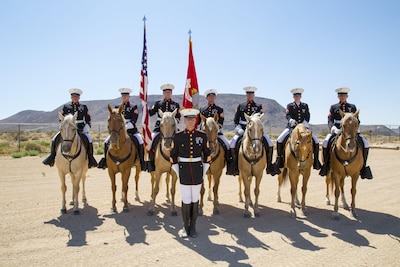
BARSTOW, Calif., Aug. 29, 2017 — The United States Marine Corps’ last remaining mounted color guard celebrates their 50th year in service this year -- attending rodeos, parades and other events across the country, but it’s the day-to-day life that keeps these horse-borne Marines grounded.

Members of the mounted color guard proudly represent the Marine Corps and serve their community and country with honor. They travel extensively to participate in as many events as possible, and the invitations keep rolling in with event organizers requesting their presence. As the only remaining mounted color guard, they are spread thin, their schedules packed with events from shore to shore, to include retirement ceremonies and high-profile events such as the Tournament of Roses Parade.

“I feel a great sense of pride every time I put on that uniform and get on a horse,” said Marine Corps Staff Sgt. Nicholas Beberniss, the staff noncommissioned officer in charge of the mounted color guard.

For events on the other side of the country, such as the Memorial Day Parade in Washington, D.C., it can take up to five days to get to the site, explained Marine Corps Cpl. Alicia Frost, a stableman. The horses are transported via truck and trailer along with the stablemen.

“For me, the best aspect is all the traveling we get to do, and being in the rodeos and parades,” Frost said. “I love meeting all the new people everywhere we go. It’s awesome! The crowds are always cheering for us and thanking us for our service.”

Representing All Marines

Children and adults alike see the mounted color guard riders, in their perfectly pressed and polished uniforms sitting tall in their saddles and request to have photos taken with them. As a recruiting tool, the goal is to inspire others to join the Corps.

“It’s a very serious responsibility,” said Marine Corps Sgt. Jedidiah Birnie, a stableman. “People don’t look at you as just a person; they see you as representing the whole Marine Corps. So, you have to be on your toes at all times and make sure you’re presenting a good face for the people.”

As the only woman on the team of riders, Frost embraces the heavy responsibility of being a role model for young women.

“I’m the face for all female Marines,” Frost said. “So, when other girls and women see me doing it, I hope it gives them the courage to think that they can do it, as well. They can be a Marine and make it onto a competitive team full of male[s].”

When the A-Team -- the first line of riders -- is on the road, some of the other stablemen attend the events to assist with transportation and care of the horses. At least one stableman remains at the stables to care for the remaining horses, the facilities and the administrative work.

While at home, the Marines all participate in the daily maintenance of the facilities, horses, administrative duties and self-care. As a team, they muck out and clean the stalls. They groom and clean the horses and engage in ground-work training. They share the administrative load and help one another with tasks such as fence maintenance or stall repairs.

Long Days

The horses are fed by the stablemen twice a day, morning and night, with each person taking flakes of hay and ensuring each horse has adequate food. They clean out the water devices and refill them often because desert conditions can cause the water to evaporate quickly.

At the end of each day at the stables, the team is often covered in dust and dirt as they take pride in a job well done.

“It’s great getting to see the reward of your hard work with the horses,” Birnie said, “and having a sense of pride knowing that the work you do here will be seen by thousands of people all across the country.”
Beberniss, who was seriously injured in combat, takes pride in representing wounded warriors as part of the mounted color guard. He leads by example, ensuring that the team represents the Marine Corps with honor and integrity.

“I like being with the Marines and mentoring them,” Beberniss said. “It’s great watching those who don’t have horse experience grow and progress with the horses. It’s really beneficial to everyone. Working with the mustangs is rewarding and the riders learn to control them in rodeos, parades, as well as noisy and busy city environments.”

The horses, which come from the Bureau of Land Management, are “green broke” before coming to the mounted color guard. Green broke means that the horses are not yet fully trained and only recently learned to be under a saddle.

“Once we get them, we start ground working them and putting a saddle on them and getting them show-ready,” Beberniss explained.

The training routine includes bonding with the horses, so that the riders earn their trust and cooperation. They work in arenas as well as open areas, with unexpected noises and movements around them, so that the horses learn to relax and trust their riders to have their best interests in mind at all times.

“It can be a very tedious job at times,” Frost said. “We work very long hours, most weekends and we usually don’t get holidays off. It’s a big responsibility and we devote our lives to the Marine Corps and the horses.”

“We always want the public to have a good impression of us, the horses, the facilities we use and the Marine Corps as a whole,” Beberniss said.
“We currently have nine riders: Lance Cpl. Jeremy Gauna, from Monroe, Louisiana; Cpl. Javier Castellon, from Norwalk, California; Cpl. Alicia Frost, of Warner Robins, Georgia; Sgt. Jedidiah Birnie, from Minden, Nebraska; Cpl. Nicholas Davis, from Lynchburg, Virginia; Sgt. Fernando Blancas, of Apple Valley, California; Sgt. Jacob Cummins, from Phoenix, Arizona; Sgt. Terry Barker, from Sunbury, Ohio; and me, Staff Sgt. Nicholas Beberniss of Westminster, Colorado. Things constantly change, though. People get stationed at other locations, or get out of the Marine Corps, or what have you. So we are always looking for good Marines to fill more slots,” he said.

DoD, Guard Will Provide All Texas Asks for in Struggle Against Harvey Floods


By Jim Garamone DoD News, Defense Media Activity

WASHINGTON, Aug. 29, 2017 — The Defense Department will provide whatever capabilities the people of Texas need to survive and recover from Hurricane Harvey, Air Force Maj. Gen. James C. Witham said here today.

The general, the director of domestic operations for the National Guard Bureau and deputy director of the Air National Guard, said the priority in the region in and around Houston remains saving life, limb and property.

He announced that the number of Texas National Guardsmen on state duty will rise from 3,000 today to 4,000 tomorrow. Texas Gov. Greg Abbott has notified about 12,000 Texas Guardsmen that they may be called up for Harvey. The National Guard Bureau has identified “20,000 to 30,000 additional soldiers and airmen that could be used, if Texas asked for them,” Witham said.

“Life-saving and sustainment [capabilities], specifically search and rescue -- both ground and air rescue -- remain at the top of the list,” the general said.

Guardsmen are also supporting the effort to house refugees from the floodwaters and clearing routes so refugees can get out of flooded areas and needed supplies can get in.

“The governor of Texas has requested an [Army National Guard] military police battalion and Air National Guard security forces to assist local, state and federal law enforcement, specifically in the heavily flooded areas,” Witham said. “That big metropolitan area around Houston is where we think most of that assistance will be required.”

Unity of Command

Defense Secretary Jim Mattis approved Army Brig. Gen. Pat Hamilton as the dual-status commander in Texas. Hamilton will command active duty and National Guard troops involved in the mission, which will provide unity of military command as forces work in support of lead civilian agencies.

Texas has already used more than 500 vehicles, including 200 that can drive through two to three feet of water. There are about 200 so-called high-profile vehicles in the state and Texas officials can get additional high-profile vehicles from surrounding states if needed.

“There are currently 30 National Guard helicopters in the fight … supporting not only airborne search and rescue efforts with hoist capacity, but also supporting medevac capacity, where required,” the general said. “Twenty-four more have been requested by the state of Texas through the emergency assistance compacts [with other states], and will be en route to Texas today. And there's the potential that we could grow up to 100 helicopters, as required by the state of Texas, as we continue to respond to the historic flooding around the Houston area. These include both Air National Guard and Army National Guard rotary-wing assets.”

Rescues Continue

National Guardsmen have been involved in rescuing more than 3,500 people -- and the rescues are continuing even as the rain continues to fall.

“Most of those … have been by some type of boat, but these also include almost 300 hoist rescues, which, as you know, are very technically difficult, in terms of hoisting people off roofs where they're inaccessible by any other method,” Witham said.

Guardsmen have also rescued 300 pets. “It’s not only the humans associated with it … as we continue to alleviate the pain and suffering that the … citizens of Texas are experiencing right now,” he said.

Though Harvey has been downgraded to a tropical storm, it remains over the Gulf of Mexico and has gained some strength. Forecasters say if will come ashore again around the Texas/Louisiana border, and Louisiana is bracing for the storm. “There are currently 400 soldiers and airmen in state active duty in the state of Louisiana,” Witham said. “The state continues to pre-position equipment and materiel in advance of anticipated large flooding.”

The nature of Harvey has forced all officials at all levels to improvise. Typically, Whitham said, the first 72 to 96 hours of a storm are the lifesaving phase, which is followed by the recovery phase. Harvey stalled over Texas after making landfall three days ago and kept dumping rain on the state. Some areas have received almost 50 inches of rain and it is still raining. The lifesaving portion of the operation is continuing.

“So as you look at historic levels of rainfall … and then sustained flooding over a period of multiple days -- or potentially weeks -- as you talk response and recovery, our response is very sustained,” the general said.

Texas and the National Guard are planning for sustained operations. Witham said the Texas National Guard will need help, and while most of that help will come from neighboring states, some assets are coming from as far away as California and New York, which are sending HH-60 Pave Hawk helicopters and pararescuemen.