Tuesday, August 29, 2017

DoD Releases Clarifying Guidance to Veterans Regarding Discharges and Military Records


Aug. 28, 2017

The Department of Defense today released clarifying guidance for discharges and military records reviews. In the past few years, the department has issued guidance for consideration of post-traumatic stress disorder (PTSD) and Traumatic Brain Injury (TBI) but there remained some questions about how the guidance applied to sexual assault, sexual harassment, or mental health conditions other than PTSD. This guidance fills in the gaps and resolves any confusion that veterans or the review boards may have had, and it ensures a fair and equitable review of separations for all veterans.  The guidance has been forwarded to a number of Veterans Service Organizations (VSOs) and Military Service Organizations (MSOs) in order to spread the news to as many veterans as possible.


Veterans who desire a correction to their service record or who believe their discharge was unjust, erroneous, or warrants an upgrade, are encouraged to apply for review. 

For discharge upgrades, if the discharge was less than 15 years ago, the veteran should complete DD Form 293 (http://www.esd.whs.mil/Portals/54/Documents/DD/forms/dd/dd0293.pdf) and send it to their service’s DRB (the address is on the form).  For discharges over 15 years ago, the veteran should complete the DD Form 149 (http://www.esd.whs.mil/Portals/54/Documents/DD/forms/dd/dd0149.pdf) and send it to their service’s BCM/NR (the address is on the form). 


For corrections of records other than discharges, veterans should complete the DD Form 149 and submit their request to their service’s BCM/NR (the address is on the form).  

Key information to include in requests:

In preparing an application for relief related to a mental health condition, PTSD, TBI, sexual assault or sexual harassment, the veteran should answer the four questions identified in the clarifying guidance released today.  Additionally, the veteran should include or identify any supporting evidence.  Examples of the types of evidence that may be helpful are included in the clarifying guidance.  Lastly, it is helpful, but not always required, to submit copies of the veteran’s applicable service records.  The more information provided, the better the boards can understand the circumstances of the discharge. 


Personnel records for veterans who served after 1997 should be accessible online and are usually retrievable within hours of a request through the Defense Personnel Records Information Retrieval System (DPRIS).  To obtain one’s personnel records from DPRIS, go to https://www.dpris.dod.mil/, then select “Individual Veteran Access” on the left side of the website and follow the instructions.  Veterans will need to register for a logon and verify their current mailing address before requesting records.  The whole process usually takes less than 10 minutes.  Those who served prior to 1997 or for whom electronic records are not available from DPRIS, can request their records from the National Personnel Records Center (NPRC) using the eVetRecs website at: http://www.archives.gov/veterans/military-service-records/.  
For other information or assistance:

Air Force BCMR
Website: http://www.afpc.af.mil/board-for-correction-of-military-records
Phone: 240-612-5379
E-mail: usaf.pentagon.saf-mr.mbx.saf-mrbc@mail.mil

Air Force DRB:
Website: http://www.afpc.af.mil/Air-Force-Discharge-Review-Board/
Phone: 240-612-0995
E-mail: usaf.pentagon.saf-mr.mbx.saf-mrb@mail.mil

Army BCMR:
Website: http://arba.army.pentagon.mil/
E-mail: army.arbainquiry@mail.mil

Army DRB: 
Website: http://arba.army.pentagon.mil/
E-mail: army.arbainquiry@mail.mil

Navy BCNR: 
Website: http://www.secnav.navy.mil/mra/bcnr/Pages/home.aspx
Phone: 703-607-6111
E-mail: BCNR_Application@navy.mil

Navy DRB:
Website: http://www.secnav.navy.mil/mra/CORB/Pages/NDRB/default.aspx
Phone: 202-685-6600
E-mail: NDRB@navy.mil


To submit feedback on policies or processes:

Send an e-mail to osd.pentagon.ousd-p-r.mbx.legal-policy@mail.mil, or mail your feedback to Office of Legal Policy at:


Office of Legal Policy
Office of the Under Secretary of Defense (Personnel & Readiness)
4000 Defense Pentagon
Washington, DC 20301-4000

Monday, August 28, 2017

‘Iron Brigade’ Soldiers Hone Readiness at Grafenwoehr Exercise


By Army Staff Sgt. Ange Desinor, 3rd Armored Brigade Combat Team, 4th Infantry Division

GRAFENWOEHR TRAINING AREA, Germany, Aug. 28, 2017 — Soldiers of the 3rd Armored Brigade Combat Team, 4th Infantry Division, closed out their final major exercise in Europe with a bang during the Combined Resolve IX live-fire exercise held here Aug. 19-24.

The exercise, involving about 2,000 soldiers from five of the “Iron Brigade’s” seven battalions and the 10th Combat Aviation Brigade, enhanced the readiness of U.S. Army Europe’s regionally allocated land and aviation forces to deter aggression in Europe while serving in support of Operation Atlantic Resolve.

“Combined Resolve IX is a brigade-level combined arms live-fire coordination exercise,” said Army Maj. Michael Harrison, 3rd ABCT, 4th Infantry Division, operations officer. “It’s a culminating event for our readiness progression as well as the deployment. This strengthens our readiness and ability to fight as a brigade.”

Synchronzied Capabilities

The brigade synchronized capabilities in a defensive scenario that emphasized speed while maneuvering to dominant battle positions against a conventional adversary.

Tanks and mechanized infantry took up the frontline fight as artillery, combat engineers, close-air support and unmanned aerial reconnaissance shaped conditions before and during the fight.

“This was a chance for us to challenge ourselves and see how we operate, how we fight, and how we function as a brigade-level organization,” Harrison said.

Combined Resolve IX was the sixth brigade-level combined arms live-fire coordination exercise for 3rd ABCT in the last 13 months.

Four of those exercises occurred during the brigade’s nine-month Atlantic Resolve rotation, including two opportunities to serve as a multinational task force during U.S. Army Europe exercises Combined Resolve VIII at Hohenfels Training Area, Germany, and Getica Saber at Cincu, Romania.

“We are very well trained,” Harrison said. “When we go back to Fort Carson, Colorado, our level of readiness will be extremely high, especially when we transition back to our own training area.”

Army Sgt. Maj. Joseph Nicholson, the operations sergeant major for 3rd ABCT, 4th Infantry Division, said a key for the brigade is carrying forward the knowledge gained during the latest exercise and the cumulative bilateral and multinational training that’s occurred with NATO allies and partners since the brigade arrived in Europe in January.

“Our goal moving forward is to maintain our current state of readiness. We need to ensure that everything we have learned here is not lost. It must be captured and continued to be exercised and improved upon,” Nicholson said.

Air Assault Training

During Combined Resolve IX, an emphasis by the brigade was imposing its lethality on an opponent early and often. This included an air assault to move scouts and infantrymen to forward positions and an artillery raid designed to steer the notional enemy onto ground favorable to the Iron Brigade.

“The artillery raid was an interesting thing to do because some soldiers have never done it for and actual mission. Throughout this entire Atlantic Resolve rotation, we have really emphasized agility and innovative approaches to engaging a near-peer threat, if we ever needed to,” Harrison said.

This final validation exercise also allowed USAREUR’s rotational armored brigade to team up with its rotational helicopter assets from the 10th CAB, out of Fort Drum, New York. During the main fight, AH-64 Apache attack helicopters addressed targets overhead as M1A2 tanks from 1st Battalion, 68th Armor Regiment, pushed to encounter their own targets.

Additionally, infantrymen from 1st Battalion, 8th Infantry Regiment, who normally serve in a mechanized role in Bradley Fighting Vehicles, were excited to jump in UH-60 Black Hawk and a CH-47 Chinook helicopter during an air assault with the 3rd General Support Aviation Battalion, 10th CAB.

“It’s not often that we get to do an air assault mission,” said Army 1st Lt. Brandon Castinado, a platoon leader with Company A, 1st Bn., 8th Infantry Regiment “It’s a great experience to see the brigade use all of our assets in various ways to defeat an enemy. This shows that we are capable of completing missions that are thought to be difficult or impossible to achieve. We did it, and we beat the odds. We are adaptable, resilient and most importantly, well-trained.”

U.S. Service Members Provide Humanitarian Aid in Djibouti


By Air Force Tech. Sgt. Andria Allmond Combined Joint Task Force Horn of Africa

DJIBOUTI CITY, Djibouti, Aug. 28, 2017 — Members of Combined Joint Task Force Horn of Africa and Camp Lemonnier helped mitigate the likelihood of disease transmission at a local youth center here Aug 22.
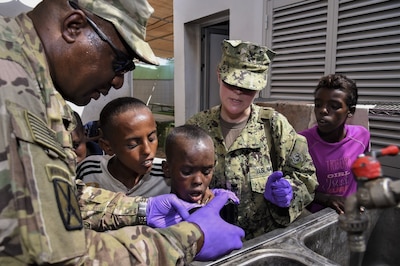
Navy Petty Officer 1st Class Samantha Ward, center, assigned to the Camp Lemonnier Emergency Medical Facility, and Army Maj. Donald Dais, 443rd Civil Affairs Battalion Functional Specialty Team Environmental Health officer in charge, test water samples at Caritas Djibouti, a mission providing humanitarian aid and education to Djiboutian children living on the streets, in Djibouti City, Djibouti, Aug. 23, 2017. The team checked for chlorine levels and retrieved samples to test for bacteria, in addition to conducting a food handling and sanitation tutorial. Air National Guard photo by Air Force Tech. Sgt. Andria Allmond

Led by Army Maj. Donald Dais, 443rd Civil Affairs Battalion Functional Specialty Team Environmental Health officer in charge, the unit conducted food-handler training, environmental health assessments, as well as tested multiple water sources for chlorine and bacteria levels at Caritas Djibouti -- a mission providing humanitarian aid and education mostly to Djiboutian children living on the streets.

“The [Camp Lemonnier] chaplains had asked me to go to Caritas with them to do an assessment the last time they went,” Dais said.

There, he identified some improvements that could be made to areas such as food-handling methods and sanitation, and created and taught a tailored class to educate and inform the Caritas volunteers in an effort to intercept the onset and proliferation of disease.

Health Appraisals

Dais and his team also conducted water purity testing and evaluated the sleeping conditions as part of the health appraisal.

“We don’t have a specialist here that can do what [the U.S military] can do to check our water,” said Alain Djeudi, a Caritas kitchen and food service volunteer. “We must be sure that there are no diseases here; we must keep everybody healthy.”

Djeudi said that many of the children that come to Caritas Djibouti are ill, refugees from areas like Somalia and Ethiopia. Often times, they arrive at the mission with both wounds and illnesses. This creates a scenario in which Caritas attempts to not only treat the acute affliction, but also halt the spread of infectious diseases from spreading to other children and eventually progressing into the local community.

Therefore, Dais’s disease prevention program has the potential to positively affect the entire region, helping shape the environment while maintaining freedom of movement in the joint operating area of East Africa.

Navy Petty Officer 1st Class Samantha Ward, assigned to the Camp Lemonnier Emergency Medical Facility, assisted Dias during the assessment.

“It’s important that we realize that what we as U.S. citizens consider the correct way isn’t always the best way for the people of other regions in the world,” Ward said. “What we’re here to do is see what can be done to assist them in implementing what works best in this environment.”

Dias echoed Ward’s sentiments, noting the dual role they played in the Caritas visit.

“We are here to conduct ourselves as not only professionals in the field of public health and disease prevention, but we are also serving as ambassadors,” he said. “In that role, we are committed to doing the very best for our regional partners, while remaining mindful of the host-nation culture.”