Thursday, January 28, 2016

Face of Defense: Soldier Crafts Career Menu as Enlisted Aide


By Dave Vergun Army News Service

WASHINGTON, January 28, 2016 — Had it not been for his mom's cooking, Army Staff Sgt. Marc Susa said he might never have joined the Army and he never would have been named the USO-Metro Inter-Service Enlisted Aide of the Year.

As a kid, Susa relished his mom's Filipino cooking, which she prepared at home and at her restaurant. Heavy on seafood and vegetables, he calls it "comfort food."

He planned to follow in her footsteps and open his own restaurant. But first, he'd need to get his feet wet. During high school, he worked part-time at restaurants and became president of the school's home economics club.

After the 9/11 attacks happened, Susa said he wondered how he might best serve his country. When an Army recruiter told Susa that he could enlist as a cook, that sealed the deal, he said.

Susa enlisted in 2003, served in Tikrit, Iraq, from 2005 to 2006 and progressed through the ranks with a military occupational specialty of 92G Culinary Food noncommissioned officer.

In 2009, Susa said he found out about another way he could serve and continue with his culinary passion: become an enlisted aide, or EA.

The part of being an EA that was especially appealing, he said, was the mission of preparing food for a general officer and his family.

Susa's first assignment was with now-retired Army Gens. James Thurman and Charles Campbell, when they were commanders of U.S. Army Forces Command. Now he is an enlisted aide for Lt. Gen. Robert S. Ferrell, Army chief information officer, G-6.

Day In The Life

A typical day starts early, he said, arriving by 6 a.m. at the general's quarters at Fort McNair in Washington, D.C., now part of Joint Base Myer-Henderson Hall.

At that early hour, Susa makes breakfast and also packs a lunch for the general to take with him to work. He then prepares dinner and leaves it in the refrigerator for reheating.

The important thing about food preparation, Susa said, is knowing the food preferences of who you support. So he gets creative and ensures there are a variety of options available.

On certain days, Ferrell entertains guests at home for official social functions, and that means finding out what each person attending likes and knowing who might have certain food allergies.

For a big social function, preparation can start the day before the event, shopping at the commissary for what will be needed. These events are often too big for Susa alone to handle, so he said he invites other EAs over to help with the preparations. In turn, he will help them when they need his assistance.

While food preparation plays a big part of an EA's duties, that's not all there is.

Throughout the day, Susa said he'll walk around inside the house and outside to see if something might be amiss: a broken window, suspicious activity, that sort of thing. Or, there might be a problem with the plumbing. Susa knows who to contact whatever the case might be.

Another very important duty, he said, is ensuring the general's uniform is squared away and all the awards and decorations are where they're supposed to be. "His appearance is a reflection on us."

Sometimes, EAs travel with the general, but that's up to the general to decide, he said. The important thing to do is to get with the general's deputy or aide-de-camp to know the general's schedule ahead of time for planning purposes.

EA of the Year

This past fall, Susa competed in -- and won -- the 13th Annual Army EA of the Year Competition. He competed against other EAs across the nation in a series of areas, from preparing a three-course meal to uniform assembly, leadership and knowledge.

Then on Nov. 19, he was named the USO-Metro Inter-Service Enlisted Aide of the Year after competing against Air Force, Marine Corps, Navy and Coast Guard EAs.

The EAs were evaluated on leadership, household management and community service skills. They also participated in a series of events during the completion that included tours of the White House and Capitol.

The Enlisted Aide of the Year award honors the hard work that all EAs do throughout the year, not just the winners and runners up, said Stephanie Lee Krasner, special events manager of USO-Metro, which sponsors the awards banquet.

As part of the awards banquet, USO-Metro invited select EAs and culinary specialists from across the services to prepare a seven-course meal for the attendees.

Ed Manley, founder of the Military Hospitality Alliance, which sponsors the competition, added that to win, the nominees went through a rigorous process, which included being vetted by a board chaired by retired Navy Adm. James Winnefeld. The board also included the spouses of two retired four-star officers and other former EAs.

Who Can Be an EA

Soldiers from any occupational specialty who are in grades E-5 through E-9 are eligible to be EAs, Susa said. Besides that, EA candidates must have really good NCO evaluation reports, pass an enlisted review board and have letters of recommendations from the command.

Once that's accomplished, EA candidates attend an "intensive" food service training and protocol course at the Joint Culinary Center of Excellence at Fort Lee, Virginia, he said.

Personality-wise, to be successful takes someone with high levels of managerial and organizational skills, initiative, honesty, flexibility and good demeanor, he said.

Once an EA completes school, there's one final requirement, he said.

The EA informally meets with a general and his spouse to determine if the EA will be a good fit for them and visa-versa. "There has to be a high level of comfort and trust," he said. "Otherwise, it won't work out."

Not Crossing the Line

There's a fine line between official duties and personal favors, and an EA has to know the difference. The latter, Susa said, are off-limits. For instance, tidying up the dining area and kitchen are official duties since those areas are where official social functions take place, but not cleaning the bedrooms or other personal spaces.

The EA is not a personal servant, he said. The EA's mission is to enable the general to focus on his or her official Army duties and not worry about potential problems at home.

Perceptions are important, and duties need to be on the up and up, he said. "You certainly don't want to get yourself or your boss in trouble."

While duties associated with being an EA are important, there are also important soldiering duties to do, he said. For instance, EAs are expected to do physical fitness training on their own and to keep up with soldiering skills.

Besides that, about 26 Army EAs from around the Military District of Washington get together for one day a month to do mandatory training, NCO leadership development and to compare notes on duties related to EAs.

Culinary Competitions

Susa has participated in not only military culinary competitions, but also civilian ones. He was recently selected as one out of four finalists to compete for the title of American Culinary Federation North East Region Pastry Chef of the Year in February.

In November, he will travel to Erfurt, Germany, to join the U.S. Army Culinary Arts Team for the Culinary Olympics at the Internationale Kochkunst Ausstellung, or International Culinary Art Exhibition, where he will compete against international civilian and military chefs. This will be his second time attending the culinary Olympics. The last time -- in 2012 -- the team won six gold and six silver medals.

Kudos From the General

"Staff Sergeant Susa's enlisted aide skills are absolutely unmatched. In fact, he's been repeatedly recognized," Ferrell said. At Fort Hood, Texas, he was captain of the III Corps culinary team and led the team to a militarywide culinary victory.

In addition, in 2010, he was selected to the U.S Army Culinary Arts Team and in 2012, he served with the USA military team and helped them win 12 gold and silver medals in the International Culinary Olympics, the general said.

"Enlisted aides perform an invaluable, official role for our Army," Ferrell added. "In Staff Sergeant Susa's case, he has also planned and executed major social events for over 3,200 total dignitaries.

"I'm especially proud that Staff Sergeant Susa takes time to mentor enlisted aides -- not only from the Army, but our fellow services as well," he said. "He is a superb example to all. On top of that, he continually volunteers in the community, and he's been involved in supporting events for our wounded warriors as well.

"What is most important to remember about Staff Sergeant Susa is that he is first and foremost an exemplary soldier. He is a consummate, professional NCO, a leader and an expert in his craft. He has also deployed, having served in Iraq, where he trained the Iraqi military on food service operations," Ferrell added.
Susa said he eventually would like to open a restaurant. He said he also wants to write a cookbook for college students that features simple ingredients and fast preparations.

NATO Secretary General Describes State of the Alliance


By Jim Garamone DoD News, Defense Media Activity

WASHINGTON, January 28, 2016 — The NATO alliance has been challenged in the past year, but the alliance’s 28 member nations are responding, NATO Secretary General Jens Stoltenberg said in Brussels today.

The secretary general briefed the press as part of his annual report on the alliance.

No one can ignore the challenges, he said. “We saw this in the brutal terrorist attacks in our cities and in the biggest refugee crisis in Europe since World War II,” he said. “We also saw it in Russia’s continued actions in Ukraine and its recent military build-up in Syria and the Eastern Mediterranean.”

But, he noted, NATO countries rose to face these challenges together.

“We implemented the greatest strengthening of our collective defense since the end of the Cold War,” Stoltenberg said. “And cuts in defense spending among European allies have now practically stopped.”

Since the end of the Cold War, NATO allies aimed at 2 percent of gross domestic product being spent on security. Few countries managed that -- the United States being one.

Now the defense cuts have stopped and seem to be reversing, Stoltenberg said. “In 2015, defense cuts were close to zero,” the secretary general said. “Five allies now meet our guideline on spending 2 percent of GDP or more on defense. Sixteen allies spent more on defense in real terms in 2015, and 23 allies increased the amount they are spending on new equipment.”

More to Do

But more needs to be done, Stoltenberg said, “because, to the east and to the south, we face the biggest security challenges in a generation.”

NATO has responded. The NATO Response Force has more than 40,000 troops, and its core -- the very high readiness Spearhead Force -- is now operational. “I was really impressed when I saw it in action at its first deployment exercise in Poland,” the secretary general said.

The alliance is also establishing eight force integration units or small headquarters in the eastern countries, Stoltenberg said. “They support planning, training and reinforcements, if needed,” he said. “To combat hybrid warfare, we are improving our intelligence and early warning.”

NATO is also streamlining the decision-making apparatus, and enhancing its cyber defenses, the secretary general said.

“Last year, we conducted around 300 allied exercises, including the largest and most complex one in over a decade, with over 36,000 troops, 140 aircraft, and 60 ships from over 30 different nations,” he said.

In 2016, the alliance will increase the number and scope of exercises, Stoltenberg said.

Russian aggression in Ukraine continues and the Eastern allies are particularly worried. “We have visibly increased NATO’s presence in the eastern part of our alliance,” he said. “Over the last two years, Russian air activity close to NATO’s European airspace has increased by around 70 percent. In response, allied aircraft scrambled over 400 times to intercept Russian aircraft.”

In the south, the alliance increased the presence of airborne warning and control system aircraft over Turkey, and the alliance has made substantial progress with our new alliance ground surveillance system, “including the first test flight of one of our new Global Hawk drones,” the secretary general said. “This system will provide real-time intelligence to our commanders in theater.”

Stoltenberg praised the arrival in Spain of two more U.S. ships carrying the Aegis ballistic missile defense system, and touted progress on the Aegis Ashore facility in Romania. “This spring, we will break ground for a new site in Poland,” he said.

Counterterrorism Efforts

NATO is supporting the Resolute Support mission and the alliance effort is to deny safe haven to international terrorists. “We continue to train, advise and assist the Afghan army and police,” Stoltenberg said.

The Afghans face significant challenges, he said, but they are holding their ground. “We decided in 2015 to maintain our current level of troops this year,” the secretary general said. “We are looking at how we can contribute to the funding of the Afghan security forces until 2020.”

Stoltenberg also addressed the global coalition to counter the Islamic State of Iraq and the Levant. “The coalition’s high degree of interoperability is a key asset,” he said. “To address the root causes of instability, NATO is working even closer with our partners in the region. We are building the defense capacity of Jordan. We will soon start training Iraqi officers, and we are working with Tunisia on special operations forces and intelligence to help them be stronger in defending themselves.”

NATO continues its mission in Kosovo, which continues to bring much needed security and stability to a region that has been highly volatile, the secretary general said.

Last year, Stoltenberg noted, “we [made] another important decision, which will advance stability in the Western Balkans: We formally invited Montenegro to begin talks to become the 29th member of NATO." Accession negotiations will begin in mid-February, he said.

“In less than six months from now, allied leaders will meet at our summit in Warsaw,” the secretary general said. “We will take the next steps to strengthen our defense and deterrence. We will decide on the right balance between a forward presence in the east and our ability to reinforce.”

In the years ahead, Stoltenberg said, NATO will remain an anchor of stability; staying strong, open for dialogue, and working with partners around the world.

Scott Airmen participate in initial Green Dot training

by Airman Daniel Garcia
375th Air Mobility Wing Public Affairs


1/28/2016 - SCOTT AIR FORCE BASE, Ill. -- To combat negative behaviors and create an environment that prevents violent acts from occurring, several personnel at Scott AFB received Green Dot violence training in January, which will continue throughout the year.

Green Dot is a new program aimed at preventing power-based violence among Air Force personnel. The program focuses on "Red Dots," a decision someone makes to assault or abuse someone else, and "Green Dots," a decision someone makes to react or prevent that from happening. The emphasis of the program is less about reporting crimes when they happen and more about creating a climate where the situations wouldn't happen in the first place.

Senior Master Sgt. Casy Boomershine, a Green Dot coordinator within Air Mobility Command, said everybody has the ability to intervene in a comfortable way. This program creates a climate where a "Red Dot" can't happen because everyone is looking out for each other.

"The actions a person can take can be something very small," she said. "It is a way for everyone to find out how to intervene while still in their personal comfort zone to keep our Wingmen safe."

According to 2nd Lt. Allison Rayome, a Green Dot coordinator within the 375th Air Mobility Wing, this training is similar to bystander intervention training, however the difference with Green Dot is it provides strategies to create a safer environment.

The Green Dot program is an Air Force-wide program, and everyone from officers to civilian personnel will receive Green Dot training which will also serve as the violence prevention training for the year. There are three levels of training: Leadership, Influencer, and General Overview.

The leadership training is targeted to those in key leadership positions such as group commanders and above, directors, and command chiefs.

The influencer training is a more in-depth training about understanding the concept and methodology behind it. Boomershine said people selected for this training will leverage their social standing within their units to inspire others to internalize the message behind the program.

"When people, who have social capital, adopt a new way of thinking, it helps to spread it within the entire population," Boomershine said.

The rest of the base will receive a 60-minute overview brief, which touches on all key points, so they can go back to their units and promote discussion.

Rayome said it's important to realize there may be people who have been affected in some way by violence, and that this training is a great way to help.

"One of the biggest things we all learned is that there wasn't a single person in the room during the training who wasn't personally affected, or knew someone who has been affected by interpersonal violence," said Rayome.

"So it's easy to look at the stats, it's easy to see when we get our [sexual assault prevention] training how many reports there are, but that's just a number. To some people, that number is a person they know and is their whole world. If we don't fix this in our Air Force culture, it's not going to change. It gave me hope, going through the training, that we actually can make a difference and those numbers are going to go down, if we allow them to internalize the message."

New Air Force unit provides support to USAFE, AFAFRICA

by Senior Master Sgt. Kelley J. Stewart
Air Force Installation and Mission Support Center Det. 4


1/28/2016 - RAMSTEIN AIR BASE, Germany -- A new unit officially opened its doors Oct. 1, 2015, to support installation management across U.S. Air Forces in Europe and Air Forces Africa.

Air Force Installation and Mission Support Center Detachment 4 currently consists of more than 70 people, has fulfilled all initial operational capability requirements and is on track to meet the full operational capability goal of Oct. 1.

Planning for the detachment began in March 2014, and the detachment now consists of five divisions: civil engineering, security forces, communications, career field education and training and financial management.

The civil engineering section is responsible for basing and bed downs, operations and housing management. The security forces section is responsible for force protection and requirements, and electronic security. The communications section is responsible for official mail, cyber infrastructure management and resources. The career field education and training section is currently responsible for the MAJCOM functional manager duties in the following Air Force Specialties: civil engineer, security forces, communications, personnel, logistics and public affairs. The financial management section is responsible for financial services and financial analysis.

The detachment currently supports Air Forces Africa requirements in the U.S. Africa Command area of responsibility through its civil engineer division with basing and bed downs and its security forces division with force protection issues. However, that support could expand to other divisions in the detachment.

"The mission of Det. 4 is to provide globally-integrated and networked installation management support to USAFE-AFAFRICA. We are revolutionizing the way our Air Force supports bases as the warfighting platform" said Wayne Sperry, AFIMSC Det. 4 deputy commander.

The establishment of AFIMSC was part of the Air Force's Future Air Force Organization Initiative implementing the July 23, 2013, guidance from the Secretary and Chief of Staff of the Air Force, that according the Program Action Directive 14-04, directed Headquarters Air Force "to plan and present for decision a streamlined management framework within the Air Force regarding basic organization structures and business practices."

"AFIMSC was established to provide centralized management of installation support, which means all the funding, all the requirements and all the programing underneath the Agile Combat Support Mission Area Plan [moved] into one center," Sperry said.

For example, AFIMSC Headquarters will provide the centralized funding for MAJCOMs. This means the initial distribution of funds will go directly to the wings.

The establishment of AFIMSC and the detachment does not change the base support leadership structure or chain of command at the base level.

USAFE retained its Air Force Forces, Component MAJCOM responsibilities, and compliance with guidance on war-fighting requirements and priorities. The MAJCOM also kept its component staff to U.S. European Command, NATO and U.S. Africa Command responsibilities.

The biggest hurdle currently for AFIMSC Det. 4 is spreading the word so customers know who they need to call for support. AFIMSC has several informative efforts are underway to help people. There is an AFIMSC Phone Book located at askafimsc@us.af.mil, AFISMC roadshows and base visits located at www.afimsc.af.mil, and installation commander update video teleconferences and briefings given at USAFE-AFAFRICA courses.

AFIMSC Headquarter reports to Air Force Material Command and is based at Joint Base San Antonio in Texas. It is headed by a two-star general, Maj. Gen. Theresa Carter.  AFIMSC Headquarters is made up of a special staff, resources directorate, installation support directorate and expeditionary support directorate.

Other AFIMSC detachments are located at Joint Base Pearl Harbor-Hickam, Hawaii; Barksdale Air Force Base, Louisiana.;  Peterson AFB, Colorado; Hurlburt Field, Florida; Joint Base Langley-Eustis, Virginia; Scott AFB, Illinois; Joint Base Andrews, Maryland; and Wright-Patterson AFB, Ohio.

Wednesday, January 27, 2016

Meeting halfway: ADR gets the job done

by Senior Airman Areca T. Bell
31st Fighter Wing Public Affairs


1/22/2016 - AVIANO AIR BASE, Italy  -- No U.S. Airman is the same. Although they all work together to ensure the Air Force remains the world's greatest air, space and cyberspace power, each person may have a different outlook when approaching circumstances.

Sometimes conflicting opinions cause tension between parties due to a lack of understanding from each other's point-of-view. To help achieve open communication and contribution of ideas to constructively resolve conflict in the work center, the 31st Fighter Wing Equal Opportunity Office manages the Alternative Dispute Resolution program.

"Sometimes when people are having an argument, they only see their side of the situation," explained Master Sgt. Melinda Morris, 31st Fighter Wing EO superintendent and ADR manager. "We act as a third, neutral party and try to restore a healthy and happy environment."

The voluntary and confidential program was created after the Administrative Dispute Act of 1996, which called for all federal agencies to adopt and promote ADR.

"This is an avenue for people who can't see eye-to-eye," said Morris. "Conflict has always been around, but healthy conflict resolution hasn't necessarily been the way it is today."

Today, ADR offers many advantages. It promotes the opportunity for parties to speak directly to each other, identify differences and find common ground, which helps create a win-win situation.  Also, the time, resources and money necessary to achieve a resolution at the lowest level is reduced.

"If a complainant comes in and if the root cause may be a lack of communication, a [review] is usually conducted by the Legal Office [to determine if ADR is suitable]," said Morris. "A session is then scheduled. When a settlement is reached, it is routed through the appropriate agencies, whether it is the Legal Office, Civilian Personnel Office or even Air Force Personnel Center."

Additionally, ADR conflicts are resolved in an average of 42 days, which drastically contrasts Equal Employment Opportunity complaints procedures and EEO settlements, which average 405 days and 247 days respectively.

"We are neutral, we don't side with management or the complainant," Morris explained. "We are protectors of the process. We are here to help articulate what the issues are and to help solve them."

For more information on the ADR program, contact the EO Office at 632-5934 or visit www.adr.af.mil.

CENTCOM Theater Course offered on JBER

by Staff Sgt. Wes Wright
JBER Public Affairs


1/27/2016 - JOINT BASE ELMENDORF-RICHARDSON, Alaska -- The U.S. Central Command Theater Course is coming to Joint Base Elmendorf-Richardson the first week of February. Two separate three-day iterations of the course are being offered: Feb 1 to 3 and Feb 3 to 5.

The course is designed for special operations personnel who will be operating in the CENTCOM theater, with emphasis on special operations forces aviation. The focus audiences include combat aviation advisors, aviation special tactics personnel, and standard and non-standard aviation mission planners. Other audiences include non-aviation SOF and those who support them.

One of the training organizers, Air Force Lt. Col. Michael Bliss, 703d Aircraft Maintenance Squadron commander, said the course is beneficial to any Airman or Soldier of any rank or career field.

"For decades, SOF have been involved with face-to-face cross-cultural interaction," Bliss said. "In today's high operations tempo environment, regular Airmen and Soldiers are involved in cross-cultural interactions that previously would have only involved SOF. Cross-cultural training is beneficial for you no matter if you're in intelligence picking targets or in civil engieering making road repairs. Every year, many units and people from JBER deploy to the CENTCOM theater, and 2016 will be no exception"

Some of the topics covered include the history of Islam, Arab social and military culture, introduction to Iraq and Syria, Islamic radicalization and terrorism, the Kingdom of Saudi Arabia, Department of State and U.S. Agency for International Development, U.S. foreign policy and the Arab spring, Iran: engagement vs. containment, Yemen, Pakistan and India, the drawdown in Afghanistan, Central Asia; and Afghanistan Transition and Development.

"This orientation course is important for all military members as we work to understand the layered complexities of the Middle East and Central Asia," said Air Force Maj. Justin Hickey, Deputy Division Chief for Theater Engagement at the USAF Special Operations School at Hurlburt Field, Florida. "Simultaneously, it will help our people better appreciate our CENTCOM allies and their culture, regardless of the type of deployment. The training originates from the SOF schoolhouse, but has been tailored to introduce Airmen and Soldiers of all backgrounds to CENTCOM's culture and security concerns."

According to Bliss, the training initiative's purpose is to develop Airmen.

"Equipping our Airmen with knowledge, understanding, and training to better accomplish their mission is our mission as tactical and operational leaders," Bliss said. "Cross-cultural (political and historical) knowledge are areas of focus that will only grow in importance. It's been said, 'an intimate understanding of culture's effects on human behavior is crucial to mission success.'"

Hickey, one of the course instructors, said the main takeaway he hopes to give students is to encourage them to critically think about the complex security issues in CENTCOM.

The training will be held at the 517th Airlift Squadron auditorium, Hanger 21, on the second floor. The Feb 1 to 3 course runs from 8 a.m. to 2:50 p.m. on days one and two, concluding with lunch at noon on the third day. The Feb 3 to 5 course runs from 1 p.m. to 3:50 p.m. on the first day, 8 a.m. to 3:50 p.m. on the second day, and from 8 a.m. to 1:50 p.m. on the third day.

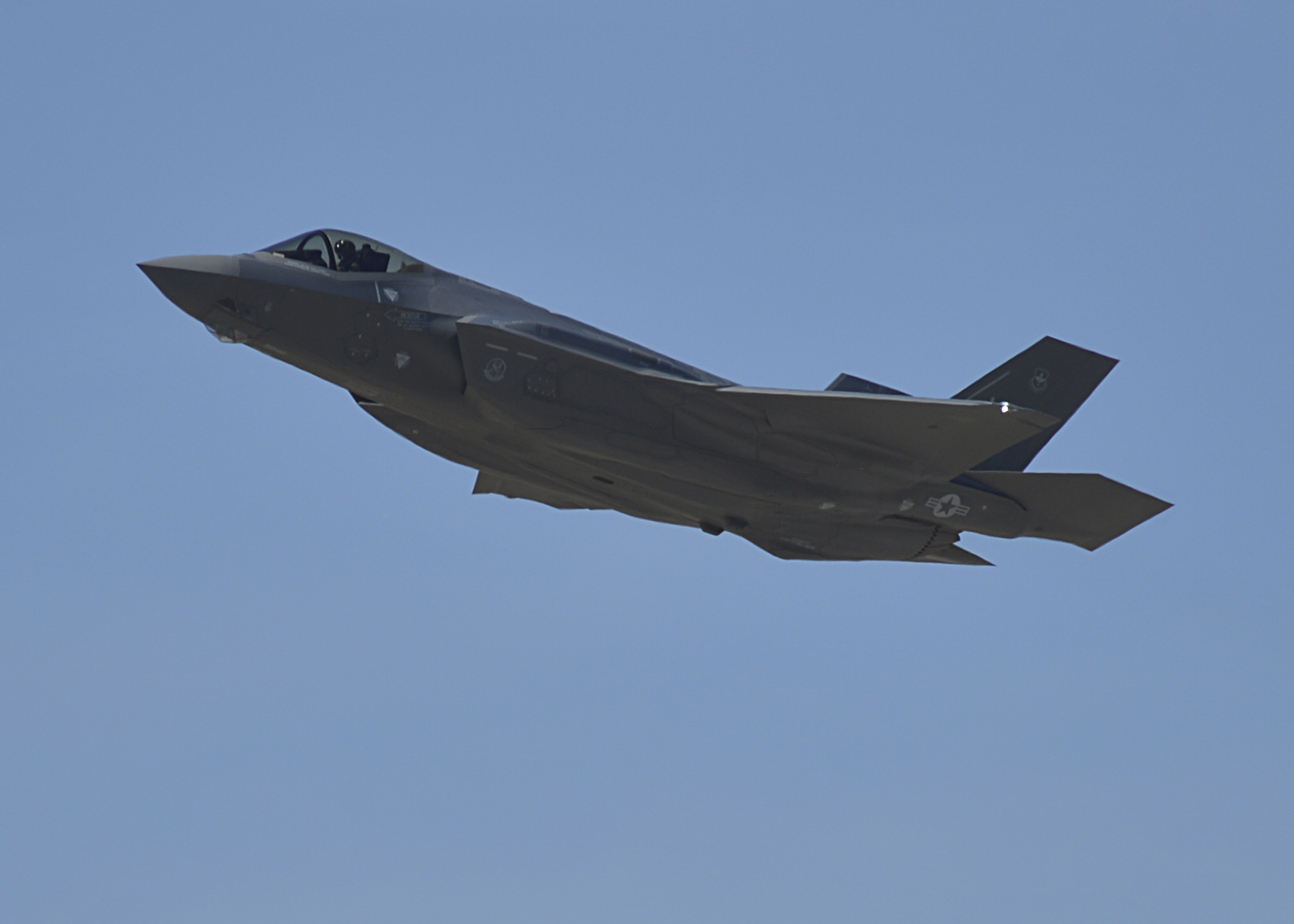
AF sends F-35A to UK for air shows


By U.S. Air Force Public Affairs, / Published January 26, 2016

WASHINGTON (AFNS) -- The Air Force is taking the future of airpower to international audiences in England this summer.

The 56th Fighter Wing from Luke Air Force Base, Arizona, will send F-35A Lightning IIs to fly in heritage flights and to be on public display at the Royal International Air Tattoo at Royal Air Force Fairford, England, and the Farnborough International Airshow. This will be the first time the Air Force sends an F-35 to an overseas airshow.

"We're very excited about demonstrating this capability to the world," said Air Force Chief of Staff Gen. Mark A. Welsh III. "The F-35 represents a new way of thinking about data integration, weapons and tactics. We're thrilled to highlight the program and the amazing Airmen who support this cutting-edge fighter."

The Air Force Heritage Flight program features modern Air Force fighter aircraft flying alongside World War II, Korean War and Vietnam War-era aircraft in a dynamic display of our nation's airpower history.

"Being a part of these heritage flights allows the world to learn more about the F-35 and at the same time see just how far airpower has come over the years," said Brig. Gen. Scott Pleus, the 56th Fighter Wing commander. "The F-35 will be the backbone of the Air Force fighter fleet and represent the future for the U.S., our partners and allies. This will be a great opportunity for everyone to see how amazing the F-35 is."