Tuesday, January 26, 2016

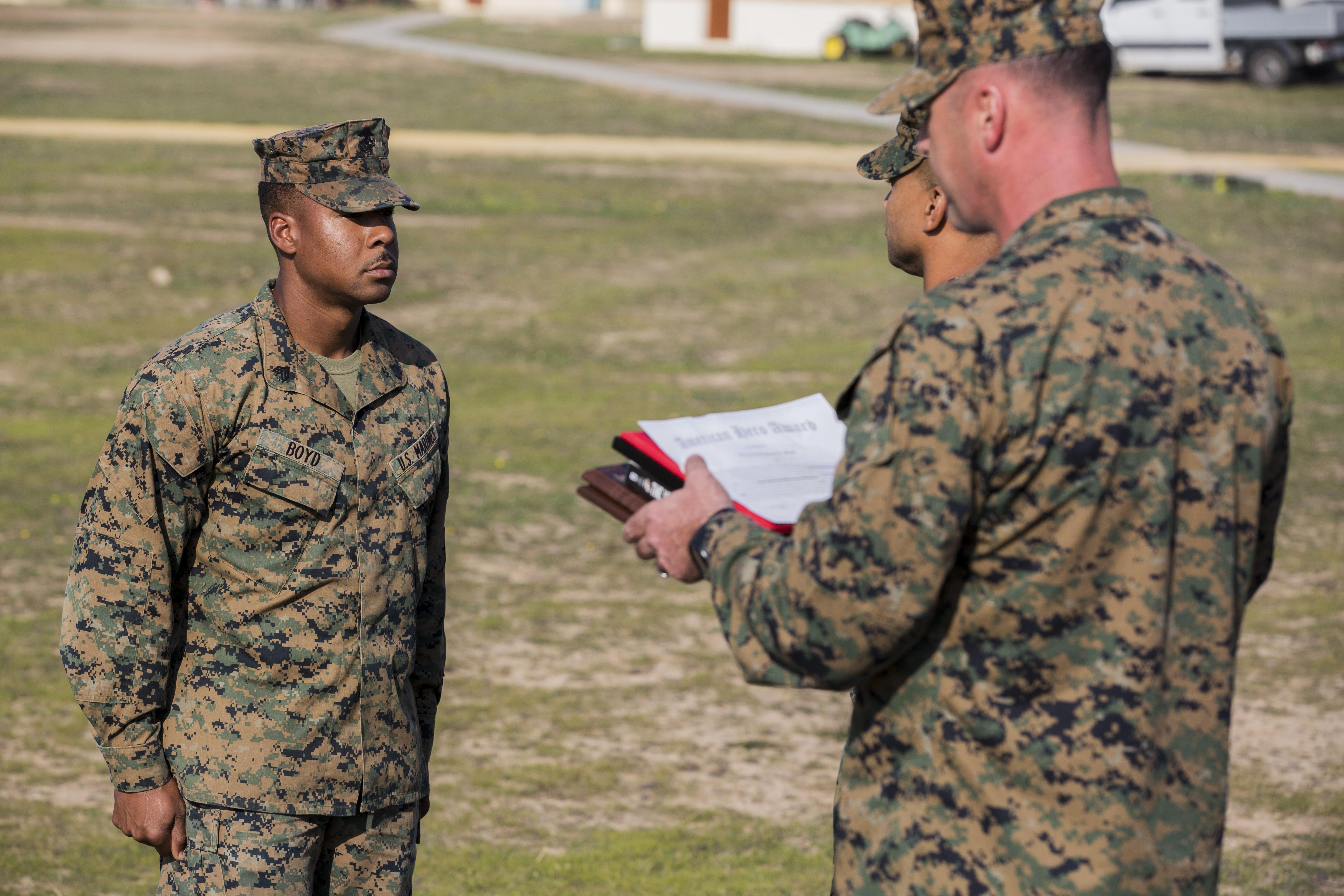
Face of Defense: Marine Takes Action to Prevent Suicide


By Marine Corps Staff Sgt. Vitaliy Rusavskiy, U.S. Marine Corps Forces Europe and Africa DoD News, Defense Media Activity

MORON AIR BASE, Spain, January 26, 2016 — Eight months ago, Marine Corps Sgt. Raheem Boyd was in his room on Camp Lejeune, North Carolina, when he received a message from a fellow Marine telling him he had discovered suicidal posts on another Lejeune-based Marine’s Facebook page.

“I checked that Marine’s page and saw one post that looked strange and made me want to investigate further,” Boyd said, adding that he recognized the Marine from a previous tour in Okinawa, Japan.

When he drove to the barracks, he found that the Marines on duty were by the Marine’s room, which was empty. After searching the area, one of the on-duty Marines briefly caught a glimpse of the troubled Marine in his car with an assault rifle as he sped off from the barracks parking lot.

Boyd said he followed and eventually saw his car sitting on the side of the road. "He did not recognize me at first," Boyd said. "It was the first time I had seen him since Okinawa."

Life-or-Death Moment

Boyd said he approached the vehicle and attempted to calm the Marine, telling him that he was there for him and that there is always another way. As they talked, the first police car pulled up and the Marine started to panic.

As more police cars approached with flashing bright red and blue lights dissipating in the darkness, the Marine reached across the seat for the rifle -- with the intent to shoot himself, Boyd said. Boyd quickly reached through the window of the car, wrapped his body around the Marine and pushed the rifle away to the floorboard.

“I gave just enough time for [the police] to come around and secure the weapon,” Boyd said. “After the situation de-escalated, I did my best to comfort the Marine and tell him that everything will be all right. He got out of the car and we escorted him to the hospital in an ambulance.”

'Me Being a Human'

The events took place not long before Boyd deployed here. He currently serves as a heavy equipment operator with Special-Purpose Marine Air-Ground Task Force Crisis Response-Africa.

“A lot of Marines were telling me I did a good job and that they wish a lot more Marines would be like me,” said Boyd, a Birmingham, Alabama, native. “But I feel that wasn’t me being a Marine, it was me being a human -- being there for someone who needs help. I always fell back on my morals -- to always treat others how you would want them to treat you.”

Boyd’s excellence in service did not stop there. During his deployment here, he was meritoriously promoted to sergeant, helped certify more than 40 new black belt recipients, led the unit’s leadership seminars for corporals and -- his latest achievement -- receiving the American Hero Award for preventing a tragic loss of life.

“Sergeant Boyd is above his peers and is very mature. The Marines in his shop always look up to him,” said Marine Corps Gunnery Sgt. Archie Mardis Jr., utilities chief for the Combat Logistics Detachment here. “I never have to worry about him. He is the Marine to go to.”
Each tragic loss to suicide has far-reaching impact on families, friends and Marines left behind. The Marine Corps had 28 suicides in the first three quarters of 2015. If not for Boyd’s actions, that number could be 29.

National Guard Forces Continue Post-Storm Assistance


By Cotton Puryear Virginia National Guard

STAUNTON, Va., January 26, 2016 — Virginia National Guard soldiers on state active duty have been using Humvees and medium tactical trucks to provide mobility support to help Virginia State Police and local first responders reach residents requiring assistance after a historic snowfall blanketed the state.

Since they began operations Jan. 22, Virginia Guard members have escorted or transported 49 law enforcement, emergency medical and fire rescue personnel to emergency locations as well as transported 26 essential medical and support personnel to their place of work.

Guard members assisted in saving at least two lives in Virginia. They also provided mobility support to citizens and law enforcement personnel for nonemergency situations, transported essential medical supplies, towed fire trucks stuck in the snow and conducted health and welfare checks.

"I think our soldiers are doing a fantastic job across the commonwealth in helping our state and local first responder partners get through the heavy snow to help their fellow Virginians," said Army Maj. Gen. Timothy P. Williams, the adjutant general of Virginia. "Working so closely with the Virginia State Police and local government emergency response officials under the guidance of the Virginia Department of Emergency Management has proven to be very effective."

Specific Actions

Some of the significant activities accomplished by soldiers of the 116th Infantry Brigade Combat Team:

-- Virginia National Guard soldiers working in support of Waynesboro Fire and Rescue responded along with an ambulance to an emergency call on Afton Mountain, Jan. 24. The resident was located about one mile from the main cleared road, but the ambulance and rescue teams were not able to reach the house. The Guard Humvee with one EMT was able to move through the unplowed road and clear a path for a follow on vehicle to pick up the resident for movement to an air evacuation site.

-- Virginia National Guard soldiers working in support of the Greene County Rescue Squad responded along with an ambulance to an emergency call near Stanardsville, Jan. 23. The ambulance was not able to make it to the residence through the heavy snow, so the EMTs moved to the Humvee to make it the residence where a man was suffering from chest pains. The soldiers helped move the patient to the Humvee, then transferred him into the ambulance for evacuation. During transport, the patient's heart stopped and a soldier assisted with CPR. The patient was revived and successfully airlifted for further medical support.

-- Virginia National Guard soldiers working in support of local civil authorities in Winchester were dispatched Jan. 23 to assist an ambulance stuck in the snow while responding to a high-priority emergency call. Using two medium tactical trucks, the soldiers drove in front of the ambulance to clear a path. Once at the residence, the EMTs were able to provide care, move the patient to the ambulance and then the Guard vehicles lead the ambulance to the cleared road.

-- Virginia National Guard soldiers working in support of Augusta County Fire Station No. 6 responded to a vehicle crash Jan. 22, where one of the passengers sustained a severe head injury. One of the soldiers assisted fire and rescue personnel with extracting the passenger from the vehicle and moving them into the ambulance for evacuation.

-- Virginia National Guard soldiers working in support of Page County helped clear a path for an ambulance to reach a dialysis patient in need of transport Jan. 23, near Stanley. The Guard was able to clear a path so the rescue squad was able to transport the patient for required treatment.

Command, Control

The Staunton-based 116th Infantry Brigade Combat Team is providing mission command for the response operations in the field and is working requests from the Virginia Department of Emergency Management to provide support to multiple locations, as well as the Virginia State Police. Soldiers are deployed along the I-81 corridor between Lexington and Winchester, along the Route 29 corridor from Warrenton to Danville, as well as in the areas near Northern Virginia, Richmond, Fredericksburg and Gate City.

More than 400 soldiers from units of the 116th IBCT as well as from the Virginia Beach-based 329th Regional Support Group and Bowling Green-based 91st Troop Command are on duty providing support.

The Virginia National Guard also has more than 100 soldiers, airmen and members of the Virginia Defense Force on duty in Richmond, Sandston and Fort Pickett, where they are providing mission command, administrative and logistical support for the overall mission.

Virginia Gov. Terry McAuliffe authorized up to 500 personnel for state active duty in his initial emergency declaration, and then he increased that to 700.

Delaware Guard Response

The Delaware National Guard activated nearly 300 soldiers and airmen to support the citizens of Delaware through Winter Storm Jonas.

The National Guard leaned forward before the storm, prepositioning operators and tactical vehicles such as Humvees, five-ton trucks and wreckers to each county's emergency operations center. From each EOC, troops and vehicles were dispatched to local fire houses and state and local police departments.

Officially, troops supported nearly 100 missions and 165 individual citizens across Delaware. Missions included transporting medical professionals and first responders to and from work shifts and moving Delawareans to safety from flooding or effects of the snowstorm.

Because of flooding in Sussex County, the Guard helped evacuate approximately 40 residents from the Oak Orchard/Long Neck area to area shelters or homes of friends. In New Castle County, due to the snowfall, the Delaware Guard helped dozens of people who needed emergency medical care or were stranded on the road.

Included in those missions were efforts to recover an ambulance and a fire truck, along with an aerial assessment of the flood damage in Sussex County, which was reported to Gov. Jack Markell and other state officials.

"Even though the Delaware National Guard has troops deployed around the world, we were able to provide the necessary support to our great state," said Army Maj. Gen. Frank Vavala, the adjutant general of Delaware.

In addition to helping 165 Delawareans on official missions, soldiers and airmen "unofficially" assisted countless stranded motorists and moved abandoned vehicles for Department of Transportation workers to plow roads and first responders to complete their missions.

Guardsmen Helping Elsewhere

Guard members were activated in other states as well. Their personnel strength numbers as of yesterday:

-- Washington, D.C., about 100;

-- Kentucky, more than 75;

-- Maryland, more than 500;

-- New Jersey, more than 120;

-- Pennsylvania, more than 300; and
-- West Virginia, more than 120.
Monday, January 25, 2016

673d Medical Group hosts Girls’ Night Out

by Airman Valerie Monroy
JBER Public Affairs


1/25/2016 - JOINT BASE ELMENDORF-RICHARDSON, Alaska -- The 673d Medical Group will host a "Girls' Night Out" event at the Arctic Warrior Events Center, Feb. 2, from 4:30 to 8 p.m.

The 673d Medical Group started the event in 2012 due to an increase in cervical cancer in females throughout the nation. Medical providers and technicians found that many women across Joint Base Elmendorf-Richardson were not receiving the preventive health care available.

"Girls' Night Out" is a way to bring women on base, more information about health care but in fun and relaxed way, said Lisa Schuette, 673d Aeromedical Squadron public health educator.

Shuette said the event is also a way for women to get connected to the community to help women who are new to JBER, to get to know each other.

One of the evening's activities will include a variety of spa treatments on a first-come, first-serve basis.

Wine tasting and snacks will be provided and live music will be ongoing throughout the night, Shuette said.

Also door prizes were donated by different organizations in the JBER and Anchorage community, Schuette continued.

"Around 30 different organizations throughout JBER will also be set up providing information on various aspects of the base," Schuette said." For example the library and outdoor recreation will be there."

Health care will not be provided at the event, but information on appointments and different types of health screenings will be available, Shuette said.

Care providers will be available to discuss risks for different diseases and help decide on future actions.

New to the event this year is the teen health information section where teens can learn about all the different health aspects that can affect them, Schuette said.

"Girls' Night Out" will feature guest speakers, Kikkan Randall, Alaska's own four-time Olympian, and Damsel in Defense which provides information on personal protection.

The event has become very popular over the years and a lot of people are expected to come with numbers climbing since last year, Shuette said.

LCMC: Powerful C-17 engine program managed at Robins

by Jenny Gordon
78th Air Base Wing Public Affairs


1/22/2016 - ROBINS AIR FORCE BASE, Ga. -- The turbofan engines that power every C-17 Globemaster III in the Air Force fleet have now transitioned into a sustainment phase.

The final F117-PW-100 engine, produced by Pratt & Whitney, is scheduled to be delivered to the Air Force this month. It will be the 1,313th engine the company has produced for the military and through foreign military sales.

Program oversight of those engines, which reaches across the globe through partnerships with several nations, is managed by the Air Force Life Cycle Management Center's C-17 Program Office here.

"We ensure continued support of the engine; we ensure it's overhauled and that parts are available to support the field," said Chuck Keown, Robins C-17 engine program manager. "Now that the engines are out of production, we will be responsible for engine sustainment."

Each of the aircraft's four engines generates 40,400 pounds of thrust and weighs more than 7,000 pounds. Its thrust reversers direct airflow upward and forward to avoid ingestion of things such as dust and debris.

The engines are tasked to fly a minimum of 4,400 N1 cycles -- an aircraft's flight cycles from idle to full thrust and back. According to Keown, C-17 engines are currently averaging 5,700 N1 cycles.

Bennett Croswell, P&W Military Engines president, said, "This is a bittersweet occasion for those of us who have played a part in developing and delivering the F117 engine to our customers over the years. The F117 production engine program might be ending, but we look forward to working with our customers around the world to sustain their engines, and to keep the C-17 fleet flying for decades to come."

The Air Force received final delivery of a C-17 in 2013, its 223rd aircraft, and celebrated a major milestone in 2015 with the fleet reaching 3 million flying hours. Since the aircraft is no longer in production, according to Keown, the engine was the last major end item that will now transition into sustainment.

While Robins maintainers don't work on the engines, the 562nd Aircraft Maintenance Squadron is dedicated to programmed depot maintenance of the aircraft. An occasion was also marked in December when the squadron produced the 500th C-17 here. That number represents aircraft which were at the depot for maintenance or modifications.

The C-17 Program Office at Robins -- with personnel co-located at Wright-Patterson Air Force Base, Ohio -- includes foreign military sales and Boeing representatives responsible for sustainment, modification, maintenance and service of the entire fleet.

Partner nations that fly the C-17, who host representatives in the program office, include the United Kingdom, Qatar, Australia, Canada and the NATO Airlift Management Program.

AMC facilitates national discussion about pilot manning

by Capt. Kathleen Ice
Air Mobility Command Public Affairs


1/25/2016 - SCOTT AIR FORCE, Ill. -- Air Mobility Command is participating in a national-level discussion about current and future-projected pilot manning shortfalls.

AMC's commander facilitated a meeting Jan. 7 with representatives from the Federal Aviation Administration, airline trade associations, academia, and several airlines, to include the major carriers.

"Pilot manning is a national issue and not specific to only the military or commercial sector," said Gen. Carlton Everhart, AMC commander.

The group gathered to discuss pilot manning shortfalls caused by mass retirements; stricter licensing requirements for first officers; new crew rest duty rules, and other recent changes, said Merle Lyman, chief of the DoD Commercial Airlift Division. 

In 2007, the Fair Treatment of Experienced Pilots Act, or the "Age 65 Law", extended pilot retirement age from 60 to 65 in order to retain experience, according to the FAA website.  At the time, this extended a large number of pilots' careers.  But recently, that large group has started to hit 65 and retire, Lyman said. 

The minimum flight hours required to earn a commercial airline transport pilot certificate jumped in 2013 from 250 hours to 750 hours for military trained pilots, 1000 hours for pilots with a degree from an aviation school, and 1,500 hours for all others, according to the FAA's website.

This change forced many to invest more time and money to get/stay certified, or choose a different career path.

Another change came in 2014: stricter regulations, which govern how many hours a pilot can be on duty.  With these restrictions in place, pilots started flying less in a given amount of time, requiring a larger pool of pilots to fill in scheduling gaps.

The pilot manning shortfalls have especially hit regional airlines hard, with several rural areas no longer getting air service, Lyman said.

Current and projected shortfalls may impact both civilian and military operations, particularly because many commercial pilots also have military obligations as Reservists.

AMC stepped up to bring everyone together.

"While individual efforts have been taking place in the industry, our aim was to encourage collaboration and go forward with a united solution," Lyman said. "Many interesting proposals were brought to the table for consideration at the meeting,"

They will continue to discuss ideas, and eventually senior representatives from industry and the military plan to meet with the Chief of Staff of the Air Force, possibly as early as spring.

"There is strength in collaboration," said Everhart. "I'm confident that, working together, we'll be able to develop solutions to any challenges with pilot sourcing."

Golden years: Host wing hits half-century mark

by Senior Airman Charles Rivezzo
60th Air Mobility Wing Public Affaris


1/22/2016 - TRAVIS AIR FORCE BASE, Calif.  -- The base chapel's 65-year-old bell rang out five distinct times, one for each of the 60th Air Mobility Wing's five decades. With each toll, cause for celebration was paused for a moment - a moment to honor the Airmen who died in service to their country.

On Jan. 8, 1966, the 1501st Air Transport Wing furled its colors and the new 60th Military Airlift Wing was born.

Fifty years later, Travis Airmen and community partners gathered Jan. 19 to commemorate the 50th anniversary of the installation's host wing, now redesignated the 60th Air Mobility Wing.

"A half-century ago, the space race was heating up and the Cold War was freezing over," said Col. Joel Jackson, 60th Air Mobility Wing commander. "Civil rights activist won hard-earned victories, John Glenn became the first American to orbit the earth and U.S. involvement in Vietnam escalated rapidly with Operation Rolling Thunder. This is what the world looked like in 1966."

The commander added that while a lot has changed over the last fifty years; one thing has remained constant: "Our mission to provide rapid global mobility to all corners of the earth."

Jackson was joined by Fairfield Mayor Harry Price, Vacaville Mayor Len Augustine and U.S. Rep. John Garamendi to honor the wing's 50th anniversary celebration.

Garamendi praised the wing for its exemplary service through the years.

"When you have a problem ... you call Travis," he said. "It is a significant honor to represent this base, the men and women who work here and all the history."

The congressman also presented a certificate citing the wing's anniversary being added to the congressional Record.

While addressing the crowd of Airmen and community partners, Jackson spoke on the highlights of the wing from its early beginning to present day.

"From the early years of the Vietnam War, to Operation Desert Shield and Storm, to today's efforts fighting against extremist organizations, for half a century, the men and women of the 60th Air Mobility Wing have left their mark on the pages of history," he said.

The ceremony concluded with the sealing of a time capsule. Within it were coins, unit patches and letters from base leadership for the future generation of Airmen of the wing.

The capsule is slated to be buried in front of the wing headquarters building and will remain unopened until January 2041.

KC-46A Pegasus conducts 1st in-flight refueling demonstration

by Daryl Mayer
88th Air Base Wing Public Affairs


1/25/2016 - WRIGHT-PATTERSON AIR FORCE BASE, Ohio (AFNS) -- The KC-46A Pegasus successfully transferred fuel through its boom to an F-16C Fighting Falcon Jan. 24 to demonstrate aerial refueling operations in advance of its first production decision later this spring.

The KC-46A passed 1,600 pounds of fuel to an F-16C piloted by Lt. Col. Daniel Alix of the 416st Flight Test Squadron, 412th Test Wing out of Edwards AFB, California, who characterized the mission as a complete success.

Officials said it was a big step forward for the program and for the tanker capability that will serve as the backbone of Air Force global operations over the coming decades.

"I'm extremely proud of the entire industry and government program team that made today happen," said Brig. Gen. Duke Z. Richardson, the Air Force program executive officer for tankers, Air Force Life Cycle Management Center. "This aerial refueling marks the first of many, and represents years of hard work beginning to pay dividends."

The tanker has a robust in-flight refueling demonstration schedule over the coming weeks. The test with the F-16C fulfilled the requirement to connect to a light/fast receiver. The remaining tests with the boom will use an A-10 Thunderbolt II as the light/slow receiver and a C-17 Globemaster III as the heavy receiver.

Flight tests employing the centerline drogue system and wing aerial refueling pods will use an F-18 Hornet as the light/fast receiver and an AV-8B Harrier as a light/slow receiver. The KC-46A will also have to demonstrate its receiver capability by taking fuel from a KC-10 Extender.

These refueling demonstrations represent the significant remaining test hurdles before proceeding to a Milestone C low rate initial production decision. Program officials anticipate awarding the first production contract shortly thereafter.

"These are exciting times for the KC-46A program," said Col. Chris Coombs, the KC-46 system program manager, Air Force Life Cycle Management Center. "We have had plans on paper and data from simulation labs, but this in-flight demonstration shows we are truly making progress on bringing this capability of the next generation of tankers to the warfighter supporting our global missions for years to come."

  Master Sgt. Lindsay Moon, a 13-year veteran boom operator, operated the boom controls passing fuel for the mission.

"This mission was a significant event towards certifying this new tanker," said Moon, who is assigned to the 418th Flight Test Squadron Detachment 1 in Seattle, Washington. "Controlling the boom from the Air Refueling Operator Station is night and day different from laying on your belly in a KC-135. The system advances being rolled into the KC-46 will give the operator great awareness."

Lt. Col. Donevan Rein, also with Detachment 1 in Seattle, Washington, was the Air Force pilot onboard the KC-46A during the test sortie.

The Air Force contracted with Boeing in February 2011 to acquire 179 KC-46A tankers to begin recapitalizing the aging tanker fleet. The program is currently working to meet the required assets available date, a milestone requiring 18 KC-46A aircraft and all necessary support equipment to be on the ramp, ready to support warfighter needs, by August 2017.

131st Citizen-Airmen Contribute to Historic Flood Response

by Maj. Jeffrey M. Bishop,
131st Bomb Wing Public Affairs


1/25/2016 - JEFFERSON BARRACKS AIR NATIONAL GUARD BASE, Mo. -- 10 Citizen-Airmen from 131st Bomb Wing's initial flood response task force will remain on State Emergency Duty as liaison officers to support flood recovery efforts as part of Operation Recovery.

The members from the 231st Civil Engineer Flight, the 131st Civil Engineer Squadron, and the 239th Combat Communication Squadron will help communities remove debris and recover from historic flooding that struck the state over the New Year holiday.

While some have completed their duties and have been released, a number remain involved. The LNOs, based here, have been coordinating debris removal and aid to assigned communities across the region under the leadership of Lt. Col. Grace Link, Missouri Air National Guard director of staff.

In the immediate aftermath of the flooding, a number of Airmen from the 131st Bomb Wing and its affiliated units worked alongside fellow Missouri National Guard soldiers to support flood response and recovery efforts.

Within the first 12 hours of the operation, a complement of Jefferson Barracks-based Airmen helped protect the water treatment facility at High Ridge, Missouri. More than 35 Airmen rallied from the 157th Air Operations Group, the 131st CES and the 239th CBCS to build a four-foot high sandbag barrier around the site in the St. Louis-area community.

"Our people had all worked a full day, and went back out there and filled sandbags until 1 in the morning," said Lt. Col. Bill Boothman, director of operations for the 157th AOG.

As part of the Missouri Guard's Quick Reaction Force, the wing has four hours to muster its Airmen. In this situation, volunteers were recalled at 4:30 p.m., and by 6:30 p.m. were on site filling and laying sandbags, according to Boothman.

At the same time, the Army Guard's armory at Festus, Missouri, the location for the flood response task force, suffered water damage that affected communications. In response, the 239th Combat Communication Squadron deployed six Airman to set up, operate and maintain its Joint Incident Site Communication Capability, or JISCC system, to provide satellite-based telephone, network and email capability to the operation.

The team had communications online within six hours, managed the system around the clock, and stayed on throughout the operation; even after armory communications were restored, in order to expand capacity and ensure continuous connectivity, according to Capt. Tony Crnko, 239th officer in charge.

"Having them here has been a blessing," said Missouri Army National Guard Maj. John Myers, a battle major in the Tactical Operations Center. "If there were any problems, they were right here to work them out for us, no matter what time it was."

Another four Airmen from the 231st CEF worked as liaison officers in the Joint Operations Center at the Ike Skelton Training Site in Jefferson City, Missouri. Their work included tracking personnel and equipment, along with liaison work to the State Emergency Management Agency, according to Maj. Rachel Jackson, a civil engineer with the unit who was not part of that team.

"That's pretty much in our wheelhouse," said Jackson of the role the LNOs played. "As a staff augmentation team, that's right in line with what we train to do."

The wing also sent public affairs support to St. Louis, where a joint Air Force-Army broadcaster team filed video stories, photos and articles and worked with reporters to keep the state in the know about the role the Missouri Guard is playing in the flood response and recovery.  Those stories can be found on the wing's Facebook page at www.facebook.com/131BW.

"The Missouri Air Guard brings a lot to the mission; in terms of numbers, in terms of rapid response and in terms of unique capabilities," said Col. Michael Francis, 131st Bomb Wing commander.  "The ANG stands 2,400 tall, and is ready to roll whenever tasked.

"Once again, the men and women of the 131st Bomb Wing have much to be proud of in respect to the help we provided our Missouri neighbors during and following these floods," Francis added.

A2D2: the impact is real

by Senior Airman Rose Gudex
21st Space Wing Public Affairs


1/20/2016 - PETERSON AIR FORCE BASE, Colo. -- When 10 p.m. rolls around every Friday and Saturday night, the Eclipse Cyber Café at Peterson Air Force Base hosts a group of Airmen awaiting the opportunity to keep their wingmen and the community out of harm's way.

Airmen Against Drunk Driving is a private organization, fondly referred to as A2D2 by the Airmen of the local area, which provides free rides home to anyone who had too much to drink and cannot drive themselves, and also either lives, works on or has access to Peterson Air Force Base, Schriever AFB or Cheyenne Mountain Air Force Station.

The organization is run entirely on volunteer support and falls squarely on the shoulders of the very people who use the services. Services are provided every Friday and Saturday night (and nights before holidays or family days) from 10 p.m. to 3 a.m. and volunteers hang out at the café and wait for calls to come in, said Senior Airman Megan Higgason, Front Range A2D2 president.

"All they need is our number and to call us between the hours 10 p.m. to 3 a.m.," she said. "All they do is call and the dispatcher takes care of the rest, and they just have to stay where they are and wait for us to pick them up."

The beauty of A2D2 is the anonymity, Higgason said. Those needing a ride need only provide a first name and phone number to contact them for when the driver arrives and that's it.

"It's a socially safe avenue to rectify the situation. You don't have to call your supervisor or your first (sergeant)," said Airman 1st Class Ben Clark, Front Range A2D2 vice president.

Each weekend finds a different unit from any of the three installations providing volunteers to support their wingmen, he said. Unit representatives from each squadron work closely with the council to hash out a schedule and are then responsible to provide volunteers for the weekend.

Individuals are encouraged to volunteer whenever they want and as often as they want, in addition to when their specific unit is assigned, said Higgason. The café offers a place to stay for the night, free coffee and drinks, board games, video games and other entertainment.

The efforts of each volunteer don't go unnoticed. At the end of 2015, A2D2 had 421 volunteers, went on 198 calls and drove 467 passengers home safely. Those numbers prove the need for and success of the program.

"This is a concrete example of service before self," Clark said. "This is the embodiment of that. People are going to volunteer not only their time, but their vehicle and gas. It's making sure our wingmen are coming home to their families and our neighbors are safe on the streets. It has a real impact on the community that we live in."

For more information about how to volunteer or unit representatives and schedules, contact the A2D2 workflow box at airmenagainst.dd@us.af.mil or any of the council members: Higgason, president; Clark, vice president; Spc. Matthew Wilson, secretary; or Airman 1st Class Melissa Thompson, treasurer.

For A2D2 services, call A2D2 at 719-552-2233 (AADD) from 10 p.m. to 3 a.m. Friday and Saturday nights.