Monday, December 14, 2015

Dunford Discusses Implications of Current Security Environment


By Jim Garamone DoD News, Defense Media Activity

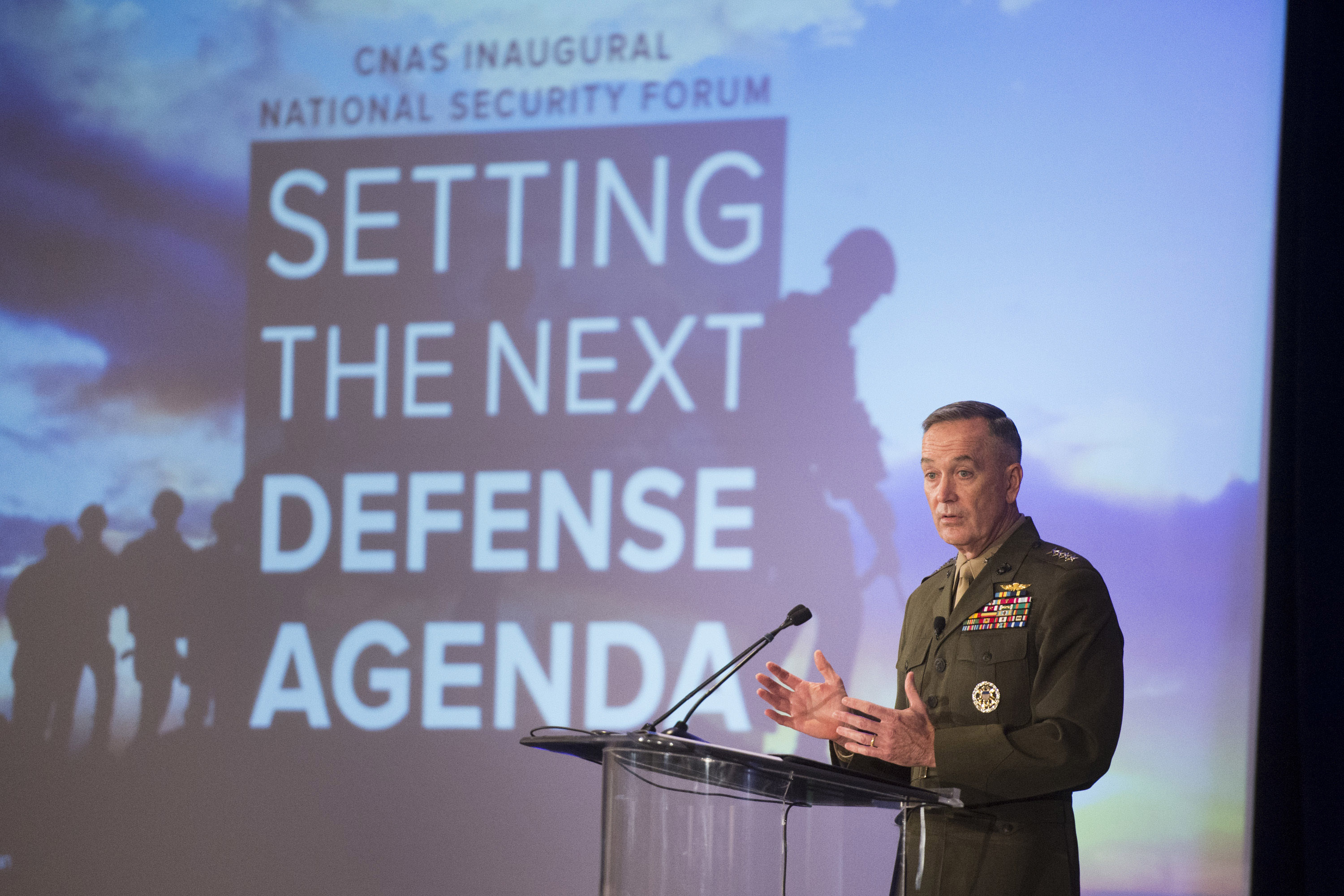
WASHINGTON, December 14, 2015 — The chairman of the Joint Chiefs of Staff discussed his short-term priority – defeating the Islamic State of Iraq and the Levant – and provided insight into his long-term goals during a talk at the Center for a New American Security here today.

Marine Corps Gen. Joseph F. Dunford Jr. spoke about the security environment and its implications on the force of the future and also spoke about joint force organization.

Current trends indicate any conflict in the future will be transregional, multidomain and multifunctional, the chairman said.

“When I look at information operations, cyber capabilities, space and counter-space capabilities, ballistic missile technology – they have all affected the character of the modern battlefield,” the general said. “And we see such capabilities fielded by both state and nonstate actors.”

The North Korean Challenge

An example of the changes these technologies have wrought is North Korea, Dunford said, noting that in the past, military planners believed any conflict would be confined to the Korean Peninsula. “But as North Korea developed ballistic missile technology, that obviously affected other regional actors, such as Japan,” he said.

Today, with ICBMs, cyber, information operations and more, “it’s pretty hard to see how even a conflict on the peninsula would be anything but transregional, multidomain and multifunctional,” the chairman said.

Current planning, organizational constructs and command and control set-ups “is not optimized for that fight,” he added.

U.S. military planning is done regionally and commanders rely on cooperation and collaboration, the chairman said. “It may surprise you to know this, but the lowest level of integration in the Department of Defense really is the secretary of defense,” he said. “That’s an issue that’s on the top of my inbox. That’s an issue that I am taking a look at hard.”

No Slowing Down

Underlying everything are the people of the U.S. military, the chairman said, noting that he returned from a trip last week in which he visited with service members in U.S. European Command, U.S. Africa Command and U.S. Central Command. “I saw a large number of soldiers, sailors, airmen and Marines, and they are in great spirits. … The closer I got to the fight, the more spirited they were. They are focused and proud about what they are doing,” he said. “I don’t take that for granted. The one thing I am mindful of as I come into the job is that we have been running pretty hard for a long period of time.”

The challenges of the world mean they won’t get a rest soon, Dunford said.

“I told them I can’t see a time where that dynamic is going to change,” he explained. “If our requirements continue to be what I believe they will be, and the force structure stays about what it is today, … we are going to be running hard for some time to come.”

Measuring Joint Readiness

The general said he is looking at new ways to measure joint readiness, and that people should expect a new way of looking at the concept after the first of the year.

“It isn’t just the readiness of our individual units and the parts and pieces,” he said. “It’s making sure we have the right inventory, and also making sure on a day-to-day basis we are postured to respond in a timely manner.”

The fight against violent extremism is a transregional conflict, the chairman said. Still, he added, the Defense Department’s portion of the nine lines of effort are focused on destroying core ISIL in Syria and Iraq, and the U.S. military does this by striking ISIL leaders and fighters. “The second critical element is to develop and support effective partners on the ground to seize and secure ISIL-held terrain,” he said.

Dunford came to the venue straight from a meeting with President Barack Obama and the rest of the National Security Council at the Pentagon. “I want to make it clear that within the framework of international and domestic law, our policies and our end state, I don’t personally feel at all inhibited in terms of making recommendations to the president,” he said. “And we will continue to do that.”

Syria, he said, is the bigger challenge, because there is no partner on the ground. The Iraqi security forces and Kurdish peshmerga provide allies to take and control terrain inside Iraq. Dunford did say he understands how much more needs to be done, but that he is encouraged by operations against ISIL.

Concerns Over State Actors

However, the chairman said, the threat from extremists, while pressing, is not the only security challenge. The capabilities and behaviors of four state actors– Russia, China, Iran and North Korea – must inform U.S. contingency plans, he said.

“Despite its declining population and shrinking economy, Russia has made a significant investment in its military capabilities,” the chairman said. Russia has fielded new ICBMs, aircraft, new submarines, tanks and air defense systems. The nation is also expanding capabilities in space and cyberspace. As you look at Russian capability, you have to look at it in the context of what they have done in Crimea, Ukraine and Syria.”

Dunford then turned to China, saying the emphasis is to cooperate with the rising giant. “We also – and we get paid to do that – watch closely the developments in their military capabilities and their behavior in the South China Sea,” he said.

Iran and North Korea are exporters of instability who continue to look for new ways to threaten neighbors, the chairman said.

All of these challenges have implications for the future joint force, he said, and the first is foundational.

“We need a balanced inventory of joint capabilities that’s going to allow us to deter and defeat potential adversaries across the range of military operations,” he said. “We don’t have the luxury to have a choice between a force that can fight the current fight against violent extremism and one that can deal with the full range of challenges.”

The second implication is to define how to use the military instrument of power in the “gray zone” of cyberspace, he said.

“I believe we need to develop more effective methods to deal with challenges like Russia’s ‘little green men’ or Iranian malign influence,” he said. “Our traditional approach – where we view things either as at peace or at war – may not be the case for our adversaries.”

On cyber, Dunford called for more offensive cyber capabilities and cyber deterrence.

Chinese Navy Ships to Visit Hawaii Sunday


By Naval Surface Group Middle Pacific Public Affairs

PEARL HARBOR-HICKAM (NNS) -- Three People's Liberation Army-Navy [PLA(N)] ships are expected to visit Joint Base Pearl Harbor-Hickam Dec. 13-17.

CNS Jinan (DDG 152), CNS Yiyan (FFG 548), and CNS Qiandaohu (AOE 886) are expected to arrive in the morning Dec. 13. This routine port visit will give Chinese sailors an opportunity to interact with their U.S. counterparts and demonstrate parity and reciprocity between two maritime nations.

Foreign Navy ships come to Pearl Harbor-Hickam regularly for scheduled port visits. In recent months Pearl Harbor-Hickam was visited by the PLA(N) ship Zheng He, by a ship from Bangladesh, and several times by Japan Maritime Self-Defense Force vessels.

As part of a planned series of military-to-military exchanges between the two nations, the ships will be hosted by USS Preble (DDG 88), USS Chosin (CG 65), and USS Chung-Hoon (DDG 93). Chinese and U.S. naval officers will conduct dialogues to build confidence and mutual understanding.

The Chinese ships will be met by Rear Adm. John Fuller, commander of Navy Region Hawaii, Capt. Stanley Keeve, commander of Joint Base Pearl Harbor-Hickam, and Capt. Kevin Brand, commanding officer of USS Chosin.

American and Chinese sailors plan to engage in deckplate level events including touring each other's ships and participating in sporting activities. Receptions aboard the PLA(N) vessels and USS Preble are also planned.

The last port visit by PLA(N) ships to Pearl Harbor-Hickam was in October 2015.

The U.S. Navy is committed to continued engagement to improve mutual understanding, build trust, enhance transparency, and reduce the risk of misperceptions and miscalculations.

BEMR: A New Reality for the Future Force


By David Smalley, Office of Naval Research

ARLINGTON, Va. (NNS) -- New virtual-reality capabilities emerging at the Battlespace Exploitation of Mixed Reality-or BEMR-Lab, in San Diego, California, will make dramatic impacts across the Navy and Marine Corps, officials announced Dec. 10.

Advancements included affordable virtual training, data assessment, firing of weapons and even basic concepts of operations.

The program is sponsored by the Office of Naval Research (ONR) and developed at the Space and Naval Warfare Systems Center, Pacific (SSC Pacific).

Viewers can get an inside look at some of the technology in a new video from ONR at https://youtu.be/rLDqcNAyVm8.

"The BEMR Lab is a constellation of technologies in augmented and virtual reality," said Karl Van Orden, senior technologist at the BEMR Lab. "It's a place where we can explore how to exploit those technologies in our warfighting systems."

When people think of virtual reality, many imagine Tony Stark from the "Iron Man" movies, hands raised and moving virtual displays projected in front of him. While that might be fanciful now, Navy engineers are working hard to develop such capabilities.

Virtual reality (VR) describes a scenario where a participant is completely immersed in a simulated/virtual world. Augmented reality (AR), by contrast, is used to describe a state where virtual objects are imposed onto real-world vision, like the yellow lines superimposed on televised sports.

When these technologies are merged, and one can easily jump between states of virtuality, it's called Mixed Reality, or MxR.

As the video shows, the BEMR Lab team believes this technology is ready now. Their vision: The future force will soon train and operate in very different ways.

"What mixed reality is all about is immersion-you want to get the warfighter feeling like he's really in the space," said BEMR Lab lead Heidi Buck.

Importantly, advanced VR and AR capabilities will utilize the skills of young Sailors and Marines.

"The modern naval force has grown up with computers at home, video games, arcades and head-mounted displays in their personal life," noted Dr. Lawrence Schuette, director of research at ONR. "Coming to float and seeing it onboard ship is just a logical extension."

Senior naval leadership has called for increased use of technological advances. In a recent address at the Reagan National Defense Forum, Chief of Naval Operations Adm. John Richardson said, "It's about the team that can bring the people, the technology and the processes together to learn the fastest-that's the team that has the advantage."

Virtual technologies could result in significant cost savings-for example:

-Training: Where the warfighter might currently need to fly to a specific spot for training, he or she could don the MxR gear and "be there" virtually, completing training at a fraction of the cost.

-Maintenance: MxR technologies can have a subject matter expert "standing" next to Sailors or Marines as they troubleshoot a difficult problem-even if the expert is on the other side of the world.

-Operations: MxR technologies will give operators views never before seen, with striking fidelity, to execute missions to exacting standards.

And the BEMR Lab team is utilizing low-cost, commercial-off-the-shelf technologies, like Oculus Rift VR goggles.

The effort ties in to the Naval S&T Strategy, which calls for leveraging advancements in a "rapidly changing landscape of new technologies."

Strike Eagles vs. Typhoons: exercise brings aircraft together

by Staff Sgt. Emerson Nuñez
48th Fighter Wing Public Affairs


12/9/2015 - ROYAL AIR FORCE LAKENHEATH, England  -- Iron sharpens iron; the same could be said for fighter jet pilots seeking new ways to improve their skills to deliver decisive combat air power.

Fighter pilots from Royal Air Force Coningsby and the 494th Fighter Squadron partnered up for dissimilar air combat training, here, Dec. 7-8, 2015.

The training session consisted of mock air to air combat fights where in this case, both aircrafts went up against each other to test each other's and their own capabilities. The aircrafts had a certain amount of mock ammunition per separate engagement and each pilot would call out on the radio whenever they were "hit".

"It's great practice for both parties to go against a different aircraft," said a Typhoon evaluator pilot from the 41 Typhoon Test and Evaluation Squadron. "The F-15 gets an opportunity to fight a superior performing threat, and we get to fight against a very capable weapons system and highly maneuverable missile."

Training with RAF jet fighters not only sharpens combat skills, but strengthens host nation partnerships for future integration.

"They reached out to us for some dissimilar flights and it's something we definitely wanted to do," said Capt. Joseph DiCocco, 494th FS weapon systems officer. "We want to integrate more with our host nation partners, so when we saw the offer, we snatched it up."

Exercises like these accomplish multiple goals for both parties involved.

"It's a lot of fun and a lot of learning at the same time," DiCocco said. "Definitely beneficial for both sides seeing a different side of how to fight in the air. We would definitely be happy to do this again. "

Liberty Wing remains Forward, Ready, Now with Expeditionary Active Shooter training

by Senior Airman Dawn M. Weber
48th Fighter Wing Public Affairs


12/9/2015 - ROYAL AIR FORCE LAKENHEATH, England  -- The hallways echoed with the sounds of gunfire. Airmen scrambled for shelter as opposing forces scurried about amidst the confusion.

In light of events such as the Charlie Hebdo and the Chattanooga Recruiting station active shooter incidents, beginning Oct. 1, 2015, the Air Force Chief of Staff implemented expeditionary active shooter training as a requirement for all deploying Airmen.

Since then, Staff Sgt. Joseph Betancourt, 48th Security Forces Squadron training supervisor, and the Defender University team has led approximately 10 deploying classes through the real world active shooter scenarios.

According to Betancourt, realistically, Airmen aren't always going to be armed and their three basic responses will be to either freeze, fight or flee. The training is designed to prepare the person to respond properly.

"We, as Security Forces, are training the base populace how to react, where to move, how to escape safely, how to properly barricade, or if need be, to fight," Betancourt said.

Acting as a bystander, SSgt. Daren Daniels, Detachment 4 unit training manager, recalled that the training had an element of fun, but remembered having the sense he was being hunted. The use of simulated munitions increased the urgency and importance of the training.

"You never know your neighbor's mental readiness; you never know how they will react to day-to-day situations," Daniels said. "As Airmen, we need to be ready for anything, especially in the event we have to engage with the adversary."

With the recent trend of violence against members of the military and law enforcement, it's not a matter of if these incidents will occur, but when, which explains the urgency in implementing these courses.
For Daniels, the most valuable portion of the training was to learn how to think aggressively in high-stake situations, to remain vigilant and always have a plan. The tactics learned in the expeditionary active shooter training keep Airmen Forward, Ready, Now, in deployed environments or at home station.

Alaskan NORAD Region prepares to track Santa for 60th year

by Capt. Anastasia Wasem and Tech. Sgt. John Gordinier
Alaskan NORAD Region Public Affairs


12/14/2015 - JOINT BASE ELMENDORF-RICHARDSON, Alaska -- The list has been made and checked twice...no, we're not talking about Jolly Old Saint Nicholas and his list of who's been naughty or nice.

It's the dedicated men and women of Alaskan NORAD Region that have made the vital preparations necessary to help keep Santa safe on his journey around the world this Christmas.

The devoted men and women of ANR have ensured that Santa has received his intelligence briefing, the current weather reports, as well as safety guidance. His sleigh has been inspected by our best mechanics and the route has been reviewed for potential logistical issues.

"As Christmas Eve approaches the anticipation builds as we await Santa's arrival. Everyone in ANR and the 176th Air Defense Squadron gets excited to be a part of such a special event that brings so much joy to children," explained Tech. Sgt. Michael Wachel, 176th ADS surveillance non-commissioned officer in-charge.

All day, every day, dedicated Americans and Canadians watch the Arctic skies of North America from here in Alaska. On the rare occasion when an unidentified or suspicious aircraft nears North American airspace, F-22 jets are launched to find out who they are and better understand why they are approaching. At Christmas, ANR eagerly awaits the moment when Santa leaves the North Pole and appears on our radar screens. In some cases, our fighter pilots may even be lucky enough to see Santa during his journey. Our mission is to ensure he travels safely around Canada and the United States.

"My job is to watch all of the airspace over Alaska," said Wachel. I help make sure that every airplane or other flying object is being tracked so we know who they are and where they are going. When Santa passes through we give him special attention to help him get to all of his stops as quickly as possible. Alaska is one of his last stops on his worldwide journey and we ensure his continued safety as he heads home after a long night!"

This annual mission is known as NORAD Tracks Santa. The North American Aerospace Defense Command, including Alaskan NORAD Region, Continental  U.S. NORAD Region, and Canadian NORAD Region will play a major part in that mission - tracking Santa across the globe to ensure safe travels.

The tradition of NORAD tracking Santa dates back to Christmas of 1955.

The program began December 24, 1955, when an incorrect phone number encouraging children to call Santa on Christmas was printed in a local Sears Roebuck and Co. newspaper advertisement.

Instead of Santa, the number actually dialed the Air Operations Center at Continental Air Defense Command, NORAD's predecessor organization, in Colorado Springs, Colorado.

The phone that rang that night was the top-secret crisis phone - and a call on that line meant serious trouble.

Air Force Col. Harry Shoup, the commander on duty that night, was not amused, he said in a 2005 interview.

He answered with a crisp "Yes, sir?" expecting to hear Air Force Gen. Earle Partridge, the NORAD commander, giving an order.

Instead, a little boy told him what he wanted for Christmas.

Shoup was suddenly even less amused, and started looking around the AOC for whichever Airman was on the phone and trying to stifle a grin.

"I thought, 'Someone's playing a joke, and I don't stand for that,'" Shoup said in the interview. "If I see who's laughing out there, I'm going to nail him good."

But no one was laughing. The little boy on the other end of the line sensed something was amiss.

"You're not Santa," Shoup recalled him saying.

"Oh-ho-ho, yes I am," Shoup responded.

Soon, the phone was ringing constantly - and Shoup pulled some Airmen aside and told them to answer the calls and "just pretend you're Santa."

Instead of having Sears pull the ad, Shoup offered the kids something else -Airmen would check the radar for Santa's official location as he made his journey across the globe.

Every Christmas since, ANR service members have worked to identify and track Santa and report it to NORAD.

Volunteers manning the telephone lines take the calls, and answer the urgent questions of children across the globe.

Starting at 10:01 p.m. locally on Dec. 24, website visitors can watch Santa make preparations for his flight.

NORAD's "Santa Cams" will stream video on the site as Santa makes his way over various locations.

Then, at 2 a.m. locally, trackers worldwide can speak with a live phone operator to inquire as to Santa's whereabouts by dialing the toll-free number (877) Hi-NORAD ((877) 446-6723) or by sending an e-mail to noradtrackssanta@outlook.com.

Children of all ages can follow along at www.noradsanta.org, the Facebook page at www.facebook.com/noradsanta, or on Twitter using the handle @NoradSanta.

Ice safety story: "Who do I call when I slip and fall?"

by Airman 1st Class Javier Alvarez
JBER Public Affairs


12/14/2015 - JOINT BASE ELMENDORF-RICHARDSON, Alaska -- Water can change physical state depending on its surrounding temperature. Gas, liquid and solid; these are the three physical states water can occupy. Of these states, solid water has proven to be one of the most destructive and befuddling for military members at Joint Base Elmendorf-Richardson this winter season.

The 673d Safety Office has recorded an increase in reported slips and falls this year, and has presented a series of measures to prevent future injuries.

"[Safety] has had 15 falls documented this year compared to nine documented last year throughout the same time frame," said Lt. Col. Randy Green, 673d Medical Operations Squadron, Physical Therapy Flight commander. "The severity has been greater this year. They have had three concussions. One involved a hospitalization and an elbow fracture. Last year, there were more sprains, strains and bruises."

A new program, which began last month and is known Air Force wide as direct access to physical therapy, offers individuals a streamlined path to reach a physical therapist, occupational therapist or musculoskeletal professional within 24 hours, Green said.

"If they suspect they have a fracture, they need to go to the emergency room," Green said. "However, if they are just embarrassed, have a bruise, or feel like something is not right because they have limited motion or swelling, we have direct access to physical therapy. They can go to their primary care manager, but if they want to get treatment right away, they can go directly and call central appointments."

If individuals seek medical attention, they should contact their supervisor and fill out a Supervisor's Mishap Report, Air Force Form 978, said Tech. Sgt. Jennifer Tuepker, 673d Air Base Wing Safety Office occupational safety technician.

"There are duty days lost because of injury," said Maj. Nathan Shepard, 673d Medical Group physical therapy element leader. "That is why we have this direct access, so we can get them in quicker to get them back to work quicker."

Certain medicines have side effects like dizziness and fatigue which can increase fall risk, Green said. Understanding personal limitations and knowing which medicines are being consumed goes a long way when preventing a slip or fall.

In battling these safety hazards, there are precautionary measures that can be taken to minimize falls on the ice, Tuepker said.

Tuepker said JBER Safety encourages people to walk like a penguin. Take short strides and walk flat footed. This technique, as silly as it may sound, is effective in preventing slips on the ice.

Wearing ice cleats can help establish a firm foot-hold when walking on icy walkways, Tuepker said.

Individuals are encouraged to have three points of contact whenever possible, Tuepker said. When entering and exiting a vehicle, one can sustain positive control by holding on to the door. Furthermore, holding on to a handrail can help prevent a slip or fall when ascending and descending steps.