Monday, December 14, 2015

U.S. Military Academy to Host 2016 DoD Warrior Games


DoD News, Defense Media Activity

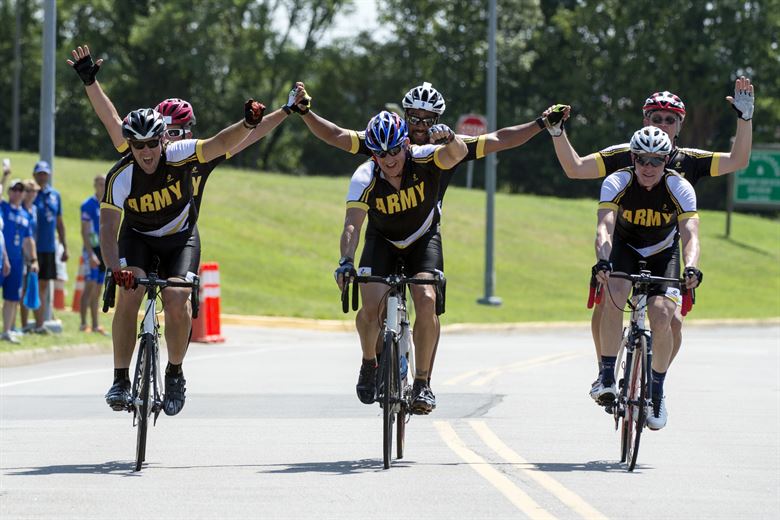
WASHINGTON, December 14, 2015 — The 2016 Department of Defense Warrior Games will take place at the U.S. Military Academy in West Point, New York, June 14-22, Pentagon officials announced today.

This is the first year the Army is hosting the Warrior Games, an annual sporting competition bringing together wounded, ill and injured service members and veterans from across the country.

"The United States Military Academy and the entire West Point community are honored to host the 2016 DoD Warrior Games," said Army Lt. Gen. Robert L. Caslen Jr., U.S. Military Academy superintendent. "These warrior-athletes competing in the games, who at one time answered their nation's call to service, exemplify the very best of America. They embody the resiliency, discipline, mental and physical toughness to overcome adversity and achieve their goals -- all traits we aspire to instill in our graduates, who will lead America's sons and daughters as Army officers."

DoD Warrior Games 2016 will feature eight sporting events: archery, cycling, shooting, sitting volleyball, swimming, track and field, and wheelchair basketball in a paralympic-style competition. About 200 athletes representing teams from the Army, Marine Corps, Navy, Air Force and U.S. Special Operations Command will compete. Each military service hosts trials in the months leading up to the games to determine their teams.

Enduring Strength

"The 2016 DoD Warrior Games will showcase the enduring strength of our service men and women who have overcome adversity and are using adapted reconditioning to become resilient warrior athletes. They represent the strength and resiliency of this great country," said Army Col. Chris Toner, commander of U.S. Army Warrior Transition Command and assistant surgeon general for warrior care and transition.

"Warrior Games is an opportunity for the services to communicate their sacred obligation and enduring commitment to their wounded, ill and injured service members, their families and caregivers," Toner added.

Adaptive sports and athletic reconditioning activities play a fundamental role in recovery, rehabilitation and reintegration of service members back to their units or as they transition into the civilian sector, officials said.

Face of Defense: Surface Warfare Officer Recalls Path to Success


By Navy Petty Officer 1st Class Mathew Diendorf, USS Makin Island DoD News Features, Defense Media Activity

SAN DIEGO, December 14, 2015 — When Navy Lt. Cmdr. Ty Wiese decided he was going to enlist, it didn't take too much to convince his father, a retired senior chief missile technician, and his grandfather, a former Navy pilot, of his decision to follow in their footsteps.

"Both my parents were supportive but initially wanted me to wait," he said. "I was only 17, but my father, a 21-year submarine veteran, was able to convince my mother that I would be okay, and the Navy would take care of me."

Wiese, a Satellite, Fla., native, began his career by attending missile technician school, where he was one of only four sailors to graduate in a class of 16.

He then reported to the ballistic missile submarine USS Henry M. Jackson, where he realized early on that he could do more with his career.

"In the submarine community, you work side by side with enlisted and officers in small groups," Wiese said. "Knowledge is power. It doesn't really matter what rank you are. The officers would come up all the time to learn the different systems, and I just realized they really aren't that much different than me."

After completing nine submarine deterrent patrols with the Jackson, Wiese became an instructor at the Trident Training Facility in Bangor, Washington.

Becoming an Officer

During his time on shore duty, he began taking night and weekend classes at Southern Illinois University, earning his four-year degree in only two years.

"After I graduated, I wanted to keep challenging myself," Wiese said. "I applied for Officer Candidate School, and three days after submitting my package, they called me at home to tell me I was selected," Wiese said. "Being selected for OCS felt amazing, but with all the excitement of telling my family and friends that I was going to be an officer, reality hit that OCS in itself was going to be a whole new set of challenges."

In November 2000, Wiese met those challenges and was commissioned as a Navy surface warfare officer.

During his career as a SWO, he served aboard the fast combat support ship USS Bridge, the guided missile destroyers USS O'Kane and USS Shoup, and also the USS Makin Island, an amphibious assault ship, where he was named Commander, Amphibious Squadron 5 Surface Warfare Officer of the Year in both 2010 and 2011.

Wiese attended the Naval War College in Newport, Rhode Island, following his tour on the Makin Island.

"The Naval War College was a fantastic tour," he said. "From day one we were treated very well. The classes were filled with officers from many communities, including international students. The assigned reading was intense, but all worth it. I learned a ton about history, critical thinking, and the importance of strategic communication."

Return to the Gator Navy

After graduating in June 2013 with a graduate degree in national security and strategy, he served two years at Carrier, Strike Group Nine. But he wasn't done in the “gator navy” -- the Navy’s nickname for the amphibious fleet.

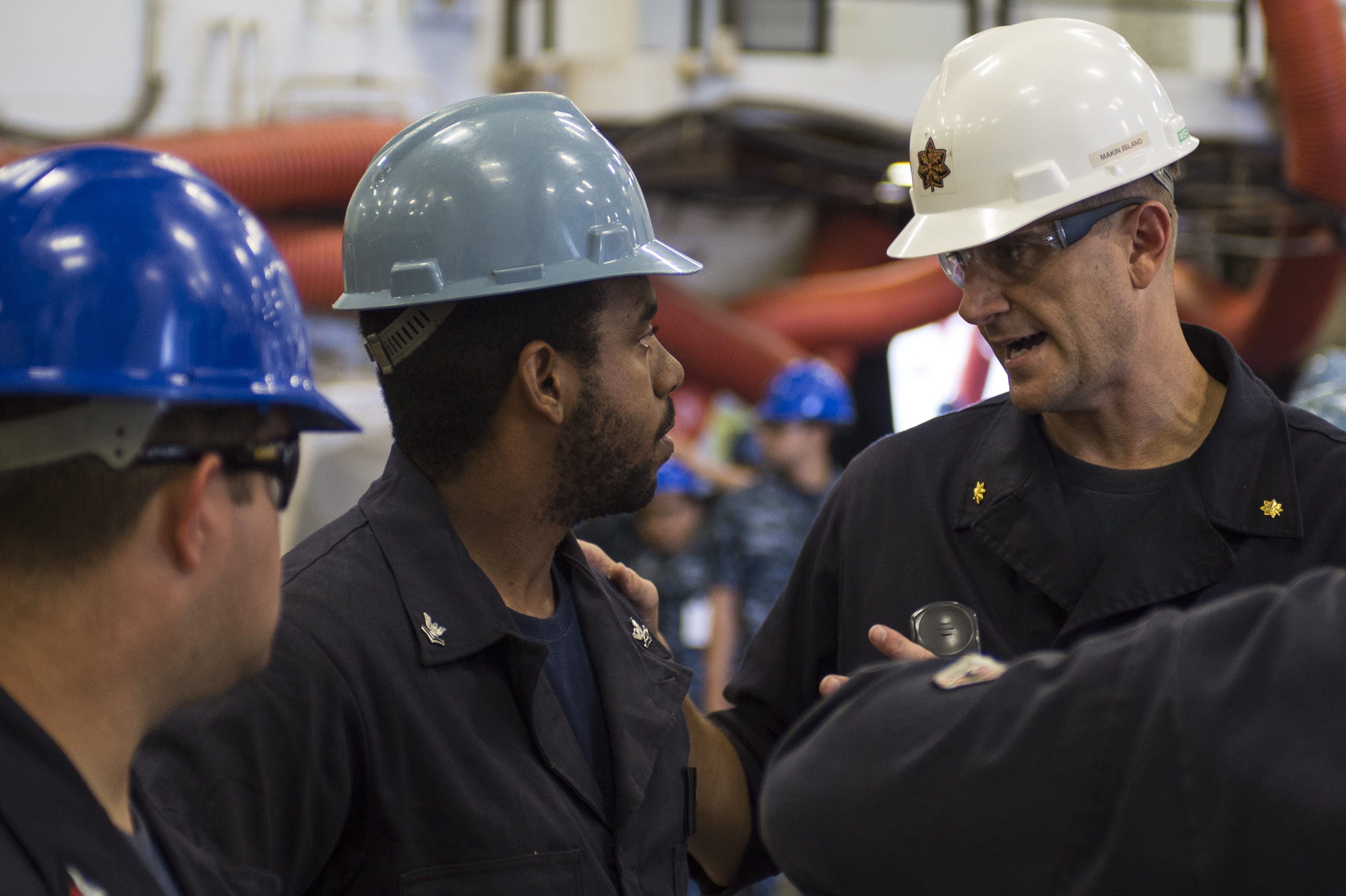
In May of 2015 he once again reported to the Makin Island and serves as the ship's damage control assistant.

Wiese was recently selected for promotion to commander, and as he looks back on his career he said he sees how far he's come.

"Coming in the Navy as an E-1, I never would have thought I'd be where I am today," he said. "Being selected for commander is just so humbling, and I'm so excited to be given the opportunity."

"It's been an interesting ride, and I'm just getting started," Wiese said.

As a 25-year Navy veteran, he has been able to balance a career and his 21-year marriage to his wife, Stephanie.

"I wouldn't be able to do what I do without my wife," Wiese added. "We've always backed each other up. When I was going to school, she was taking care of the house. You can't be successful in this community unless you have the support at home."

Friday, December 11, 2015

Work: Wargaming Critical in Dynamic Security Environment


By Cheryl Pellerin DoD News, Defense Media Activity

WASHINGTON, December 11, 2015 — Restoking the Pentagon’s wargaming engine will multiply ways to explore defense and national security futures, Deputy Defense Secretary Bob Work has said multiple times this year.

Work and Air Force Gen. Paul J. Selva, vice chairman of the Joint Chiefs of Staff, both have written about wargaming and how the Defense Department could revitalize the valuable practice, which would generate ideas and integrate new technologies into doctrine, operations and force structure.

In a May 8 memorandum to military department leaders and the chairman of the Joint Chiefs of Staff, Work laid out three initiatives that together, he said, would help align department decision-making and the wargaming enterprise.

“We are entering a critical period for the United States,” Work wrote in the memo, referring to resetting the joint force after 13 years of war, “[and] we must turn our attention to numerous emerging challenges to U.S. global leadership.”

In such a dynamic environment, he added, department leaders are making programmatic decisions to meet the challenges, and wargaming is an important way to inform those decisions and spur innovation.

Future Wars

More recently, Work and Selva wrote a Dec. 8 commentary on wargaming and the new initiatives -- titled "Revitalizing Wargaming is Necessary to be Prepared for Future Wars" -- for warontherocks.com.

The web-based publication on national security and foreign policy has contributors who are defense officials, former diplomats, military officers, noncommissioned officers, intelligence professionals and war scholars.

Work and Selva began the commentary with a historical look at the topic -- in this case the inter-war years of the 1920s and 1930s, when militaries around the world were adapting to new inventions like radar and sonar and rapid improvements in other militarily relevant technologies.

“To help navigate through this period of disruptive change, the United States military made extensive use of analytical wargaming,” Work and Selva wrote. “Wargames were an inexpensive tool during a period of suppressed defense spending to help planners cope with the high degree of contemporary technological and operational uncertainty."

Revitalizing Wargaming

With the initiatives he introduced in May, Work said he intends to revitalize wargaming, embed wargaming more firmly in DoD’s suite of analytical approaches, and do a better job of sharing wargame insights with senior leadership.

“This effort is part of our broader commitment to foster greater innovation within the department, make the most of increasingly constrained resources, and avoid operational or technological surprise in tomorrow’s dynamic security environment,” Work and Selva said in the commentary.

The first step, now underway, is for all services, combatant commands and wargaming centers to contribute to a wargaming repository that will help everyone better understand and guide current wargaming efforts and share insights across the defense enterprise.

The repository, which so far contains the results of more than 250 wargames, the defense officials said, offers a single place to access wargame results and insights and to learn about upcoming wargames and tabletop exercises.

The second step is to form a Defense Wargaming Alignment Group, or DWAG, to share senior-leader priorities with the wargaming enterprise and to help ensure that feedback and insights from wargames that align with department priorities are communicated to department leaders, Work and Selva said.

Including Partners, Allies

The DWAG will inventory wargaming capacity and capability department-wide, particularly among the services and combatant commands, and institute a regular series of senior-leader wargaming events, they added.

The third step, because the department relies heavily on allies and partners in almost everything it does, is for the department to examine better ways to include them in its wargaming efforts and how best to share results, they said.

Wargames are useful for exploring the integration of allied capabilities and helping develop cooperative concepts of operation, the defense leaders said, adding that wargames play an increasingly critical role in informing interagency partners about complexities and challenges the department would face in a high-end conflict against a great power.

“For example,” Work and Selva wrote, “we recently held a specific wargame on space that illuminated some of the challenges and opportunities we could face if a conflict extended into that domain.”

Going to School on Wargames

The department also will consider the value of using wargames that explore joint multidimensional combat operations in pursuit of joint professional military education goals, they said.

Today, wargaming courses are generally electives, Work and Selva explained, adding that building school curricula around wargaming might help spark innovation and give the joint force a better understanding of transregional, cross-domain, multidimensional combat.

Entering the force is a new generation of young men and women whose exposure to commercial multiplayer gaming is greater than that of any previous generation, they said.
“Should they be introduced to wargaming in their accession programs? We have not yet answered these questions,” they said, “but we are considering them, as well as other initiatives to reinvigorate wargaming across the department.”