Monday, October 26, 2015

Boxer ARG Departs For COMPTUEX


By Mass Communication Specialist 2nd Class Robert Sanchez

PACIFIC OCEAN (NNS) -- The Boxer Amphibious Ready Group (ARG), along with Marines assigned to the 13th Marine Expeditionary Unit (MEU), departed San Diego to begin Composite Training Unit Exercise (COMPTUEX), Oct. 19.

The exercise, which is conducted off the coast of southern California, is designed to assess the readiness of the Boxer ARG prior to deployment.

"COMPTUEX is an invaluable opportunity to work together with our Marine Corps teammates and prove that we are fully prepared for deployment," said Capt. Keith Moore, commodore, Amphibious Squadron (PHIBRON) 1. "I have full confidence in the Boxer Amphibious Ready Group, and I look forward to facing the challenges that the evaluation team has planned for us."

The exercise, which is evaluated by Commander, Carrier Strike Group (CCSG) 15, is designed to certify the Boxer ARG as deployment-ready, by testing its ability to react to realistic scenarios. The training scenarios include live fire evolutions, simulated straits transits, maritime security exercises, amphibious landings and other events that the ARG may encounter while deployed.

"We've been preparing for this for some time," said Yeoman 2nd Class Sandy Toves, a small craft assessment team (SCAT) member. "[SCAT is] expecting to run scenarios in which small boats will be circling the ship and be tested on how well we respond. This is just one more thing that can prepare us for what deployment might bring."

After satisfactorily completing COMPTUEX, the Boxer ARG will be certified for their next deployment, which is scheduled to begin in early 2016.

The Boxer ARG is composed of PHIBRON-1, the 13th MEU, Wasp-class amphibious assault ship USS Boxer (LHD 4), amphibious transport dock ship USS New Orleans (LPD 18) and dock landing ship USS Harpers Ferry (LSD 49).

B-52 Stratofortresses fly alongside Canadian allies

by U.S. Strategic Command Public Affairs

10/26/2015 - OFFUTT AIR FORCE BASE, Neb. -- U.S. Strategic Command (USSTRATCOM) B-52 Stratofortress bombers based at Minot Air Force Base, North Dakota, and Barksdale Air Force Base, Louisiana, conducted training in and around the area of Goose Bay, Canada, with Royal Canadian Air Force units, Oct. 20 through Oct. 23.

These missions allow bomber crews to receive valuable experience in executing flexible long-range global-strike capabilities while working alongside Canadian and NORAD forces.

"Integrating U.S. bombers into allied training events supports a strong, credible bomber force that is essential to enhancing regional security while remaining committed to our allies," said Adm. Cecil D. Haney, USSTRATCOM commander. "Continuing to train the strategic bomber force in a variety of environments is important to retaining key skill sets and remaining ready to confront a variety of potential threats."

USSTRATCOM forces routinely conduct training missions worldwide in support of geographic combatant commands to ensure the U.S. has a credible and flexible capability to respond to a variety of potential threats. Bomber operations enhance this capability by providing the President a variety of options to protect the nation and our allies.

One of nine DoD unified combatant commands, USSTRATCOM has global strategic missions, assigned through the Unified Command Plan, which include strategic deterrence; space operations; cyberspace operations; joint electronic warfare; global strike; missile defense; intelligence, surveillance and reconnaissance; combating weapons of mass destruction; and analysis and targeting.

Sunday, October 25, 2015

Pacific Thunder tests combat search, rescue capabilities


By Staff Sgt. Benjamin Sutton, 51st Fighter Wing Public Affairs / Published October 23, 2015

OSAN AIR BASE, South Korea (AFNS) -- A bilateral exercise involving combat search and rescue drills ended Oct. 23 after nearly two weeks of constant training between U.S. and South Korean forces.

Exercise Pacific Thunder 15-02 brought together units from the Air Force, Marines and South Korean air force to practice air combat and CSAR by focusing on enhancing interoperability and combat readiness of the military alliance across the Korean Peninsula.

"This exercise helps us bring together assets who would be involved and integrated into a real world CSAR mission," said Capt. Jerrod Dillon, the 25th Fighter Squadron flight safety officer. "It also gives U.S. forces a chance to integrate and execute with our ROKAF (Republic of Korea Air Force) counterparts, further building the combined force proficiency and readiness, while simultaneously improving relations between our two militaries."

Pacific Thunder is a total-process exercise, encompassing nearly all aspects of communication, coordination, command and control, mission planning, and execution.

"By taking a look at current tactics and procedures, practicing and refining those, and then exercising the system as realistically as possible we are able to provide a world-class training opportunity to everyone involved," Dillon said. "We are getting realistic training that's in line with how we would fight."

More than 10 different organizations and squadrons came together to participate in the most recent exercise.

"In size and scope, it's rapidly approaching large-force-exercise levels, but I think it's unique in that it's primarily planned and executed on a squadron or tactical level," Dillon said. "What we do locally during these missions directly impacts the big Air Force mission. The knowledge and experience gained while participating in this exercise is spread throughout the rest of the Air Force as people move on from Korea, carrying that knowledge with them."

Working closely with all players on a bi-annual basis builds individual proficiency and increases the total-force capability of all participants, he added.

"I'm excited to be a part of this exercise, especially since we are working closely with the (South) Korean air force," said Senior Airman Jacob Ricker, a 718th Aircraft Maintenance Squadron crew chief from Kadena Air Base, Japan.

Pacific Thunder highlights the longstanding military partnership, commitment and enduring friendship between the two nations. It helps ensure peace and security on the Korean Peninsula and reaffirm the U.S. commitment to stability in the Indo-Asia-Pacific region.

"It's all about the CSAR," Dillon said. "Aircraft can be replaced but it's much harder to replace the pilot who could have many years of training and experience. This exercise ensures we are ready to do the CSAR mission whenever called upon."

Friday, October 23, 2015

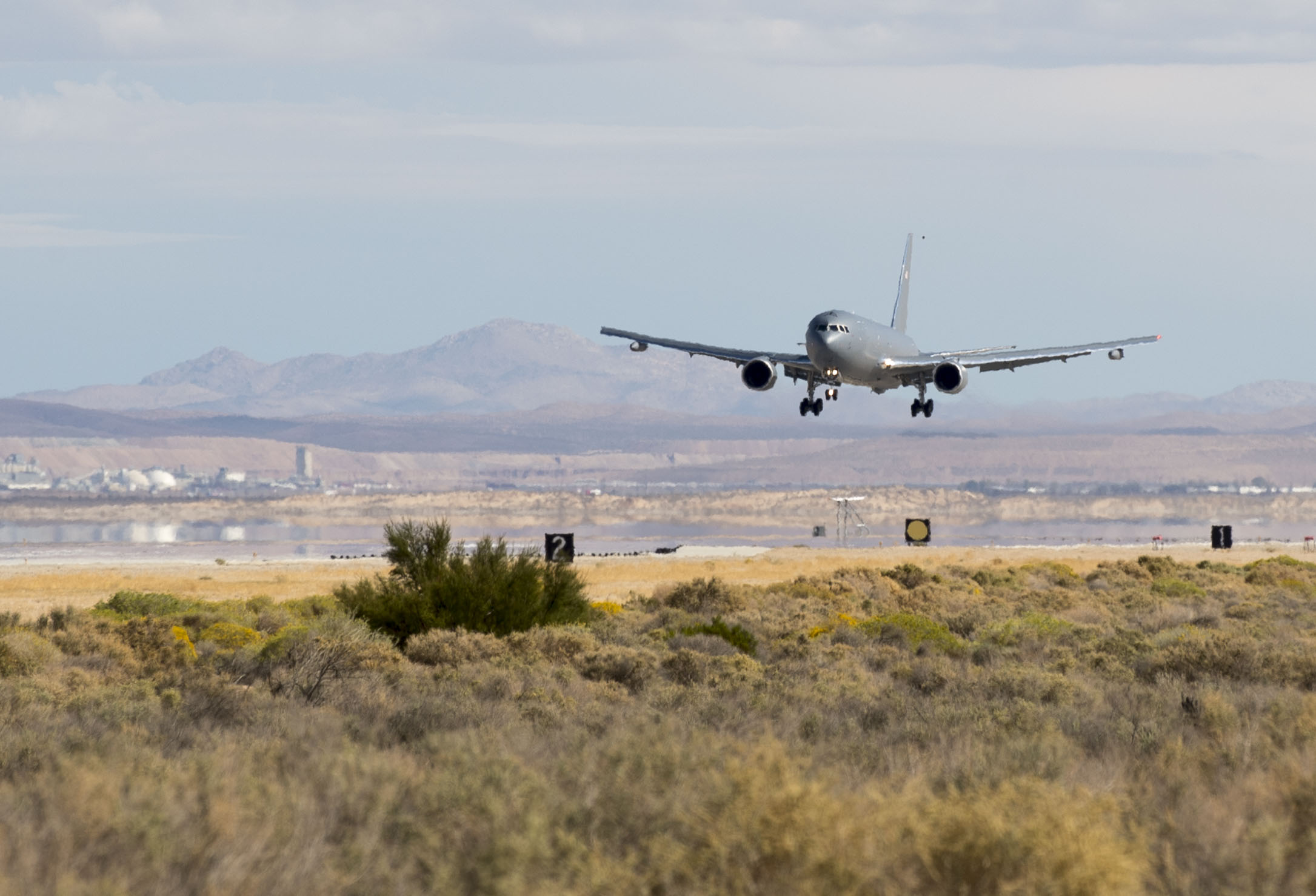
KC-46 test aircraft touches down at Edwards


By Kenji Thuloweit, 412th Test Wing Public Affairs / Published October 22, 2015

EDWARDS AIR FORCE BASE, Calif. (AFNS) -- The KC-46 program's first test aircraft, a Boeing 767-2C (EMD-1), departed from its home at Boeing Field in Seattle and touched down here for the first time for testing Oct. 15.

The plan is to have EMD-1 at Edwards Air Force Base for about two weeks, as Boeing and the 418th Flight Test Squadron conduct ground effects and fuel onload fatigue testing on the new tanker.

Ground effects testing will gather aerodynamic data for updating the KC-46A Pegasus simulator as well as supporting certification. Fuel onload fatigue tests will gather data to characterize the aircraft interaction typically experienced when the KC-46A is flying in receiver formation behind a current KC-135 Stratotanker or KC-10 Extender.

While the KC-46's role is to refuel other aircraft, it too may need to be refueled from other KC-10s or KC-135s to extend its range. Fuel onload fatigue testing is the first look at the KC-46 acting in that role and the interactions between the three different tankers in an aerial refueling formation.

As throughout history, Edwards AFB continues to be the premier base for flight testing the Air Force's newest capability.

"For ground effects, Edwards Air Force Base provides calm morning weather and long runways, including the lakebeds, both are requirements to take the data," said Capt. Dylan Neidorff, a KC-46 test operations engineer. "For fuel onload fatigue, Edwards has a top notch special instrumentation section who provides modifications to legacy tanker aircraft to support data collection on the 767-2C."

Neidorff said Boeing and Air Force pilots have been operating as combined crews through all of the testing at Edwards including the ferry flight from Seattle.

"This also includes flight test engineers who have been on each fuel onload fatigue flight,” he said.

Several units from both on and off base are supporting the testing. The 412th Test Engineering Group is providing special instrumentation support; the 416th Flight Test Squadron is providing chase aircraft support; and the 370th FTS is providing KC-135 tanker crew support. The 92nd Air Refueling Wing based at Fairchild AFB, Washington, is also providing the KC-135 and maintenance support, and the 60th Air Mobility Wing based at Travis AFB, California, is providing the KC-10 and maintenance personnel.

According to Neidorff, the KC-46A will return to Edwards AFB to accomplish testing in the Benefield Anechoic Chamber as well as conduct aerial refueling certifications.

The KC-46A is intended to replace the Air Force's aging tanker fleet, which has been refueling aircraft for more than 50 years. With more refueling capacity and enhanced capabilities, improved efficiency and increased capabilities for cargo and aeromedical evacuation, the KC-46A will provide aerial refueling support to the Air Force, Navy, Marine Corps as well as allied nation coalition force aircraft.

The 412th Test Wing at Edwards AFB is the lead developmental test organization for the KC-46 program.

NYANG firefighters conduct joint search and rescue training

by Tech. Sgt. Catharine Schmidt
109th Airlift Wing Public Affairs


10/22/2015 - STRATTON AIR NATIONAL GUARD BASE, N.Y. -- Firefighters from the New York Air National Guard's 109th Airlift Wing, 106th Rescue Wing, and 105th AW, from Scotia, Long Island, and Newburgh respectively, met up at Camp Smith, New York, Oct. 20, to complete three days of joint search and rescue training.

The Airmen trained on high-angle rescues and breaching and breaking, as well as improving their interoperability in the event they are called to respond to a real-world disaster.

"This exercise was a proof of concept for our USAR mission set," said Lt. Col. Robert Donaldson, 109th Civil Engineer Squadron commander. "The collaboration efforts among the 109th, 106th and 105th AW USAR teams helped streamline our existing convoy capabilities and also helped refine our high angle rescue tactics, techniques and procedures.  The USAR members were able to share their valuable skill-sets with each other, and worked together as an integrated team, which made this training opportunity reach far beyond ordinary expectations."

High angle rescues are those in a very steep environment in which a person is primarily supported by a rope system, explained Master Sgt. Brian Kissinger, 109th Fire Department assistant chief of operations. "Breaching and breaking is like if a building were to collapse, we would cut through the concrete using different methods," he said. Along with the rescue training, three Airmen from the 109th Vehicle Maintenance Flight who convoyed down with the firefighters, trained the 106th on skid steer operation. The skid steers are part of the debris clearance package the 109th AW obtained earlier in the year.

"A lot of my guys haven't had training on the debris clearance kits that all the units have," said Senior Master Sgt. James Nizza, 106th Fire Department chief. "[The 109th] brought their [skid steer] and now we're getting all of my guys certified on it."

Camp Smith proved to be the ideal location for the units to come together as it is the central location between Scotia and Long Island, and also had the environment the teams needed to complete the training they wouldn't be able to get at home station, including the cliff they used for the high angle training.

"We don't get the ability to do this type of training at home, and [because of that] the skills are diminishing; if we don't continue to practice it, we're going to lose the skill-set," Nizza said. He said this joint exercise gave them the opportunity to continue their training to keep the domestic operations mission going, "and it also builds the partnership with the other state units."

The Airmen agreed the importance of this type of training in keeping the Air National Guard the first choice for homeland operations. In a real-world situation, the search and rescue assets throughout the state would be activated. "Our goal is to be out the door in four hours," Kissinger said.

"This is huge training," Kissinger said. "We are now training together and learning how each unit works. This is our first joint training exercise."

"A special thanks goes out to the Camp Smith leadership for allowing us the opportunity to use their facilities and to the multi-talented Airmen who made this event a huge success," Donaldson said. "I have no doubt that the support and training we received here will pay dividends when our USAR teams are called upon for their life-saving skill-sets during real-world events.  We're actively planning additional collaborative training opportunities in the very near future."

The 109th Fire Department's urban search and rescue team, the lead USAR within the New York Air National Guard, is currently the only self-sufficient fully capable mobile unit in the Air National Guard. "As we stand now, we are mobile-ready to go anywhere, anytime," said Kissinger.

Hardrock comes home

by Airman 1st Class Connor J. Marth
366th Fighter Wing Public Affairs


10/22/2015 - MOUNTAIN HOME AIR FORCE BASE, Idaho -- More than 100 members of the 726th Air Control Squadron returned Oct. 18 from a deployment to Southwest Asia supporting multiple operations in the area.

Since April, the 726th ACS, also known as Hardrock, provided support using various forms of communication and detection equipment across the areas they were deployed.

"Our mission is to control the airspace wherever we are sent," said Maj. Rene Prieto, 726 ACS director of communication and operations. "We keep the skies clear and the ground informed."

Their efforts supported troops and aircraft throughout the 876,000-square-mile region. They established more than 150 communication systems and earned 100 percent completion on every mission assigned during their six-month deployment.

"It's amazing what we ask of them and what they give back to us day-in and day-out," said Prieto. "Of the one percent who raised their hand in America to join the military, I think these guys are some of the best."

The 726th is a tenant unit here and assigned to the 552nd Air Control Wing located at Tinker Air Force Base, Oklahoma.

Their Air Force family is ready to have them back, but the joy of their own families is an entirely different story.

"The kids are really excited; there is just a lot of stress leading up to this moment," laughed Wendy Strength, spouse of Senior Airman Jesse Strength, 726th ACS weapons director. "But, when he finally comes back, I'll be extremely happy. And then I'll probably cry later."

Some have missed important moments while defending their country. Jesse missed his daughter's first steps and deployers like Tech. Sgt. Raymond Parker even missed the birth of their children.

"Some of our returning airmen are seeing their children for the first time today," said Prieto. "There is a lot of change happening and I want them all to know we are here to help with whatever comes their way."

The Hardrocks made an impact overseas and after six months of communication and intelligence missions, they're finally home with their families again.

"We are all a family," said Prieto. "Having our Hardrockers come back makes us whole again and we can work at full force."