Thursday, October 08, 2015

Guard Members Help Out in Hard-Hit South Carolina


By Army 1st Lt. Jessica Donnelly South Carolina National Guard

MANNING, S.C., October 8, 2015 — In the aftermath of record rainfall levels throughout South Carolina, communities are faced with damaged roads, loss of power and an inability to obtain their basic needs such as clean water, food and medical attention.

For this reason, the South Carolina National Guard is working with civilian authorities conducting health and welfare checks to ensure community members receive the help they need.

As of this morning, more than 2,650 Guard members were on duty in the hard-hit state, according to figures at the National Guard Bureau in Arlington, Virginia. The death toll in North and South Carolina was at least 19, according to the Associated Press.

Providing Food, Water

One such community receiving National Guard attention is Clarendon County where National Guard soldiers are working around the clock bringing food and water to the community members, as well as providing transportation when needed where areas are flooded.

“They were able to transport a doctor into the Olanta area, a small community in Clarendon County, where she was one of the only health professionals in that area,” said Army Maj. Michael Barrett, the 218th Maneuver Enhancement Brigade’s liaison officer for Clarendon County. “We had a Humvee transport her through some areas that were flooded so that she could provide medical care for anyone who needed it.”

Barrett explained that South Carolina National Guard units have been working in the county since Oct. 3, supporting the local civilians by conducting these sustainment and recovery operations. They have supported multiple agencies during this time including Urban Search and Rescue from Fairfax County, Virginia, the Federal Emergency Management Agency, and various levels of county authorities.

Helping Spanish Speaking Residents

However, some community residents are Spanish speaking and do not understand the message being communicated when a person in uniform offers help. This is where Army Spc. Antonino Bautista, 1st Battalion, 178th Field Artillery Regiment Charlie Battery, has stepped up.

“We have a soldier that speaks fluent Spanish and he’s from the local area,” Barrett said. “He goes out with the teams, talks with the civilians and communicates the message to them … so that they don’t feel excluded or abandoned from the local county or state.”

Bautista said that he believes it brings the community members comfort that he can talk to them in Spanish and assure them that the National Guard is there to help. He has lived in the area for about 10 years, so he is part of the community and is willing to do his part.

“I went out there and translated. I asked them what they needed and some people needed help,” Bautista said. “This is what I signed up for -- to help people.”

Working overtime: Barksdale hustles to host evac'd aircraft

by Senior Airman Joseph Raatz
2nd Bomb Wing Public Affairs


10/7/2015 - BARKSDALE AIR FORCE BASE, La. -- While the B-52 Stratofortress owns the skies around Barksdale Air Force Base, spotting a fighter or tanker in the area is not uncommon.

Barksdale often serves as a refueling stop for military aircraft and is an operations center for joint-force exercises like Green Flag. But on rare occasions, the home of the 2nd Bomb Wing plays an even bigger role: safe haven.

Several KC-135 Stratotankers, dozens of F-15E Strike Eagles and more than 200 Airmen from Seymour Johnson Air Force Base, North Carolina, temporarily relocated to Barksdale, Oct. 1, to avoid potential damage caused by Hurricane Joaquin.

"It's great that the Air Force has facilities where aircraft can escape to evade harm or weather elements," William Flentge, 2nd Operations Support Squadron airfield manager, said. "We're proud to provide that at Barksdale."

Category 4 hurricanes like Joaquin can create punishing winds of up to 156 mph and cause catastrophic damage.

Barksdale's number one goal of preparing for and receiving the aircraft was to protect them from danger, Flentge explained. Hurricane-force winds could easily have damaged any aircraft caught on the ramp, making evacuation the most logical decision.

While the 2nd Bomb Wing was more than happy to provide refuge for Seymour Johnson's Airmen and aircraft, Barksdale currently fields 48 B-52s and has a corresponding-sized infrastructure. Hosting double that number of aircraft, even temporarily, posed a tremendous challenge.

"There are plans on file for us to do this kind of thing, however, it doesn't always seem like that plan is complete when it's brought to the table and you really have to think outside the box to figure out how to do what works best for everybody. So that's what we did," said Master Sgt. Michael Hollister, 96th Aircraft Maintenance Unit B-52 production superintendent.

In addition to finding parking space for more than 60 additional aircraft, Barksdale maintainers and airfield management personnel had to coordinate fuel deliveries and ensure proper safety measures were in place.

"For this many aircraft to come in at the same time, it really is a huge challenge for us and what we have to do," Hollister said. "But we were ready for that challenge and we rose to the occasion. I think it's fantastic that we can do this and still execute our mission, they can execute their mission, Green Flag is still going on and everyone seems to be rolling with the punches and moving forward. I'm proud of everyone we have here working to get these guys settled in. They really did a fantastic job."

Redistributing aircraft in the face of a hurricane is something Barksdale is well-acquainted with. In August 2005, Hurricane Katrina struck the Gulf Coast with devastating results, causing approximately 1,500 deaths and more than $100 billion in damage. As the storm moved northward, Barksdale was forced to relocate its B-52s to bases around the country.

"To see it the opposite way, to be the ones taking in all these aircraft and sheltering them, is really cool," Hollister said. "I feel pretty good about what we've done. These guys needed refuge, and we did what we had to do to get them bedded down."

The decision to relocate so many aircraft is generally made several days in advance, giving both bases time to prepare. The time it took to make the decision to evacuate Seymour Johnson's aircraft and get the first flight airborne? About four hours.

"I don't know how you all did it, but you were able to support us phenomenally well, through the maintenance group, the logistics readiness squadron and the operations group. It was just incredible," said Col. Andy Freeman, 414th Fighter Group commander. "Col. Goodwin, your team has done phenomenal work for us. I can't believe [they] did it that quick. It was like a well-oiled machine, and I couldn't imagine that they put it together that fast to support all our troops showing up."

To thank Team Barksdale for their generosity, Airmen from the 4th Fighter Wing offered guided tours of their aircraft to Barksdale personnel.

"This is my first evacuation to Barksdale. I've been to many other bases with Strike Eagles, but I'm pretty sure that this is the base we want to return to because of the open arms we've received," Freeman said.

The ability to successfully relocate so many aircraft in such a short time highlights the flexibility that has helped make the U.S. Air Force the world's premier military aviation force.

"When you look behind you, and you see all these airplanes on the ramp, that's what our Air Force is capable of," Freeman said, gazing out over the mix of B-52s, F-15Es and KC-135s. "It demonstrates our flexibility and how well we can move at a moment's notice. It's just an amazing feat."

Through the hard work and dedication of Team Barksdale, the 2nd BW was able to successfully host the evacuated aircraft and Airmen for nearly a week, with no interruption to B-52 flight operations.

"The collaborative work of both the 4th FW and 2nd BW at Barksdale is a true example of total force effort," said Col. Mark Slocum, 4th FW commander. "We thank our 2nd BW partners for being world-class hosts to our Airmen."

28th CES performs speed training exercise

by Airman Sadie Colbert
28th Bomb Wing Public Affairs


10/7/2015 - ELLSWORTH AIR FORCE BASE, S.D.  -- Airmen from the 28th Civil Engineer Squadron conducted a speed training exercise in preparation for future deployments Oct. 1.

The exercise is conducted to determine how quickly and effectively Airmen can perform mission-related tasks while under time constraints.

The goal is to improve mission execution time as well as hone operation precision and performance standards, all while reviewing basic safety procedures.

"Any exercise we do is important," said Senior Airman Justin Girbach, 28th CES pavements and construction heavy equipment operator and exercise crater-chief. "It shows what we are capable of, what we are strong in and what we need to work on."

The quarterly exercises help prepare the squadron to work as a unified group, as each person serves a distinct purpose.

"It's not just my experience," Girbach said. "It's everyone who is involved - as long as we all blend together and do what we're supposed to be doing, everything will work out just fine."

This specific exercise focused on a variety of obstacles personnel are expected to know how to handle, to include airfield damage repair, conventional attacks and mission-oriented protective posture training. These scenarios prepare Airmen for operations in a deployed location.

"It's a great experience for Airmen," said Staff Sgt. Paul Terlop, 28th CES pavements and construction heavy equipment operator. "It prepares them for down range. You never know what's going to happen. So anything you can do to prepare is [beneficial]."

Carter Addresses Syria, Afghanistan, Modern NATO Mission


By Cheryl Pellerin DoD News, Defense Media Activity

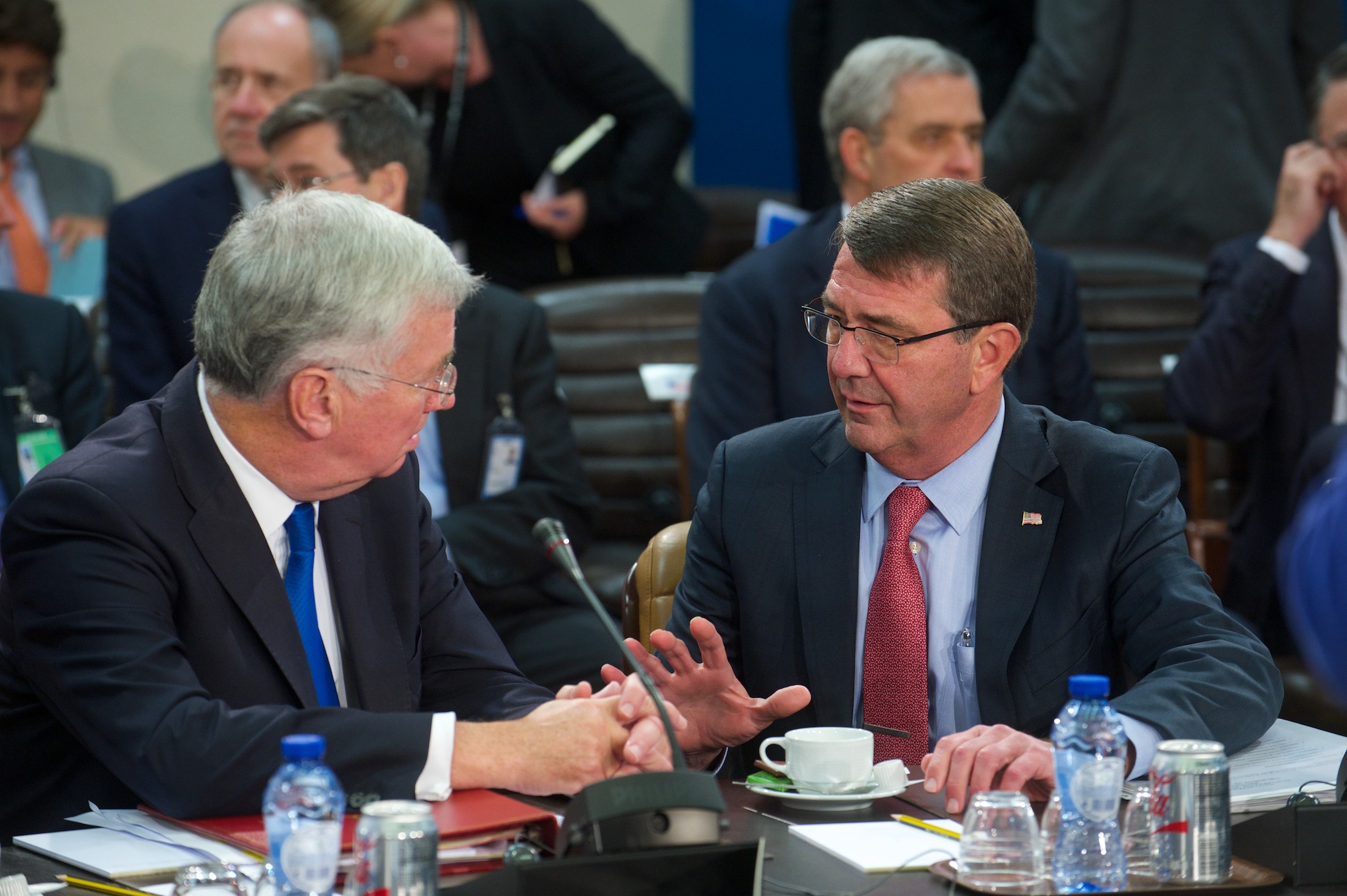
WASHINGTON, October 8, 2015 — During a busy meeting today at NATO headquarters in Brussels, defense ministers discussed Afghanistan, Russian activities in Syria, and how NATO is adapting to meet future threats, Defense Secretary Ash Carter said during a scheduled press conference.

Carter is in Belgium to attend the NATO Defense Ministerial as part of a five-day trip to Europe featuring meetings with counterparts in Italy, Spain and the United Kingdom.

Carter said, “We had, as we always do, direct, substantive conversations about how we can better address the common challenges we face and to reaffirm the enduring principles and great strength we share as members of the alliance and as individual partners.”

On the sidelines of the meetings held in Brussels today, Carter met with French Minister of Defense Jean-Yves Le Drian, according to a Defense Department news release.

Carter and Le Drian reaffirmed the importance of the enduring defense partnership between the United States and France, and the two leaders discussed a range of security issues, including Russian activities in Syria, and the need to maintain the pace of counter-ISIL coalition operations, the release said.

Carter thanked Le Drian for his leadership role in countering terrorism worldwide, the release said.

Ripple Effects

Earlier this week, Carter visited Defense Minister Pedro Morenes in Spain and Defense Minister Roberta Pinotti in Italy.

In both nations, he said, “I witnessed U.S. troops working and training with their counterparts to meet the challenges facing NATO's southern flank, including the ripple effects of [the Islamic State in Iraq and the Levant] and state instability in North Africa and the Middle East.”

Two weeks ago he met with Norwegian Defense Minister Ine Eriksen Soreide to discuss challenges in the north and east, and tomorrow he’ll visit British Defense Secretary Michael Fallon in the United Kingdom.

There, he noted, the government recently announced it will meet the pledge all NATO allies made last year to invest no less than 2 percent of gross domestic product in defense.

Actions in Afghanistan

On Afghanistan, Carter said the United States is taking three actions.

The first is President Barack Obama’s March decision to maintain 9,800 U.S. troops in Afghanistan through the end of this year, and the second is to formulate options for 2016 and beyond, and adjust the planned U.S. presence in Afghanistan based on current circumstances.

“I was pleased, very pleased, to hear ministers of defense from our NATO allies reaffirm their commitment -- discussing not whether but how to continue the mission in Afghanistan. And of course, that is also the view of the United States,” Carter said.

The third action involves the fiscal year 2017 defense budget, in which the secretary said he would include “critical financial support to the Afghan national defense and security forces” to help it sustain its current force levels of 352,000 troops in 2017 and beyond.

“I think it's widely understood that we need to do an assessment. It's widely understood that the United States is doing an assessment and, as other countries have, a number of countries today indicated a willingness to change their own plans and posture,” the secretary added.

Russia in Syria

On Russia’s actions in Syria, Carter said that, rather than engaging in a Syrian political transition, Russia has chosen to continue its longstanding relationship with the Assad regime by committing more military hardware capabilities and personnel to the fight there.

Instead of targeting ISIL, al-Nusra and other terrorist organizations, Carter said that the Russians began striking other kinds of targets within days of deploying their forces.

“I have said repeatedly over the last week that we, the United States, believe this is a fundamental strategic mistake and that it will inflame and prolong the Syrian civil war,” the secretary said.

He added, “We have not and will not agree to cooperate with Russia so long as they continue to pursue this misguided strategy.”

Russian forces also have violated Turkish airspace, shot cruise missiles without warning from a ship in the Caspian Sea, flown within a few miles of U.S. unmanned aerial vehicles, and initiated a joint ground offensive with the Syrian regime, Carter said.

“This will have consequences for Russia itself, which is rightfully fearful of attack upon Russia. And I also expect that in coming days the Russians will begin to suffer casualties in Syria,” he added.

Open Door

Going forward in Syria, Carter said, the United States will prosecute the counter-ISIL air campaign in Syria at the same pace and in the same battle space as it has since the campaign began.

“We will continue to support the moderate Syrian opposition. We will seek an agreement with the Russians on professional safety procedures for coalition pilots. And we will leave the door open for Russia to rejoin the track toward a political transition in Damascus,” he said.

If Russia wants to end its international isolation, it must stop its aggression in eastern Ukraine, end its occupation and attempted annexation of Crimea, and live up to its commitments under the Minsk agreements, Carter said.

There's a reason why the NATO alliance is stronger than ever while Russia acts alone, he added.

“Our member nations share common values reflected in the way we conduct ourselves. … We treat each other as equals and take each other's interests into account. … That is the core of the NATO alliance and the community of nations it brings together, and that is what we shall all continue to do,” Carter said.

Striker Trident (Part 3 of 3): Air Force Missile Officers Get their Sea Legs

by U.S. Strategic Command Public Affairs

10/8/2015 - OFFUTT AIR FORCE BASE, Neb. -- Through the Striker Trident nuclear officer exchange program, four hand-selected intercontinental ballistic missile (ICBM) officers, assigned to various Air Force Global Strike Command (AFGSC) units, are broadening their horizons by serving multi-year tours with U.S. Navy Submarine Forces (SUBFOR) ballistic missile submarine (SSBN) units.

The recently-implemented program enables Navy and Air Force nuclear-qualified officers to gain an expanded view of the nuclear triad, as well as each leg's respective role in U.S. Strategic Command's (USSTRATCOM) strategic deterrence mission. The four Air Force officers selected for the initial exchange are gaining first-hand experience with SSBNs, the most survivable leg of the nation's strategic forces.

"It is a great honor to be selected in the first group of participants in this program," said Air Force Capt. Patrick McAfee, who is serving a three-year assignment as a strategic targeting assistant in the strategic forces, nuclear weapons and force protection directorate at Commander, Submarine Force, U.S. Pacific Fleet (COMSUBPAC) at Joint Base Pearl Harbor-Hickam, Hawaii. COMSUBPAC is also designated as USSTRATCOM's Task Force 134.

"After serving in ICBM operations and maintenance at two missile wings, I was interested in broadening my knowledge of strategic operations," he said. "I have already benefitted from learning about the complementary roles of ICBMs and SSBNs."

Before entering the exchange program in November, 2014, McAfee was assigned to the 341st Missile Wing at Malmstrom Air Force Base, Montana. He credits his father's service in the U.S. Navy for his eagerness to apply for the program and learn about SSBN and Navy operations, saying "it seemed like a great opportunity to join my Air Force experience with my Navy roots."

Air Force Capt. John Mayer said his time with a Navy unit has reinforced his appreciation for the importance of teamwork. In December, 2014, he began a two-year assignment as an assistant strategic targeting officer in the strategic forces directorate at Commander, Submarine Force, U.S. Atlantic Fleet (COMSUBLANT) in Norfolk, Virginia. COMSUBLANT is also designated as USSTRATCOM's Task Force 144.

After leaving 20th Air Force headquarters at F.E. Warren Air Force Base, Wyoming, Mayer immediately noticed the close proximity in which SSBN crew members work.

"When you put more than one hundred men and women in a submarine underwater, in dangerous conditions with a challenging mission, good leaders can't help but build good teams," he said. "With everyone's safety dependent on the competence of their shipmates, a lot of good dynamics develop."

He went on to describe the operations of an ICBM crew, which often differ greatly from those in the SSBN community.

"An ICBM team might be composed of one missile combat crew member talking to a team chief 20 miles away and a missile maintenance operations center controller a hundred miles away; but they will likely never meet face to face," he said.

Air Force Capt. Cody daMota left the 91st Missile Wing at Minot Air Force Base, North Dakota, to serve his three years of "sea time" as an assistant nuclear weapons surety officer in COMSUBPAC headquarters' strategic forces, nuclear weapons and force protection directorate. He arrived at Joint Base Pearl Harbor-Hickam in May and said the program has already enabled him to see the mission through a wider lens.

"As young [company-grade officers/junior officers], we have a pretty narrow perspective on nuclear operations that is pretty much limited to what we do in our day-to-day jobs," he said. "This program has already significantly broadened my perspective."

He also predicted that participants - present and future - will benefit from the experience and bring new ideas back to their respective wings and submarine groups, strengthening the deterrence force.

"I believe this program will provide an increased level of knowledge and appreciation for the bigger strategic picture and how everyone fits into it," he said. "This in turn will lead to higher job satisfaction and increased morale."

Capt. daMota described his selection for the initial Striker Trident exchange as "a great honor," while acknowledging the responsibility that comes with the unique opportunity.

"We are breaking new ground in this assignment and charting a course for our successors," he said. "Our work here will set the tone for many years to come."

Like Capt. Mayer, Air Force Capt. Jessica Tiffany is serving as an assistant strategic targeting officer in the strategic forces directorate at COMSUBLANT in Norfolk, Virginia. She started her three-year Striker Trident exchange in May, after serving with the 341st Missile Wing, Malmstrom Air Force Base, Montana.

She said that she saw a "new and unique" opportunity to serve in a joint nuclear environment and decided to apply for Striker Trident. She also noted how the program provides participants a "fresh look" at how their counterparts conduct deterrence operations and said she hopes "to have some impact on the program for future Striker Trident members, where I can help make the program better."

"There are plenty of reasons a service does things one way or another," she said. "Sometimes the answer is 'because we've always done it this way' and with the changes to the nuclear enterprise, we (the Air Force and Navy) can make improvements to better accomplish USSTRATCOM's mission."

Capt. Tiffany's experience was also featured in a recent Air Force Times article, which can be viewed at http://www.airforcetimes.com/story/military/careers/2015/09/06/exchange-allows-missileers-and-submariners-switch-services/71632792/.

The four participants in the initial Striker Trident exchange program shared their thoughts on the experience, lessons learned through the program, and provided advice for officers who may be interested in applying:

What has surprised you most about the experience, Navy culture or the SSBN mission?

CAPT DAMOTA: Although there are obvious, significant differences between the SSBN and ICBM missions, it has surprised me how much common ground we have as a force with regards to the challenges, stresses and victories we perceive.

CAPT MAYER: Every career field demands amazing proficiency at difficult tasks from very junior members. You get used to your job though, and forget how impressive it may be to an outsider.  Having no familiarity with submarine operations, I was truly blown away by the performances I saw underway. Very young sailors, enlisted and officers alike, do unbelievably challenging things that affect the entire crew's safety and an incredibly valuable national asset. They do it under pressure every day, and they do it very well.

CAPT MCAFEE: I have been impressed by the complexity of SSBN operations. While ICBM operations can be complex in their own right, SSBN operations are infinitely more so. At [USSTRATCOM's] TF-134, we manage eight units that independently move through a large portion of the Pacific Ocean plus all of the associated support facilities and organizations. Just the sheer scale of the operating area and the fact that the units are mobile complicates the equation immensely. Additionally, communications, supplies, materiel condition, parts availability and humanitarian issues all significantly impact operations. From what I have seen, the Navy does an excellent job of handling the interplay between these challenges while meeting mission requirements.

CAPT TIFFANY:Although this may seem obvious, one of the biggest adjustments I've had to wrap my head around is the number of layers that go into the SSBN strategic mission because they operate in a moving environment. SSBN crews not only have to concentrate on strategic mission procedures, but also on keeping a large metal tube undetected in a vast ocean without hitting anything.

What is the most significant take away from your Striker Trident experience?

CAPT DAMOTA: My most significant take away has been my exposure to different ways of thinking and approaching problem solving. After being in any career field for a period of time, I believe that thinking becomes somewhat homogenized, so it is very healthy that individuals be exposed to diverse experiences and thought processes. The Striker Trident program is unequivocally accomplishing this.

CAPT MAYER: I will definitely take away a better perspective of how ICBMs, or any other individual mission area, plays just one role in the bigger picture. In career fields like ICBM operations, it is easy for a junior officer to forget that there is more to the Air Force than ICBMs, and more to the DoD than the Air Force.

CAPT MCAFEE: My greatest take away will be an in-depth understanding of big picture SSBN operations and issues that affect the joint force. I've been exposed to many complexities that the fleet deals with on a daily basis, including scheduling challenges, changes and conflicts, exercise requirements, inspection requirements, materiel problems, nuclear weapons surety and security issues. All of these subjects significantly affect how the Navy meets USSTRATCOM requirements and mirror the issues that affect the Air Force in the ICBM fields. By acquiring a working knowledge of these subjects in two of the three legs of the triad, I believe that I will be an asset in my future assignments. There are few Air Force or Navy officers that have this first-hand experience in two areas of strategic operations, and the Striker Trident program will pay dividends in the future for the nuclear enterprise as a whole.

CAPT TIFFANY:  There is always something to learn. I am constantly asking questions about similarities and differences between ICBM and SSBN procedures and asking "why" a lot. The more I learn, the more questions I have. I'd like to think I'm getting a better idea of how the triad works together to accomplish nuclear deterrence. I look forward to the next few years.

What advice do you have for those interested in the Striker Trident program?

CAPT DAMOTA: I absolutely love this program, so my advice would be to go for it. When I initially applied, there was no one who had been in the Striker Trident program, so I basically applied blind because of my interest in the SSBN mission. Now, there are four USAF and two USN personnel already in the position.

CAPT MAYER: It is a great opportunity that you will not regret applying for!

CAPT MCAFEE: I personally think it is a great opportunity, but it may not be for everyone. Each officer serving in the Striker Trident program is more than willing to share our experiences with anyone who might be interested.

CAPT TIFFANY: Try to gain as much experience in different positions wherever you are stationed. I think it is important to get as much "big picture" experience as you can so you gain a better understanding of how the nuclear enterprise works as a whole, instead of just one aspect of it. This has been a great learning experience so far, so I think anyone who is interested should apply.

One of nine DoD unified combatant commands, USSTRATCOM has global strategic missions, assigned through the Unified Command Plan, which include strategic deterrence; space operations; cyberspace operations; joint electronic warfare; global strike; missile defense; intelligence, surveillance and reconnaissance; combating weapons of mass destruction; and analysis and targeting.